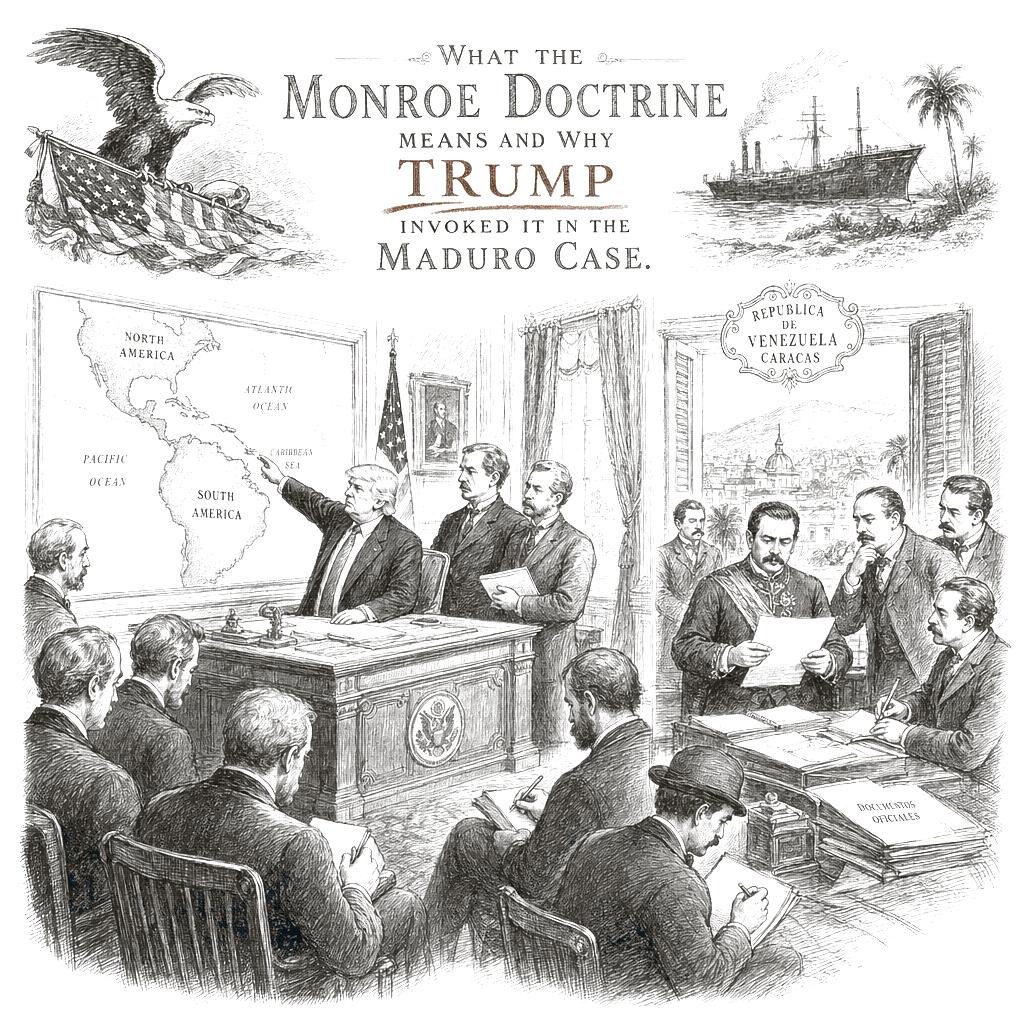
President Donald Trump cited the Monroe Doctrine as partial justification for a U.S. operation that led to the arrest of Venezuela’s Nicolás Maduro, drawing on a foreign-policy maxim that has influenced American decisions for more than two centuries. In remarks Saturday, Trump also joked about the doctrine’s name, saying some now call it “the Don-roe Doctrine.”
The renewed attention has also put the Monroe Doctrine back under historical scrutiny, with political scientists tracing how the doctrine’s language has been invoked by presidents in later eras and how the Trump administration’s approach appears to echo older patterns.
What is the Monroe Doctrine?
The doctrine is traced to a 1823 address to Congress by President James Monroe. It was originally intended to ward off European colonization or other interference in independent nations of the Western Hemisphere, and it included a reciprocal U.S. commitment to stay out of European wars and internal affairs.
At the time, many Latin American countries had recently gained independence from European empires. Jay Sexton, a history professor at the University of Missouri, said the doctrine became closely connected to Venezuela over time, describing the country as “the pretext or the trigger for a lot of corollaries to the Monroe Doctrine.”
Venezuela as a recurring “trigger”
Sexton, who authored “The Monroe Doctrine: Empire and Nation in Nineteenth-Century America,” connected that pattern to the broader historical context in which the Monroe Doctrine and later add-ons were invoked. He said Venezuela is a “divided, fractious country” that has had difficult relations with foreign powers and is courted by U.S. rivals.
The AP report also described how Venezuela’s role in these episodes has extended from the late 1800s through Trump’s first administration, with the Monroe Doctrine often cited as part of the justification for expanding U.S. involvement in the hemisphere.
The Roosevelt Corollary and “big stick” diplomacy
The Monroe Doctrine’s later uses included challenges that led to new justifications for U.S. intervention. The AP report described an early test after France installed Emperor Maximilian in Mexico in the 1860s, followed by France’s withdrawal after the end of the Civil War under U.S. pressure.
In 1904, President Theodore Roosevelt’s argument that the U.S. should be allowed to intervene in unstable Latin American countries became known as the Roosevelt Corollary. The report said the corollary was invoked in connection with supporting Panama’s secession from Colombia, which it said helped secure the Panama Canal Zone for the United States.
Cold War-era uses
During the Cold War, the Monroe Doctrine was also invoked in the AP account as a defense against communism. The report cited the U.S. demand in 1962 that Soviet missiles be withdrawn from Cuba and said the Reagan administration opposed the leftist Sandinista government in Nicaragua.
Gretchen Murphy, a professor at the University of Texas, said Trump’s reference fit what she described as a long-running approach in which the doctrine could be extended in ways that, rather than merely defending Latin American nations from European interference, effectively policed whether governments served U.S. commercial and strategic interests.
Murphy said, “I think Trump is jumping on this familiar pattern -– citing the Monroe Doctrine to legitimate interventions that undermine real democracy, and ones where various kinds of interests are served, including commercial interests,” adding she believed the pattern echoed earlier administrations.
What Trump said about Venezuela and the doctrine
The AP report said Trump argued that under Maduro’s rule, Venezuela had been “increasingly hosting foreign adversaries in our region and acquiring menacing offensive weapons that could threaten U.S. interests.” Trump also called those actions “in gross violation of the core principles of American foreign policy dating back more than two centuries.”
Trump then tied the reasoning to what he described as a new national security strategy. He said, “under our new national security strategy, American dominance in the Western Hemisphere will never be questioned again,” and he framed the goal as surrounding the U.S. with stability and protecting energy supplies. In one passage, he said, “We have tremendous energy in that country. It’s very important that we protect it. We need that for ourselves. We need that for the world.”
The “Trump Corollary” explanation
Asked Saturday how the move reflected his “America First” mentality, Trump defended it as an effort to strengthen America itself, comparing the reasoning to the doctrine’s origin story. The AP report said the administration’s national security strategy references “a ‘ Trump Corollary ’ to the Monroe Doctrine,” intended to “restore American preeminence in the Western Hemisphere.”
The AP report also said Murphy’s account was consistent with how she described the Monroe Doctrine’s evolution under later presidents, including Roosevelt. Sexton, meanwhile, described the corollary framework as a recurring way to justify presidential agendas using Monroe Doctrine language. He said presidents used to “cloak whatever their agenda was in the Monroe Doctrine by issuing corollaries.”
A strategy and a potential political backlash
According to the AP report, a national security strategy released by the White House in December portrayed European allies as weak and aimed to reassert America’s dominance in the Western Hemisphere. It also described military strikes on alleged drug trafficking boats in the Caribbean Sea and the eastern Pacific Ocean as “a ‘Trump Corollary’ to the Monroe Doctrine” meant to “restore American preeminence in the Western Hemisphere,” and it said the effort would be aimed at combating narcotics and controlling migration.
Sexton said capturing Maduro could lead to a protracted U.S. involvement in Venezuela and could split Trump supporters again. He said, “This is going to be potentially quite a mess,” describing it as something that could contradict the administration’s policies on withdrawing from “forever wars.” He also said there are “a lot of isolationists, within the MAGA coalition,” who may be affected by the outcome of the operation.