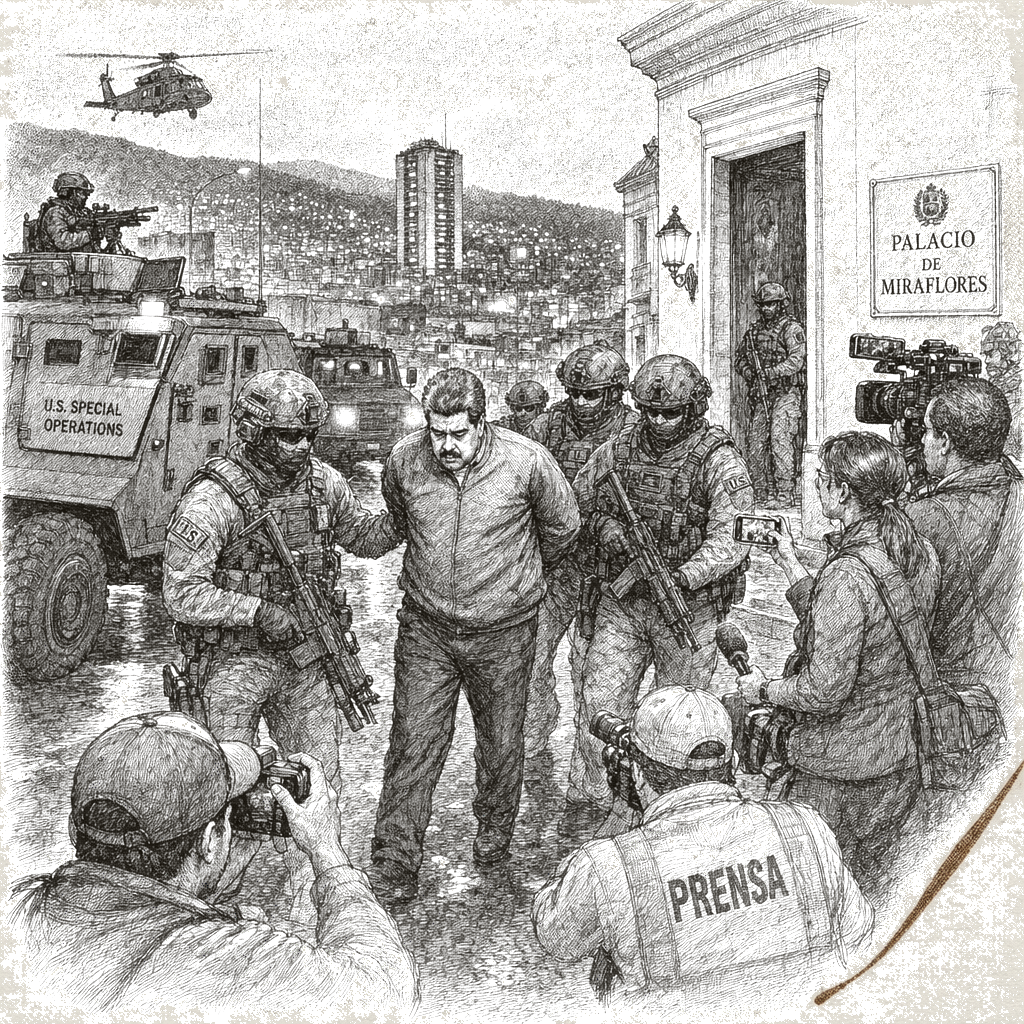
The operation, which Defense Secretary Pete Hegseth described as a “massive joint military and law enforcement raid,” has generated immediate legal questions in the United States and internationally about its basis in domestic and international law, while leaving unanswered how the United States intends to exercise governance over Venezuela going forward.
U.S. military forces captured Venezuelan President Nicolás Maduro and his wife, Cilia Flores, during an overnight raid on his Caracas compound, President Donald Trump announced Saturday at his Florida home, describing a covert operation months in the making that removed a sitting head of state from office and delivered him to a U.S. warship. Trump said Maduro and Flores would face criminal charges in New York and declared that the United States would “run” Venezuela until a new leader can be chosen.
Trump posted on Truth Social a photo showing Maduro in a gray sweatsuit, wearing protective headphones and a blindfold.
A months-long covert operation
Gen. Dan Caine, chairman of the Joint Chiefs of Staff, said at Trump’s Saturday news conference that U.S. forces had spent months rehearsing the mission, studying everything about Maduro — the hours he kept, the details of his pets, the clothes he wore.
“We think, we develop, we train, we rehearse, we debrief, we rehearse again, and again,” Caine said. “Not to get it right, but to ensure we cannot get it wrong.”
Trump said forces had practiced the extraction on a replica of Maduro’s presidential compound, including a steel-reinforced safe room. U.S. service members were equipped with what Trump called “massive blowtorches” in the event the steel walls needed to be cut through. Maduro, Trump said in a Saturday morning interview on Fox News, did not reach the room in time.
“He didn’t get that space closed. He was trying to get into it, but he got bum-rushed right so fast that he didn’t get into that,” Trump said.
Caine said U.S. forces were ready to move by early December but held off for weeks waiting for favorable weather. Trump said forces waited four days for cloud cover to clear. On Friday night, Caine said, “the weather broke just enough, clearing a path that only the most skilled aviators in the world could move through.” Helicopters flew low to the water to enter Venezuelan airspace, with U.S. aircraft providing cover above.
The raid
The operation, named “Absolute Resolve,” lasted less than 30 minutes, according to Defense Secretary Pete Hegseth, who described it as a “massive joint military and law enforcement raid.” At least seven explosions were heard in Caracas.
Trump said U.S. forces turned off the city’s electricity during the strike.
“The lights of Caracas were largely turned off due to a certain expertise that we have,” he said, offering no further details.
Trump said a few U.S. members of the operation were injured but that he believed no one was killed. Caine said one helicopter was struck by fire as it closed in on Maduro’s compound but flew safely on its return.
The operation was a sharp escalation from a series of U.S. military strikes on alleged drug-carrying vessels in the Caribbean Sea and eastern Pacific Ocean that had been underway since September. On Dec. 29, the CIA conducted a drone strike at a docking area believed to be used by Venezuelan drug cartels — the first known direct U.S. operation on Venezuelan soil before Friday night’s raid.
Casualties and Venezuela’s response
Venezuelan Vice President Delcy Rodríguez, who under Venezuelan law assumed power following Maduro’s removal, said in a televised address on state television that some Venezuelan civilians and members of the military were killed. She did not provide a specific count.
Rodríguez demanded that the United States free Maduro and declared him Venezuela’s rightful leader. She also left open the possibility of dialogue.
“We are willing to have respectful relations,” she said.
Yanire Lucas, a Caracas resident whose home sits adjacent to a Venezuelan military base struck overnight, told the AP she began hearing explosions around 1:50 a.m.
What the U.S. says comes next
Trump said at his news conference that the United States would direct Venezuela’s path forward. He left open the possibility of a continued U.S. troop presence in the country.
“We’re not afraid of boots on the ground if we have to,” he said. “We had boots on the ground last night.”
Trump said a team of officials standing behind him at the news conference — including Hegseth, Caine, and Secretary of State Marco Rubio — would “be a team that’s working with the people of Venezuela.”
“We’re going to make sure that country is run properly. We’re not doing this in vain,” Trump said.
Questions about the legal basis for Maduro’s capture and for the Trump administration’s stated intention to govern Venezuela have emerged in the United States and abroad. Trump offered few details about how U.S. authority over the country would be structured or for how long.