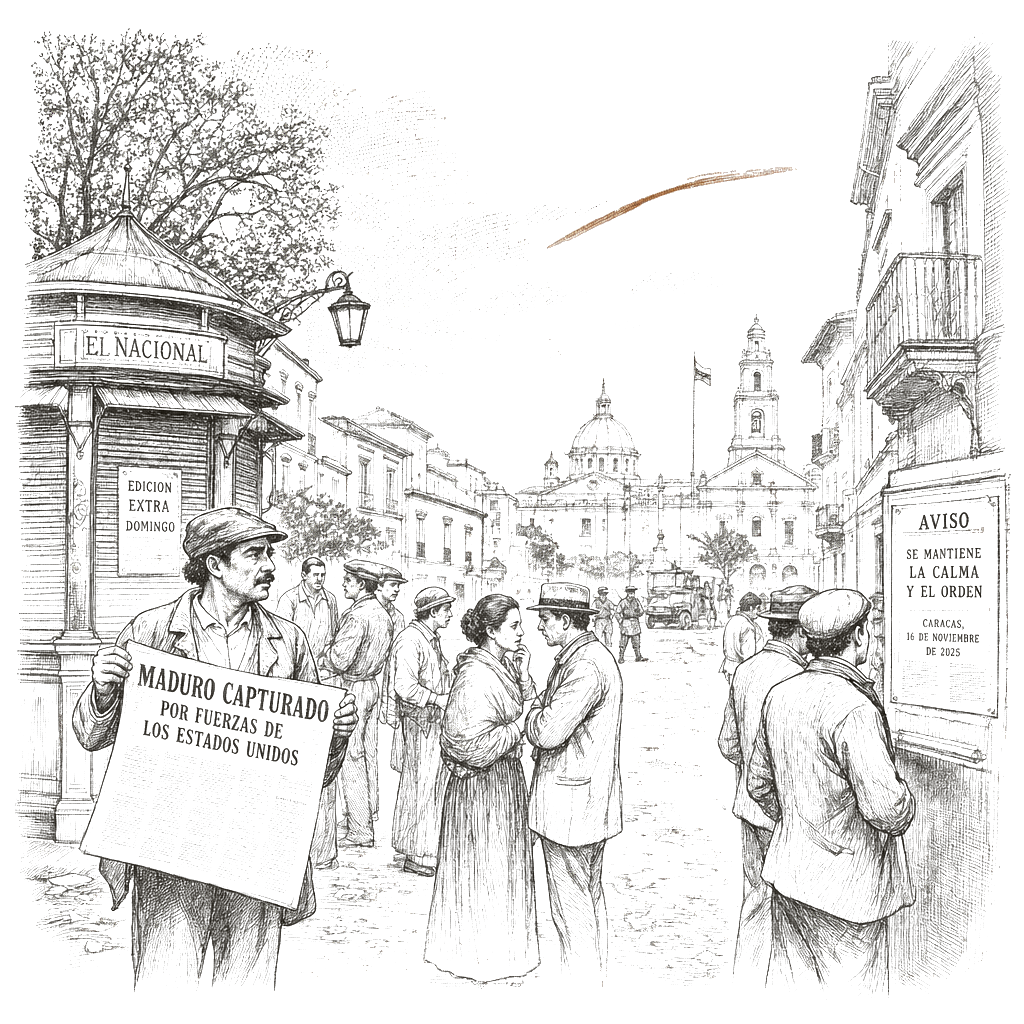
An anxious quiet settled over Venezuela’s capital on Sunday after President Nicolás Maduro was deposed and captured in a dramatic U.S. military operation early Saturday, leaving many residents in Caracas slow to restart daily routines and unsure what comes next.
People stayed off the streets or moved cautiously, with dozens of stores, restaurants and churches remaining closed. Those who did venture out looked shell-shocked, staring at their phones or into the distance, as armed civilians and military personnel guarded the area near the presidential palace.
“People are still shaken,” said 77-year-old David Leal, who arrived to work as a parking attendant but realized he likely would not have customers. He pointed to the deserted street a few blocks from the presidential palace.
The operation plunged Venezuela into a new chapter without a ready script, while U.S. leaders offered signals that appeared to shift over the weekend. U.S. President Donald Trump initially said the U.S. would “run” the country until there was stability, a remark Secretary of State Marco Rubio seemed to walk back on Sunday.
Rubio said in interviews that Washington would use control of Venezuela’s oil industry to force policy changes and that the government currently in place was illegitimate. “We want to see Venezuela transition to be a place completely different than what it looks like today,” Rubio said, adding: “But obviously, we don’t have the expectation that’s going to happen in the next 15 hours.”
Defense Minister Vladimir Padrino López told Venezuelans that Maduro was still the rightful leader, while also indicating continuity of command with the high military command flanking him. At the same time, presidential duties now belong to Vice President Delcy Rodríguez, whom the high court ordered to assume the role of interim president; Rodríguez made no public comment Sunday.
Maduro’s government officials demanded his release from custody in New York, where his first court appearance is set for Monday. State-controlled media did not air images of Maduro handcuffed on U.S. soil, and Venezuelans instead saw the footage on social media, with many expressing disbelief at what was shown.
For some residents, the moment carried fear as much as joy. “May God give us strength for what we are experiencing. I’m sad. He is a human being,” said Nely Gutiérrez, a retiree, as her eyes welled with tears. She said she had walked to church only to find it closed and that she would have prayed for peace in Venezuela and for Maduro, adding, “The word of God says love your enemy.”
Gutiérrez said that if Maduro is in the hands of the “empire,” no one can save him from there, “only God, not even God,” framing her remarks as something beyond political outcomes. Some people in Venezuela also appeared to restrain themselves, while in the U.S. and some Latin American countries Maduro’s ouster was celebrated.
In Venezuela, the scenes differed, with some supporters burning U.S. flags and holding signs reading “Gringo go home.” Construction worker Daniel Medalla said people did not dare celebrate out of fear of government repression, even as he said they had long been waiting for the former president’s exit, saying, “We were longing for it.”
Memories of the crackdown after the 2024 presidential election remained fresh for residents. Official figures cited in the report said protests after the election left 28 people dead, 220 injured and at least 2,000 detained, amid claims by Maduro that he won despite credible evidence he lost by more than a 2-to-1 margin.
The presence of police and military personnel across Caracas on Sunday was notable for its smaller size compared with an average day. Soldiers attempted to clear an area of an air base that burned along with at least three passenger buses during the U.S. attack, according to the report.
Rubio, in the interviews cited by the report, said no U.S. forces were on the ground in Venezuela but did not rule out further strikes there.
Far from Caracas, violence and damage also weighed on some families. In La Guaira, Wilman González picked through rubble and broken furniture after an American strike blew apart the wall of his apartment, killing his sleeping 80-year-old aunt, Rosa Elena González. González said the family took her to a hospital where medical staff scrambled to give her oxygen, but he said there was nothing they could do.
Venezuelan officials have said the operation killed civilians and military personnel, but they have not provided a toll, and the government’s press office did not respond to multiple requests, the report said. Now, with stitches lining the corner of his blackened eye, González said, “This is it, what we are left with: ruins.”
González spoke with anger not only about what he described as the personal losses from the attack, but also about years of economic and political crises. “The government ‘can throw me in jail if they want, but I’m talking about the reality of the country we live in,’” he said, adding: “What we want is a government that is good for all Venezuelans, not just a few.”
CC0 notice: This article is released into the public domain (CC0). Generated by Main Street Independent’s News Article Generator framework from the public sources listed above. Human review: not_triggered.