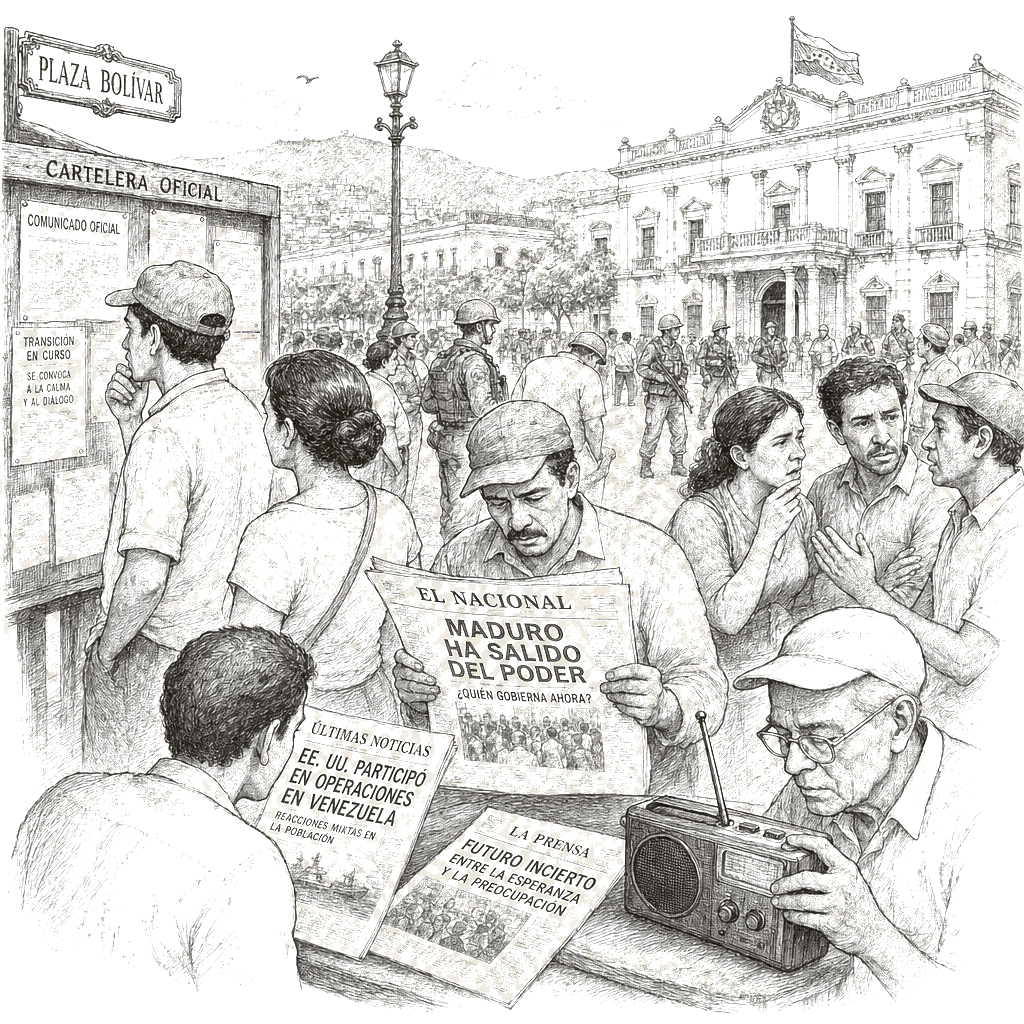
Venezuelans scrambled to understand who was in charge of their country on Saturday after the U.S. military captured President Nicolás Maduro, ousting a leader the report said had survived a failed coup attempt, army mutinies, mass protests and economic sanctions.
In Caracas, residents described a fast-emerging atmosphere of uncertainty. Juan Pablo Petrone asked what would happen “tomorrow,” while another resident, Yanire Lucas, said the city remained “still on edge” and now unsure “what to do,” after an explosion at a nearby military base shattered windows in her home.
At a press conference, President Donald Trump offered a stark account of what comes next, saying the United States would take control of Venezuela, possibly “in coordination with” one of Maduro’s most trusted aides. The report said Trump described a call in which he claimed Delcy Rodríguez told the U.S. that “We’ll do whatever you need,” and Trump said she was “quite gracious.”
Rodríguez, described as next in the presidential line of succession and as Maduro’s vice president since 2018, was ordered by Venezuela’s high court to assume the role of interim president. During a televised address before the court decision, she demanded the immediate release of Maduro and his wife, Cilia Flores, and denounced the U.S. operation as a violation of the United Nations charter. “There is only one president in this country, and his name is Nicolás Maduro,” Rodríguez said, according to the report, surrounded by senior civilian officials and military commanders.
The report also said Venezuelan military officials sought to project strength in video messages and warned they would not yield to U.S. pressure. Defense Minister Gen. Vladimir Padrino López, dressed in fatigues, said, “They have attacked us but will not break us,” and Interior Minister Diosdado Cabello urged Venezuelans to “get out on the streets” to defend the country’s sovereignty. Cabello said of the U.S., “These rats attacked and they will regret what they did,” and some Venezuelans gathered in scattered demonstrations across Caracas, including burning American flags.
While Trump suggested Rodríguez had already been sworn in as president under the constitutional transfer of power, the report said Venezuelan state television did not show any swearing-in ceremony. During Rodríguez’s televised speech, a screen ticker identified her as vice president, and the report said she did not indicate she would cooperate with the U.S. In that address, she said, “What is being done to Venezuela is an atrocity that violates international law,” adding, “History and justice will make the extremists who promoted this armed aggression pay.”
The Constitution also calls for a new election within a month if the president is absent, but the report said experts were debating whether the succession scenario would apply given the government’s lack of popular legitimacy and the extraordinary U.S. military intervention. The report said there was no immediate sign that the U.S. was directly administering Venezuela, and described senior officials as appearing to have survived the operation and held on to their jobs at least for the time being.
The report said opposition leader Maria Corina Machado, who received last year’s Nobel Peace Prize, called on her ally Edmundo González—described as a retired diplomat widely considered to have won the disputed 2024 presidential election—to “immediately assume his constitutional mandate and be recognized as commander-in-chief.” In a separate statement, Machado said her movement would “restore order, free political prisoners, build an exceptional country and bring our children back home,” and added, “Today we are prepared to assert our mandate and take power.” The report said Trump responded with skepticism, telling reporters, “I think it would be very tough for (Machado) to be the leader,” and saying she “doesn’t have the support or respect within the country.”
Delcy Rodríguez’s background, as described by the report, includes work representing the revolution associated with the late Hugo Chávez on the international stage, as well as a record in Venezuela’s oil-dependent economy and intelligence service oversight. The report said she developed ties with Republicans in the oil industry and with Wall Street figures who resisted U.S.-led regime change, and it cited past interlocutors including Erik Prince and Richard Grenell, a Trump special envoy who the report said tried to negotiate a deal with Maduro for greater U.S. influence.
The report said internal tensions could arise as Rodríguez tries to assert authority within a security establishment that, it said, includes hard-liners wanted in the United States on drug-trafficking charges and accused of serious human rights abuses. David Smilde, a sociology professor at Tulane University who has studied Venezuela’s political dynamics over the past three decades, said in the report that these leaders “have all seen the value of staying united,” adding that Cabello has “always taken a second seat or third seat” because “his fate is tied up with Maduro’s.” Smilde said much would depend on the condition of Venezuela’s military after the U.S. bombing raid, warning that if it “doesn’t have much firepower anymore, they’re more vulnerable and diminished.”
Associated Press reporter Joshua Goodman contributed from Miami, and E. Wayne DeBre contributed from Buenos Aires, Argentina.