-
-
Summary
-
- Subtype: fact
-
- Article describes significant development with named actors and concrete outcomes.
- Health advocates and safety-n…
-
How the Coverage Was Extended, Then Cut
- The Minnesota Legislature — then controlled by a Democratic-Farmer-Labor trifecta — passed the expansion in 2023, the same session in which lawmake…
How the Coverage Was Extended, Then Cut
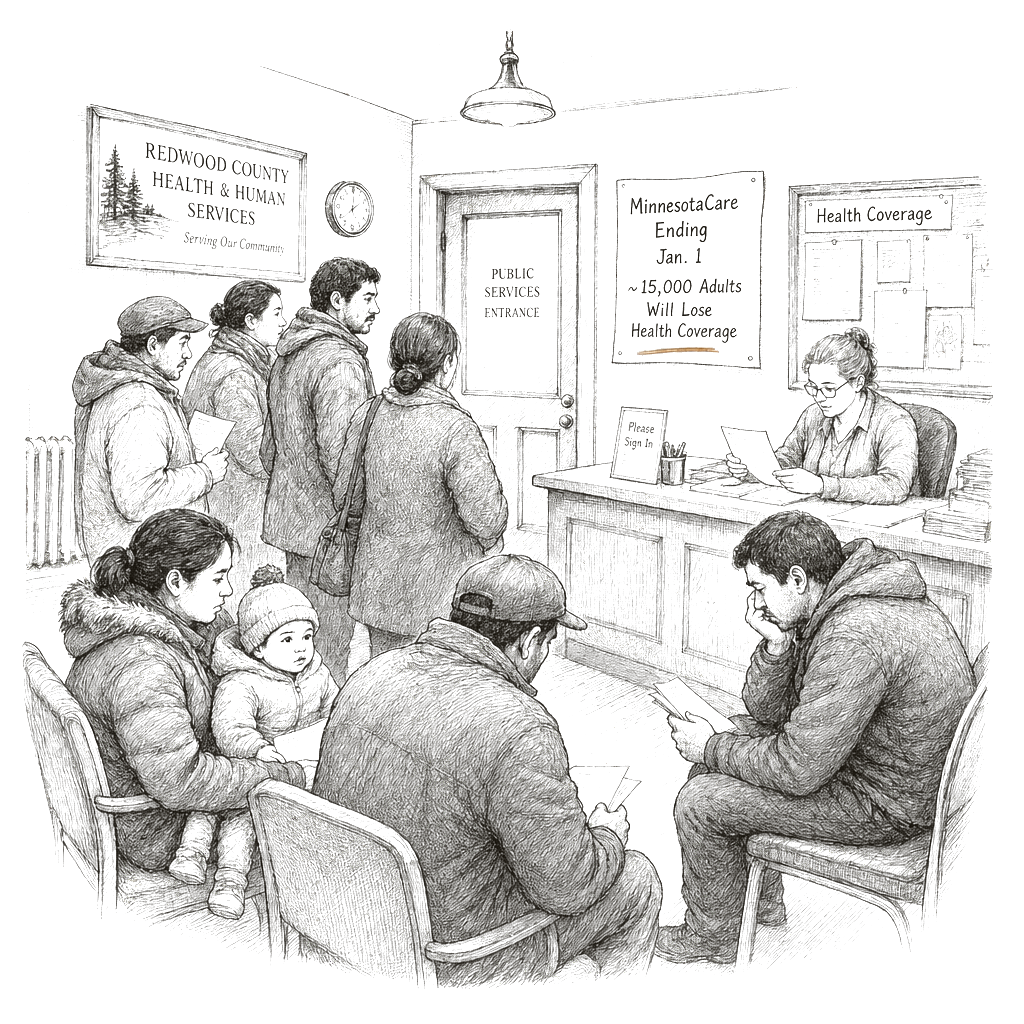
The Minnesota Legislature — then controlled by a Democratic-Farmer-Labor trifecta — passed the expansion in 2023, the same session in which lawmakers approved the Driver’s License for All law allowing undocumented immigrants to obtain state driver’s licenses. Enrollment for undocumented immigrants opened in 2024, and coverage through the program began in 2025.
Approximately halfway through 2025, a divided Legislature voted to end those benefits for adults. The decision drew an immediate response from DFL lawmakers: after Gov. Tim Walz held a news conference following the vote, legislators banged on the door of the event and shouted, “Don’t kill immigrants,” according to Sahan Journal.
Advocates Warn of Deferred and Catastrophic Care
Ma Elena Gutierrez, who leads Fe y Justicia, a faith-based nonprofit organized around health equity, said immigrants who lose coverage are likely to delay surgeries, skip preventative checkups, and forgo medications.
“This is really sad,” Gutierrez said. “More people are going to get sick.”
As the end of 2025 approached, Gutierrez encouraged those enrolled in MinnesotaCare to obtain as much care as possible before the deadline.
Ann Rogers, CEO of People’s Center Clinic — a community health center in Minneapolis’s Cedar-Riverside neighborhood that predominantly serves East African patients — said she fears the coverage loss will lead people to avoid care until their conditions deteriorate severely.
“I think that’s a really big risk, waiting to come in for care, and then have it be much more catastrophic,” Rogers said.
Rogers also said she is concerned that patients will forgo vaccinations, including for illnesses such as measles.
Safety-Net Alternatives Face Reimbursement Gaps
John Connolly, deputy commissioner and state Medicaid director at the Minnesota Department of Human Services, said adults who lost coverage can seek care at federally qualified health centers and community health centers, which provide services regardless of a patient’s ability to pay. But he said absorbing a large number of uninsured patients could strain those facilities, which would not be reimbursed for those visits.
“We worry both for people in terms of their access to services, but also in terms of providers having a steady form of payment which strengthens them overall,” Connolly said.
Hennepin Healthcare, which frequently serves immigrant patients, maintains an uncompensated care program under which qualifying patients do not receive a bill. Pam Quast, director of patient access and financial security for Hennepin Healthcare, said the system has been notifying affected patients about their options since the budget passed in June 2025.
But Quast said reimbursement from state and federal sources for uncompensated services routinely falls far short of actual costs.
“If you get reimbursed for anything through the state or the federal government, it’s very minimal,” Quast said. “Sometimes you don’t even get anything back.”
Children Remain Covered; Guidance Available
Immigrant children under the age of 18 are not affected by the rollback and remain eligible for MinnesotaCare. According to the Minnesota Department of Human Services, about 5,000 immigrant children were enrolled in the program in 2025.
The Department of Human Services has issued guidance for immigrants affected by the change in English, Oromo, Somali, and Spanish.