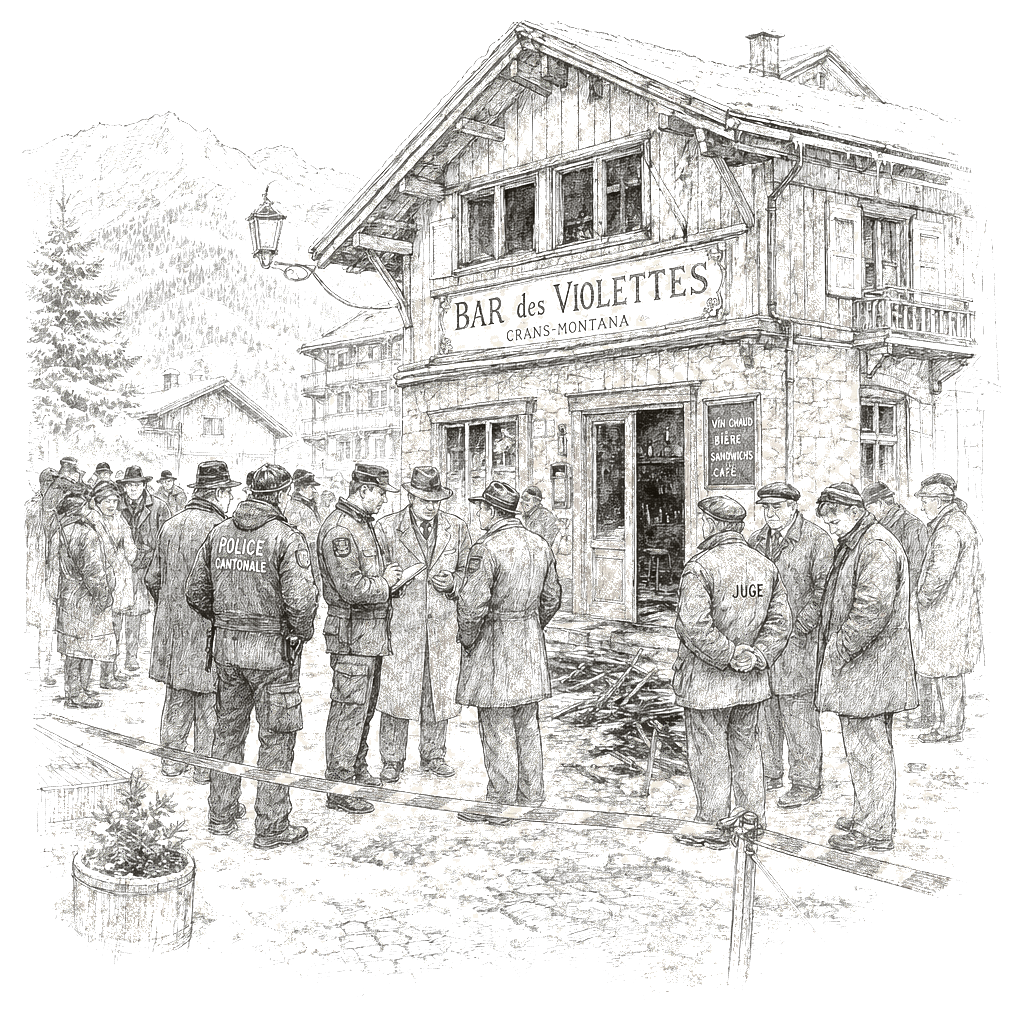
Swiss authorities opened a criminal investigation into the managers of a bar in Crans-Montana where a fire at a New Year’s party killed 40 people, the Valais region’s chief prosecutor said Saturday.
Beatrice Pilloud said the investigation was opened on Friday night and that it would help “explore all the leads,” without naming the managers. She said investigators suspect the managers of involuntary homicide, involuntary bodily harm and involuntarily causing a fire.
The fire broke out around 1:30 a.m. on Thursday at Le Constellation bar in the Alpine resort town of Crans-Montana. Police said many of the injured were in their teens to mid-20s, and more than 100 people were injured in the blaze.
Authorities said the process of identifying the dead and injured was continuing on Saturday, prolonging uncertainty for relatives. Because of the severity of burns, officials said families have had to supply DNA samples, and that in some cases wallets and identification documents inside were turned to ash.
Investigators said Friday they believe sparkling candles placed atop champagne bottles ignited the fire when they came too close to the ceiling of the crowded bar. Officials also said they planned to examine whether sound-dampening material on the ceiling met regulations and whether the candles were permitted for use in the bar, along with other safety measures such as fire extinguishers and escape routes.
Stéphane Ganzer, the Valais region’s top security official, told SRF public radio Saturday that “such a huge accident with a fire in Switzerland means that something didn’t work — maybe the material, maybe the organization on the spot.” Ganzer added: “Something didn’t work and someone made a mistake, I am sure of that.”
Nicolas Féraud, who heads the Crans-Montana municipality, told RTS radio he was “convinced” checks on the bar hadn’t been lax, according to the broadcaster. Justice Minister Beat Jans, asked whether the tragedy could have been avoided, said officials could not yet answer and “we know that the world needs an answer on this question.”
On Saturday, regional police said the bodies of four victims — a boy and a girl, both 16, an 18-year-old man and a 21-year-old woman, all Swiss — had been identified and handed over to their families. Several injured people still have not been identified.
Laetitia Brodard, whose 16-year-old son, Arthur, went to Le Constellation to celebrate the New Year, told reporters Friday evening that “I’m looking everywhere. The body of my son is somewhere.” She later said: “I want to know where my child is and be by his side. Wherever that may be, be it in the intensive care unit or the morgue.” On Saturday, she told French broadcaster BFM TV that “we, parents, are starting to get tired … and anger is starting to rise.”
Elvira Venturella, an Italian psychologist working with the families, said “It’s a wait that destroys people’s stability,” and added that “the more time passes, the more difficult it becomes to accept the uncertainty, not having information.”
Swiss officials said Friday that 119 people were injured and 113 had been formally identified. Italy’s ambassador to Switzerland, Gian Lorenzo Cornado, told reporters Saturday that he had been briefed by local authorities that the number of injured stood at 121, with five not yet identified, and that 14 Italians were being treated in hospitals. Cornado acknowledged “a lot of stress,” but said it was right for authorities to share information only when it is “accurate and 100% sure.”
Ganzer visited the site along with Jans and called the families’ wait “unbearable,” saying officials’ top priority was providing them the “legitimate answers they are waiting for.” Swiss police said the injured included more than 70 Swiss nationals and over 10 each from France and Italy, along with citizens of Serbia, Bosnia, Luxembourg, Belgium, Portugal and Poland.
Outside Le Constellation, mourners and well-wishers brought flowers to makeshift memorials. “RIP you are all our children” read one handwritten note.
Geir Moulson and Stefanie Dazio contributed from Berlin, and Sylvie Corbet contributed from Paris.