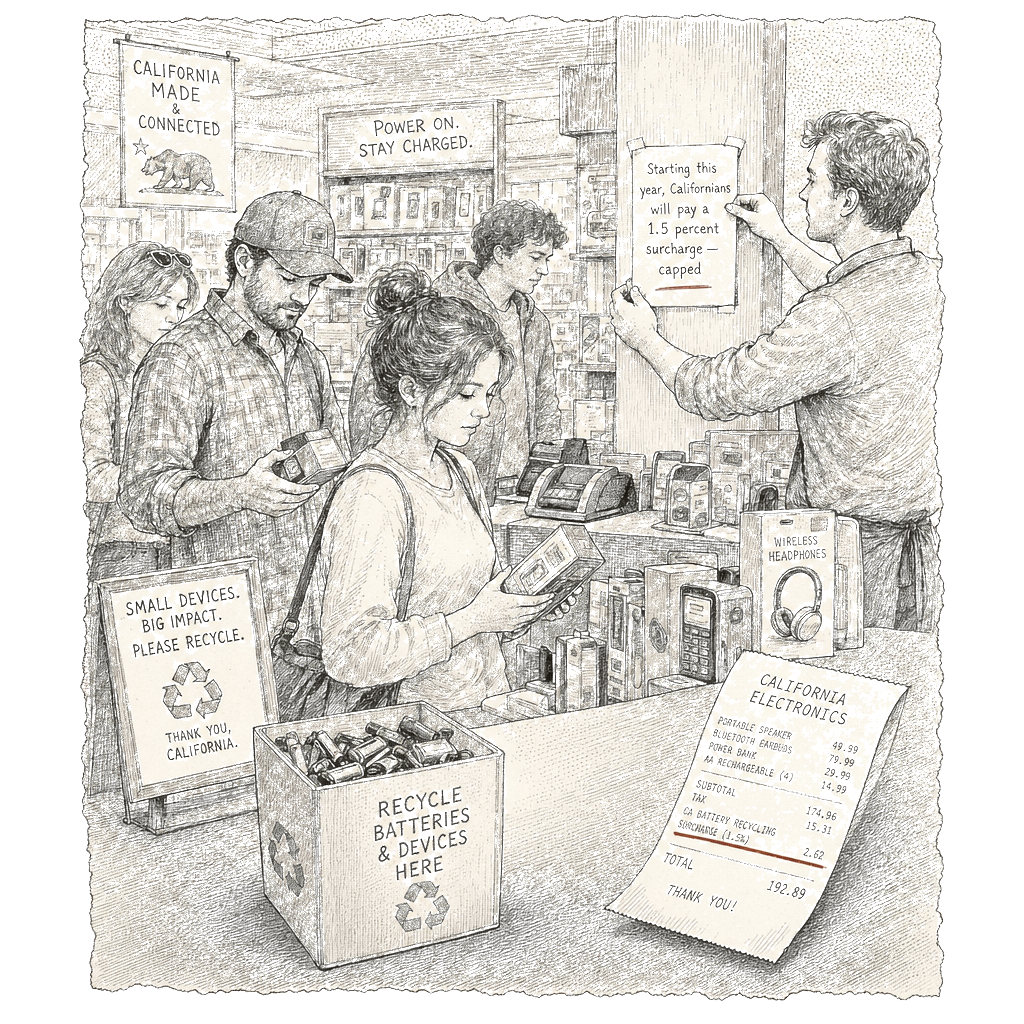
How the fee works
The law — Senate Bill 1215, authored by former state Sen. Josh Newman, a Democrat who represented parts of Los Angeles and San Bernardino counties, and signed by Gov. Gavin Newsom in 2022 — applies to products with embedded batteries whether rechargeable or not. Consumers will see the surcharge at the point of sale.
“These things are everywhere. They’re ubiquitous,” said Joe La Mariana, executive director of RethinkWaste, a regional waste management agency that oversees services for 12 San Mateo County cities and co-sponsored the legislation.
Doug Kobold, executive director of the California Product Stewardship Council, which also co-sponsored the legislation, said the fee was a matter of shifting costs to the point of purchase rather than passing them to communities after the fact.
“Paying a small check‑stand fee to fund proper collection is far cheaper than million‑dollar fires, higher insurance premiums, and rate hikes passed back to communities,” Kobold said.
A costly lesson in San Carlos
The hazard is not hypothetical. In 2016, a lithium-ion battery sparked a fire at the Shoreway Environmental Center, a recycling facility in the San Mateo County city of San Carlos. The fire caused a four-month plant shutdown and $8.5 million in damage.
RethinkWaste, which oversees the facility, saw its annual insurance premium climb from $180,000 to $3.2 million as a result, La Mariana said. Ratepayers ultimately bore that cost.
“Being a publicly owned facility, every bit of that property is owned and paid for by our 430,000 ratepayers,” La Mariana said. “So we have a fiduciary responsibility to maintain the integrity of these assets. But also, on a human level, we have a very high responsibility for the safety of our colleagues and our co-workers.”
Experts say battery fires in waste and recycling facilities are an everyday hazard and are likely underreported, because facilities fear regulatory oversight or increases in insurance premiums. The Federal Aviation Administration records nearly two battery fires on U.S. flights every week.
Vapes left out — and growing
Not every lithium-ion battery product falls under the new law. Single-use plastic vapes are exempt because the Department of Toxic Substances Control raised concerns about collection and recycling systems handling nicotine, a hazardous substance, said Nick Lapis, an advocate with Californians Against Waste, which co-sponsored the legislation.
Vapes are also, according to Lapis, the fastest-growing source of lithium-ion battery waste.
“If you imagine somebody’s a pack a day smoker, that means every single day they’re throwing out a device with a lithium-ion battery,” Lapis said.
Assemblymembers Jacqui Irwin and Lori Wilson introduced Assembly Bill 762 last year, which would ban single-use plastic vapes entirely. Lapis said he expects the Legislature to address vape-related battery waste in the current session.
Larger-scale hazards
The new consumer fee addresses one end of the battery disposal problem. At the other end, large-scale lithium-ion installations have presented hazards of a different kind.
During recent fires in the Los Angeles area, electric vehicle batteries left behind required a major cleanup operation by the Environmental Protection Agency. In Moss Landing, a fire burned at a battery storage site for two days, requiring more than 1,000 people to be evacuated; Monterey County neighbors to the facility have reported feeling ill since the fire, and a recent study detected toxic metals in nearby marshes, according to the AP report.
In 2024, Newsom established a collaborative of state agencies — including the California Air Resources Board and the California Department of Forestry and Fire Protection — to examine safety solutions for battery storage technologies. New CalFire regulations for battery storage systems are set to take effect this year.
Meg Slattery, a scientist for Earthjustice, said the question of what happens to batteries at the end of their useful life is one the state’s clean-energy transition forces into view.
“The next question becomes … where are we sourcing materials, and thinking through what happens to this when we’re not using it anymore, which I think we’re not traditionally great at thinking about as a society,” Slattery said.