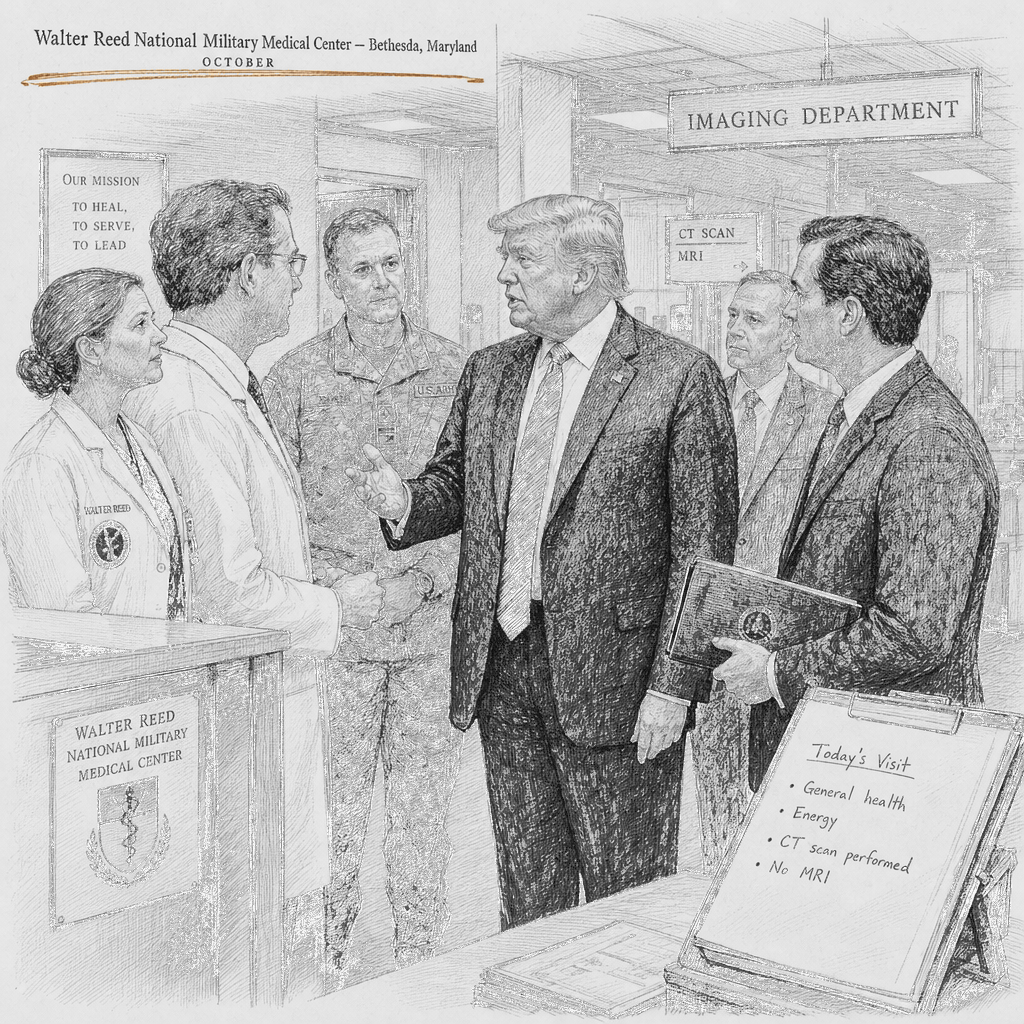
Trump used a Thursday interview with The Wall Street Journal to address multiple health-related questions, including new details about an October exam at Walter Reed National Military Medical Center that the White House and Trump had previously delayed explaining in detail. In the interview, Trump said he had a CT scan rather than an MRI scan and expressed regret that he underwent the advanced imaging during the visit, saying it raised questions about his health.
White House physician Navy Capt. Sean Barbabella, in a statement released by the White House on Thursday, said Trump’s doctors recommended that he undergo additional routine imaging during the October visit to Walter Reed. Barbabella said the goal was to “definitively rule out any cardiovascular issues,” and he said the results were “perfectly normal and revealed absolutely no abnormalities.” He also said the imaging was recommended to make use of Trump’s time at the medical center, adding that Trump already had an annual physical in April.
In earlier discussions of the October exam, Trump had described the scan as an MRI, and the interview published Thursday included his explanation that he did not know which part of his body had been scanned. The Associated Press reported that Trump’s interview added that the test was a CT scan, describing it as a quicker imaging method than MRI that provides less tissue detail.
Barbabella also said in his statement that the recommendation covered either CT or MRI because the intent was to definitively rule out cardiovascular issues. He said Trump agreed to meet staff and soldiers at Walter Reed in October, and that another routine physical evaluation was recommended to ensure continued optimal health. The statement added that Trump had “advanced imaging” as a preventive screening for a man his age.
Karoline Leavitt, the White House press secretary, said in a Thursday statement that Trump’s doctors and the White House have “always maintained the President received advanced imaging.” Leavitt said that further details about the imaging had been disclosed by the president himself because he “has nothing to hide,” according to the AP account of the statement.
In the interview, Trump said he regretted taking the scan during the October visit and suggested he thought it provided “ammunition” for questions about his health. He said that if he had not undergone the imaging, he would have been better off, because the act of having it led others to wonder whether something was wrong despite, he said, that nothing was.
Trump also addressed other visible and ongoing concerns, including swelling in his ankles and bruising on his hand. The White House previously said Trump was diagnosed with chronic venous insufficiency, and Trump told the outlet he briefly tried wearing compression socks but stopped because he did not like them.
Leavitt attributed bruising on Trump’s hand to “frequent handshaking and the use of aspirin,” and the interview included Trump’s comments about aspirin use. Trump said he takes more aspirin than his doctors recommend but said he has resisted taking less because he has been taking it for 25 years and described himself as “a little superstitious.” Barbabella’s statement, as described by the AP, said Trump takes 325 milligrams of aspirin daily.
The interview also addressed questions raised by cameras during White House meetings, with Trump denying he has fallen asleep. Trump said he was resting his eyes or blinking, adding: “I’ll just close. It’s very relaxing to me,” and he said observers catch him blinking and he does not sleep much at night. He said he starts his day early at the White House residence before moving to the Oval Office around 10 a.m., and works until 7 p.m. or 8 p.m.
Finally, Trump said he has plenty of energy and attributed it to genetics, saying “Genetics are very important” and “I have very good genetics.” He also dismissed questions about his hearing, saying he only struggled to hear “when there’s a lot of people talking.”
The discussion of Trump’s health and energy comes as he has repeatedly faced scrutiny about his age and fitness for office. The AP reported that questions have also followed him this year as he has been seen with visible bruising and swelling, even as he and White House officials have continued to offer explanations tied to medical conditions and routine medication use.