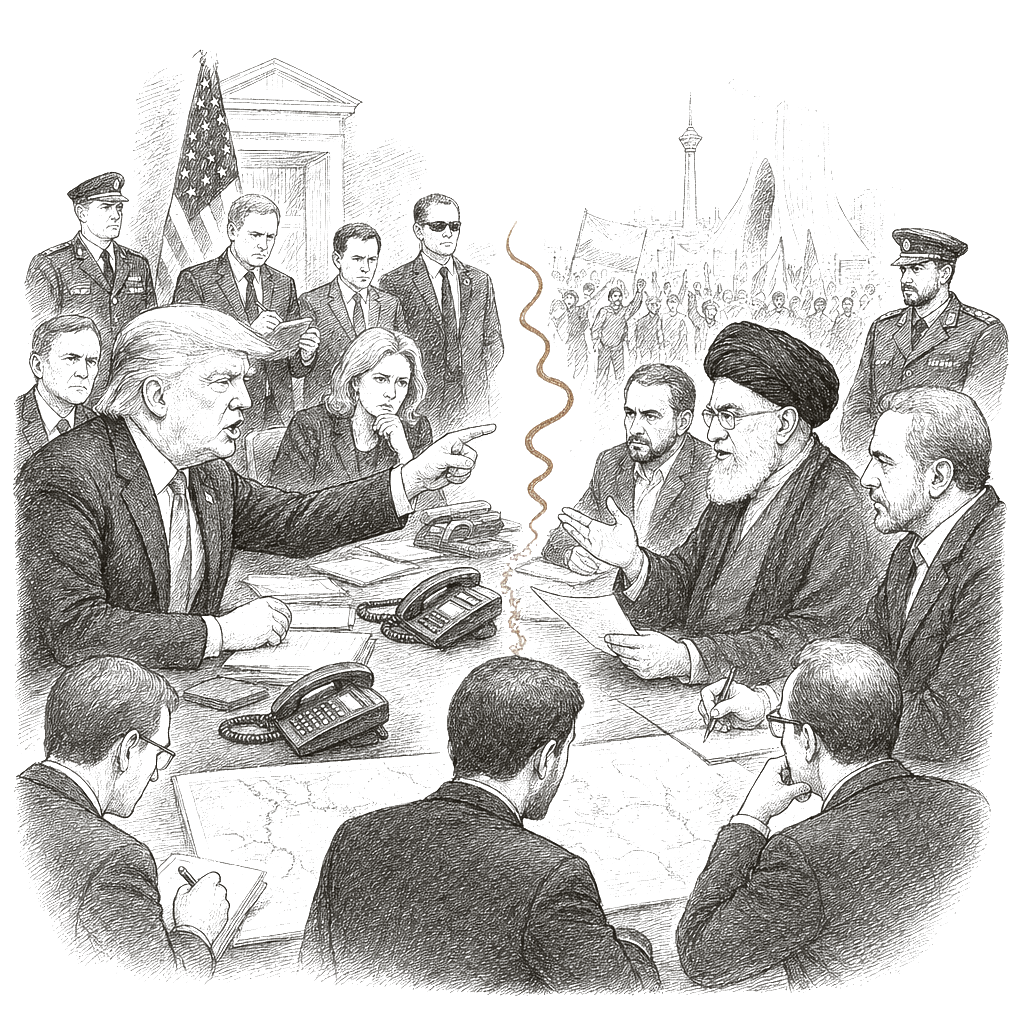
U.S. President Donald Trump and Iran’s top officials exchanged threats as protests spread across Iran for a sixth straight day, according to Associated Press reporting. At least eight people have been killed in violence surrounding the demonstrations, which were sparked in part by the collapse of Iran’s rial currency but have grown to include crowds chanting anti-government slogans.
In the unrest, the demonstrations have become the biggest in Iran since 2022, when nationwide protests followed the death of 22-year-old Mahsa Amini in police custody. The current protests have not matched the scale and intensity of the demonstrations that followed Amini’s detention over not wearing her hijab.
Trump’s response began with a warning posted on his Truth Social platform. AP reported that Trump wrote that if Iran “violently kills peaceful protesters,” the United States “will come to their rescue.” The same post included Trump writing: “We are locked and loaded and ready to go,” without elaborating further.
Iran’s response came from senior officials. Ali Larijani, a former parliament speaker serving as secretary of Iran’s Supreme National Security Council, alleged that Israel and the U.S. were stoking the protests. AP reported that Larijani offered no evidence for the allegation, a charge Iranian officials have made during earlier rounds of protests.
On X, Larijani also warned that “Trump should know that intervention by the U.S. in the domestic problem corresponds to chaos in the entire region and the destruction of the U.S. interests,” and added that “The people of the U.S. should know that Trump began the adventurism. They should take care of their own soldiers.” AP reported that the comment likely referenced the U.S. military footprint in the region and came after Iran attacked Al Udeid Air Base in Qatar in June, following U.S. strikes on three nuclear sites during Israel’s 12-day war on Iran.
A U.S. official, speaking on condition of anonymity to discuss sensitive military plans, told AP that as of Friday there had been no major changes made to U.S. troop levels in the Middle East or their preparations after Trump’s posts.
Iran also directed its warnings to international institutions. AP reported that in a letter late Friday to United Nations Secretary-General António Guterres and the U.N. Security Council, Iran’s envoy asked the world body to condemn the rhetoric and reaffirm Iran’s “inherent right to defend its sovereignty, territorial integrity, and national security, and to protect its people against any foreign interference.” Amir Saeid Iravani, Iran’s ambassador to the U.N., said the United States of America “bears full responsibility for any consequences arising from these unlawful threats and any ensuing escalation.”
Separately, Ali Shamkhani, an adviser to Supreme Leader Ayatollah Ali Khamenei and previously the council’s secretary, warned that “any interventionist hand that gets too close to the security of Iran will be cut.”
AP reported that Trump’s Truth Social message amounted to a direct sign of support for the demonstrators. The report said other American presidents have generally avoided public backing of Iranian protests because activists might be accused of working with the West, noting that President Barack Obama held back during the 2009 Green Movement but later said in 2022 that he viewed his decision as a mistake.
Naysan Rafati, an analyst at the International Crisis Group, told AP that the grievances fueling these and past protests are due to Iran’s own policies, but that Tehran is likely to use Trump’s statement as “proof that the unrest is driven by external actors.” Rafati added that using that as justification for a “crack[down] more violently” risks inviting the U.S. involvement Trump has hinted at.
As protests continued Friday, AP said demonstrations went on in various cities, while life largely continued unaffected in Tehran. The U.S.-based Human Rights Activists News Agency reported that protests had reached over 100 locations in 22 of Iran’s 31 provinces, and said the death toll rose to eight with the death of a demonstrator in Marvdasht in Iran’s Fars province.
The AP report said demonstrators took to the streets in Zahedan in Iran’s Sistan and Baluchestan province, a region bordering Pakistan, and that burials of several demonstrators killed in the protests took place Friday and sparked marches. AP also described videos purportedly showing mourners chasing off security force members at the funeral of 21-year-old Amirhessam Khodayari, who was killed Wednesday in Kouhdasht, over 400 kilometers (250 miles) southwest of Tehran in Iran’s Lorestan province.
AP reported that Khodayari’s father denied his son served in the all-volunteer Basij force of Iran’s Revolutionary Guard, as authorities had claimed, and that the semiofficial Fars news agency later reported there were now questions about the government’s claims.
Iran’s civilian government led by reformist President Masoud Pezeshkian has sought to signal it wants to negotiate with protesters, AP said, though Pezeshkian acknowledged he has little he can do because the rial has rapidly depreciated, with $1 now costing some 1.4 million rials. The protests also include chants against Iran’s theocracy, according to AP.
In parallel with the protests, AP said Iran recently told the world it was no longer enriching uranium at any site in the country and was trying to signal openness to negotiations to ease sanctions. AP reported that those talks have not happened as Trump and Israeli Prime Minister Benjamin Netanyahu have warned Tehran against reconstituting its atomic program.
Associated Press writers Konstantin Toropin in Washington and Farnoush Amiri in New York contributed to this report.