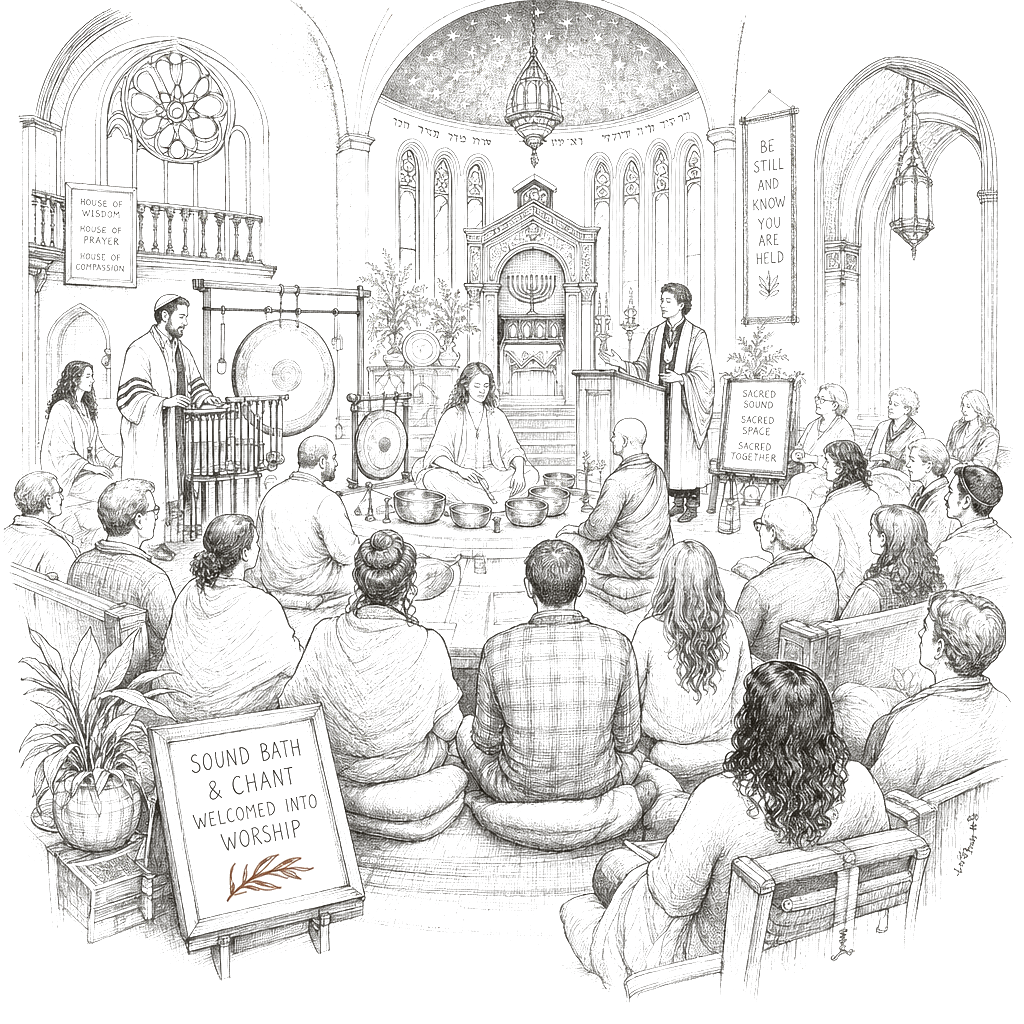
With eyes closed and a small mallet in hand, the Rev. Kyohei Mikawa struck a bronze Himalayan singing bowl and let its resonance fill a Buddhist sanctuary in Los Angeles during a session he described as a sound bath. Over the next 45 minutes, he moved between instruments and chanting as participants sat or meditated on yoga mats, seeking an immersive experience meant to settle attention.
Sound baths, sometimes described as sound healing or sound meditation, have grown in popularity in recent years, driven in part by public interest in mental health and wellness. But faith leaders say the practice is increasingly showing up in mainstream worship settings, including churches, temples and synagogues, rather than remaining limited to yoga centers or crystal-healing studios.
Mikawa, who oversees the Rissho Kosei Kai Buddhist Center in Boyle Heights, said the sounds that punctuated his session came from Buddhist tradition and were meant to energize and calm the mind. He described the structure of the session as part of a spiritual outreach effort, saying he and other leaders are looking for ways to bring spiritual experiences to neighbors who may want community without necessarily being affiliated with a religion.
In his session, Mikawa said a chant offered at the end carried a message: “Seek refuge in the true spirit of who you are.” He said the practice’s aim is not to convert attendees, quoting his own framing: “The goal is not to become a Buddhist, but a Buddha — the best version of who we are.”
Rabbi Jonathan Aaron, who leads Temple Emanuel in Beverly Hills, said he performs a sound bath the first Saturday of each month at the end of the Shabbat service during Havdalah. As part of the ritual, he said blessings are offered over wine, sweet spices and a multi-wicked candle while participants reflect on the difference between sacred and ordinary time, and he said the sound bath fits the sensory nature of Havdalah.
Aaron said he works with a practitioner who uses crystal bowls, gongs, rain sticks and an ocean drum, designed to mimic the sound of waves, to create a relaxing, meditative atmosphere. He said a sound bath might not be inherently Jewish, but that it can align with Jewish heritage, pointing to a biblical description of God creating the world through speech—“Let there be light”—as well as listening to sacred sounds such as the shofar.
Aaron said, “I’m not trying to make the sound bath Jewish,” adding that he is “trying to bring Jewish energy and an experience by creating this environment that has a sound bath as part of it.” A congregant who attended, Anna Reyner, said the synagogue setting is particularly suited to the practice because it supports community and a sense of connection to holiness.
Other Christian leaders described a similar approach: adding sound baths not as evangelism, but as a community practice. Pastor Paul Capetz, of Christ Church by the Sea, a United Methodist congregation in Newport Beach, California, said the church’s monthly sound bath sessions are performed by a local practitioner and that they are drawing people “who would never otherwise darken the door of a church.” He said the sound bath brings participants to “another level of existence,” and he described the feeling as serenity rather than intoxication.
Capetz said the goal is “not to convert, but to relate to others in the community who may be spiritual but not religious.” Lynda Arnold, a longtime sound healer who has performed at Episcopal churches in Los Angeles, said churches are conducive to sound baths because of their sense of history, sanctity, reverence and, often, acoustics, and she said the sessions aim to bring people into “deep listening, contemplation, prayer and intention.”
Sound researchers and cognitive scientists described the practice as rooted in longstanding beliefs about primordial sound and in modern explanations about how the brain responds to rhythmic frequencies. Alexandre Tannous, a New York-based sound researcher and sound therapist who has led sessions around the U.S. and abroad, said many religions and cultures treat sound as fundamental to creation and sustaining the universe, and he pointed to traditions that describe beginnings connected to “aum” and spoken-word concepts such as Logos.
Tannous said the instruments used in sound baths—such as gongs, singing bowls, bells, chimes and didgeridoos—provide vibrations that can help people quiet the mind and become focused. He also described what he called “notes between the notes,” saying they have the power to quiet what he referred to as the “multitasking monkey mind.”
Ramesh Balasubramaniam, a professor of cognitive science at the University of California, Merced, said the practice can work by influencing brain activity through entrainment. He said that when someone hears a sound wave oscillating four times a second, it can facilitate brain waves in the same frequency range, comparing the combined effect to “a crowd chanting in a football game.”
Participants described effects without necessarily citing scientific mechanisms. Jazmin Morales, who lives near the Rissho Kosei Kai Buddhist Center, said she has attended weekly sound baths for several weeks and that, although she does not know the science behind it, she said it helps her focus during meditation and has helped with sleep when she could not sleep. Ridge Gonzalez, who practices yoga and meditation, said it was her first sound bath and described it as “amazing,” saying she could visualize the sound and felt clarity while meditating.
(AI disclosure and CC0 license are applied in pipeline metadata. Sources are listed by the system from the provided cluster.)