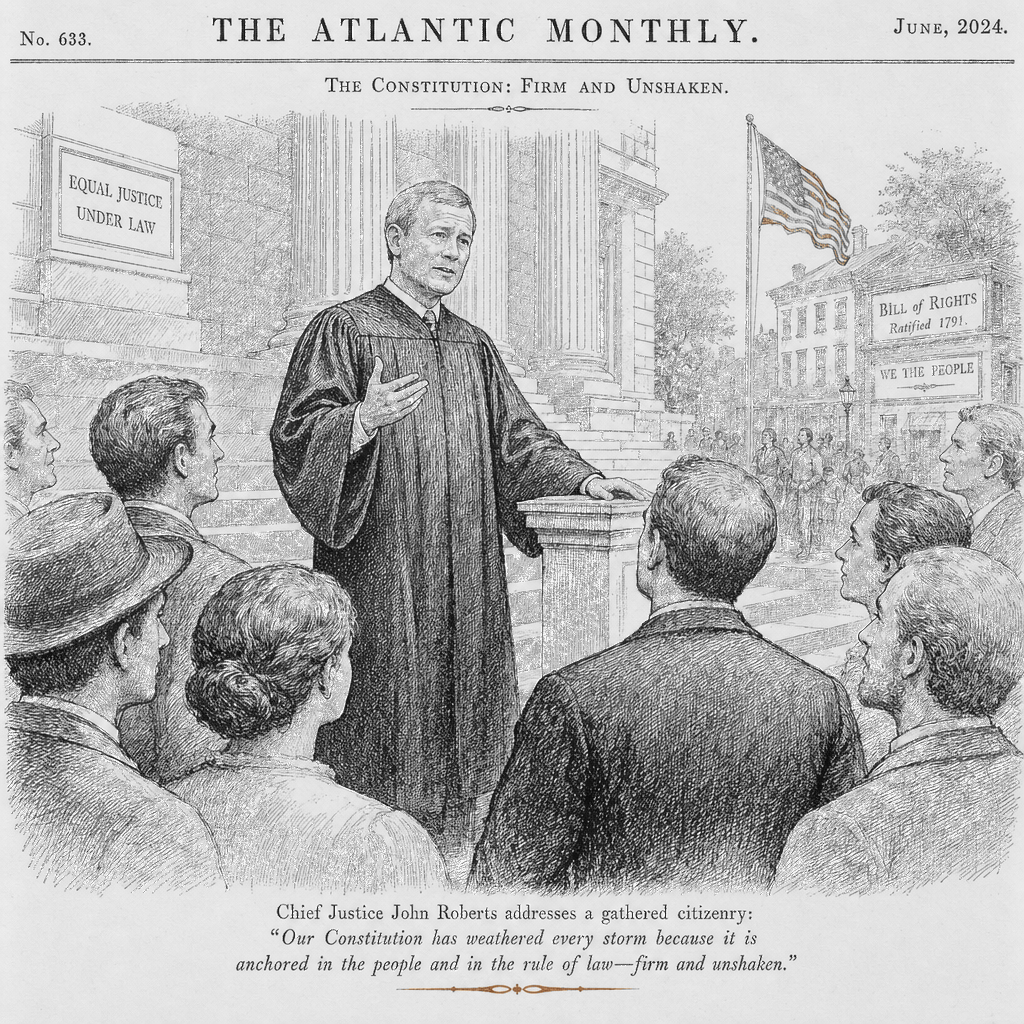
Roberts’ annual message to the federal judiciary opens with a contrast between history and the current moment, and it uses the Constitution as the anchor for that comparison. In a letter delivered to judges, the chief justice said the founding document remains “firm and unshaken,” and he added, “True then; true now,” invoking a century-old line attributed to President Calvin Coolidge.
The letter landed after what the AP described as a tumultuous year for the nation’s judicial system, with legal scholars and Democrats raising concerns about a possible constitutional crisis. The concerns, the report said, grew as Republican President Donald Trump’s supporters pushed back against rulings that the administration and its allies argued slowed a far-reaching conservative agenda.
Roberts framed his guidance in the form of an oath-like directive for judges. The AP reported that he called on judges to “continue to decide the cases before us according to our oath,” and he tied that instruction to the obligation to give “equal right to the poor and to the rich,” while performing duties “faithfully and impartially under the Constitution and laws of the United States.”
Much of the letter, according to the AP, focused on judicial independence through historical example. It included discussion of an early 19th-century case that Roberts used to highlight the principle that Congress should not remove judges over contentious decisions. The letter also looked beyond that U.S. judicial precedent to other founding-era references, beginning with Thomas Paine’s 1776 pamphlet “Common Sense.”
The AP report said the letter arrived after a high-profile confrontation involving Roberts in March, when the chief justice issued a rare rebuke after Trump called for the impeachment of a judge who had ruled against him in a case involving deportation of Venezuelan migrants accused of being gang members. The AP said Roberts’ Wednesday letter itself contained few direct references to the specific, fast-moving disputes that have marked the administration’s litigation posture.
In broader context, the AP said the Trump administration has scored a series of wins on the Supreme Court’s emergency docket over the last year, including actions that, as described by the report, allowed Trump to move ahead with banning transgender people from military service, clawing back billions of dollars of congressionally approved federal spending, moving aggressively on immigration, and firing Senate-confirmed leaders of independent federal agencies. The AP also noted that the court handed Trump some defeats during the same period, including in a push to deploy the National Guard to U.S. cities.
Looking ahead, the AP said multiple pivotal issues are set for 2026, including arguments tied to Trump’s push to end birthright citizenship and a case about whether he can unilaterally impose tariffs on hundreds of countries. The AP reported that Roberts’ letter largely bypassed those upcoming disputes, instead closing with Coolidge’s encouragement to “turn for solace” to the Constitution and Declaration of Independence “amid all the welter of partisan politics.”