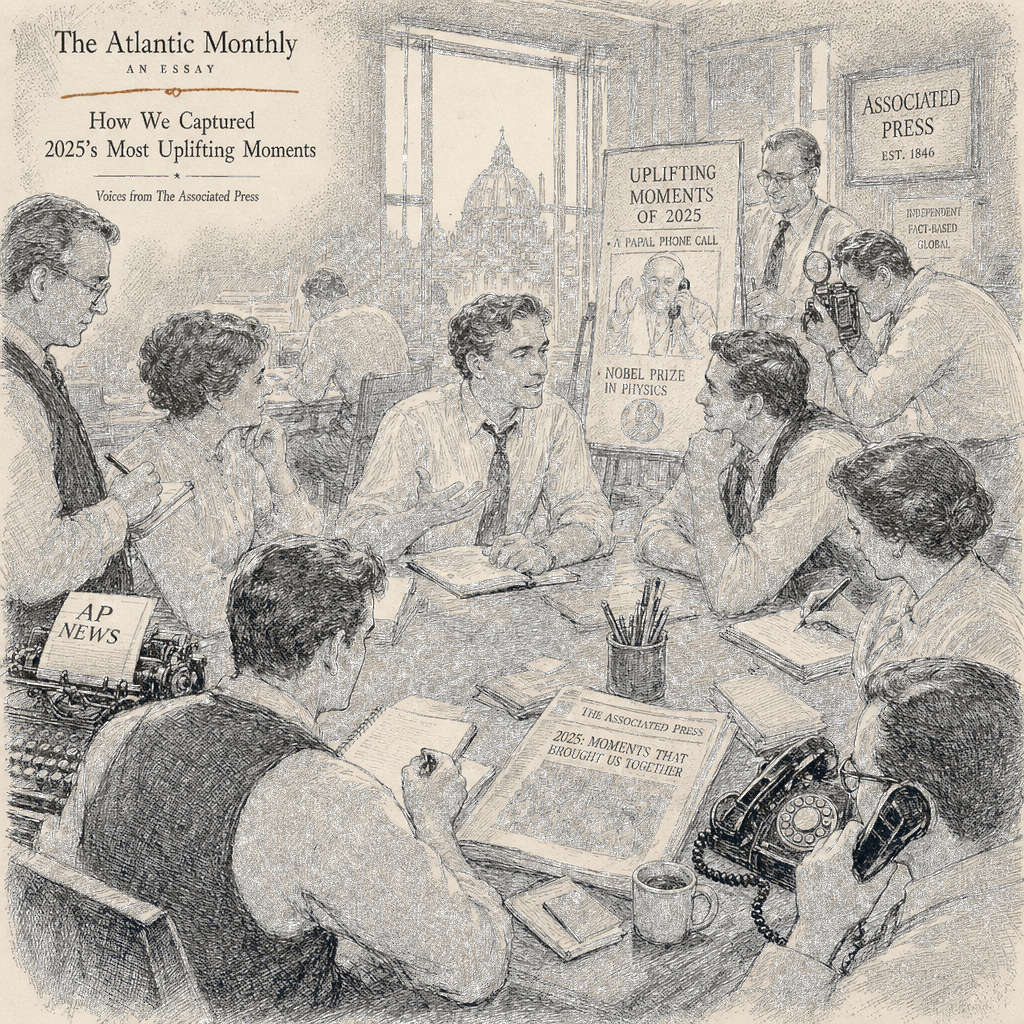
In 2025, the Associated Press described how some of the year’s most uplifting stories unfolded on the ground—often in moments that began as routine coverage but turned into something more personal.
One such scene came as video journalist Obed Lamy was interviewing John Prevost at his home in New Lenox, Illinois, after Prevost’s brother became Pope Leo XIV. Lamy and Prevost were talking when a ringing came from the basement, prompting Prevost to rush downstairs to check the calls.
The phone call was from Pope Leo XIV. Prevost found missed calls from his brother and called him back, using a speaker so the audio could play aloud. Lamy listened as the pope spoke, and the conversation led Lamy to rush down the basement stairs to capture what he described as the pope’s greeting to his brother.
“I was shaking because I didn’t know what the pope would say,” Lamy said, describing his uncertainty about how to respond to the call. He added: “Am I supposed to say something or not say anything?”
Lamy reported that the call lasted only a few minutes and that it sounded like ordinary sibling talk. In the conversation, Prevost told the pope, “Oh, we’re coming to Rome,” and the pope asked, “Oh, where are you going to sleep?” Lamy also noted it was notable that the pope did not seem to know what accommodations for his family would look like.
Another AP moment described the rush of breaking science news. When the Nobel Prize in medicine was announced, photographer Lindsey Wasson was dispatched before dawn to the home of Mary E. Brunkow in North Seattle, arriving before the Nobel committee could reach Brunkow. Wasson described reaching the wrong house at first because her GPS took her to the back, then arriving at the front door where no one was awake.
Wasson said she identified herself and asked if a Mary lived there, and she reported that the response came from Ross, Brunkow’s husband, who spoke through the glass. Wasson told him, “Sir, your wife just won the Nobel Prize,” and Ross let her in so she could bring Mary to the kitchen as he delivered the news.
The AP account said the initial reaction was a mix of tension, annoyance and disbelief after being woken up at 3:45 a.m. Ross told Wasson that when he first went into the bedroom with the news, Brunkow said, “Don’t be ridiculous.” The story said that as Mary and Ross processed the news and realized missed calls from Sweden overnight were not spam, the mood shifted to joy, and Wasson followed along as Mary sifted through messages from family, friends and other journalists.
AP photography also captured how weddings and other traditions can continue during natural disasters. Photographer Aaron Favila described rushing to cover a wedding in a typhoon-flooded church just north of Manila after getting a tip. He said he had an hour window to make it to the venue, quoting: “I had an hour window to make it to the venue.” Heavy downpours left roads too deep for their vehicle, and Favila said he rode in a rescue truck to reach the ceremony.
Favila reported arriving just before the bride’s door opened and said the groom, Jade Rick Verdillo, described the decision to proceed despite floodwaters. Verdillo told him, “We’ve been through a lot. This is just one of the struggles that we’ve overcome.”
In Southern California, reporter Jocelyn Gecker described covering opening night of a youth theater group whose theater and many cast members’ homes were destroyed by the Palisades wildfire. The account said rehearsals for the group’s musical, “Crazy for You,” had started on Jan. 6, and the following day the Palisades Fire ripped through their community—though the show would go on.
The AP story quoted director Lara Ganz about why the production mattered after the loss. “It was about restoring togetherness, hope and routine and showing the kids who had lost so much that life was not over,” Ganz said.
After the article was published, the AP said Ganz relayed that members of the Gershwin family trust read the story and attended a later performance, then delivered a letter to the cast and crew. The letter said, “On behalf of the families of George and Ira Gershwin, we applaud your resilience,” and praised their “amazing dedication,” adding that they hoped the cast was immensely proud. “We know that George and Ira would be too,” the letter said.