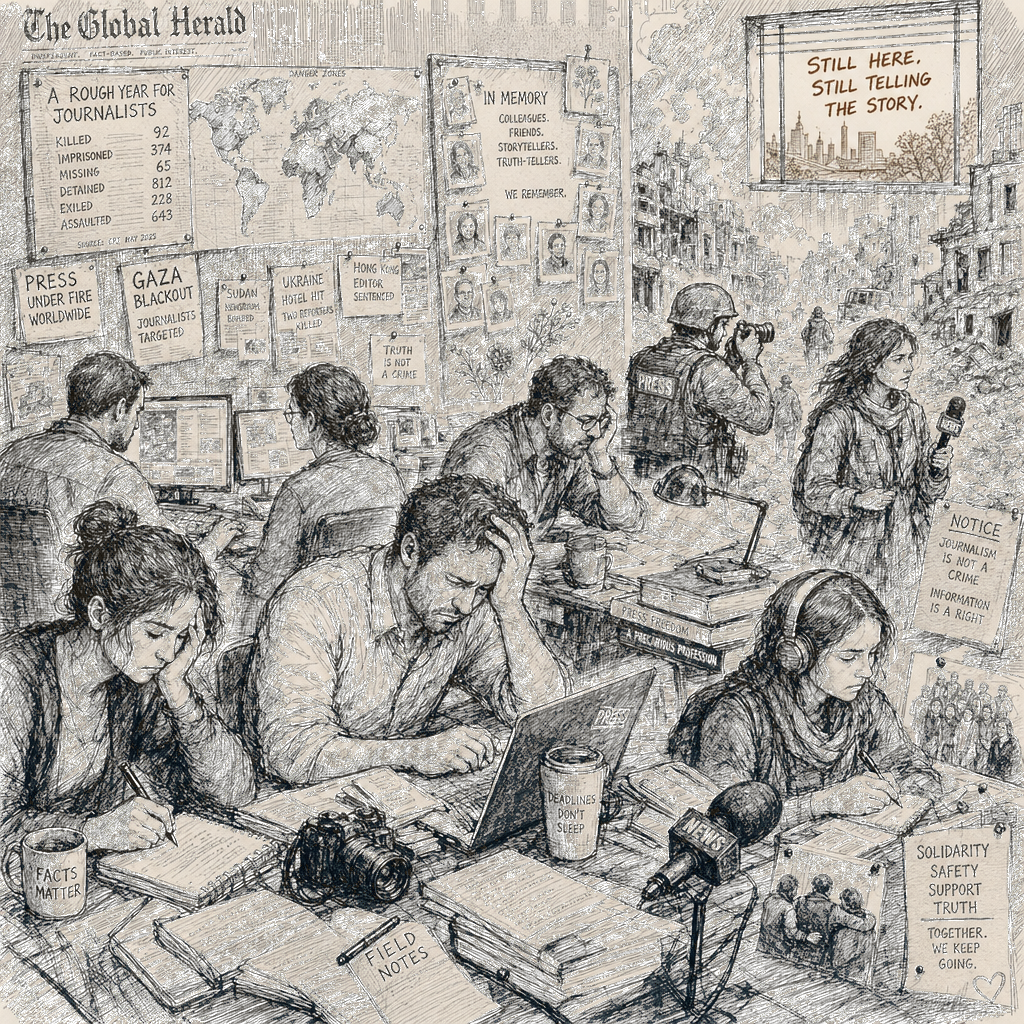
A rough year for journalists, with a little hope
By nearly any measure, 2025 has been a rough year for people concerned about freedom of the press, with the year’s grim body count and legal fights landing alongside a backdrop of rising hostility toward reporters and fewer people staying in the job. In a year-end AP report, the Committee to Protect Journalists said the number of media workers killed worldwide by early December matched the number of deaths in all of 2024. The committee also estimated that at least 323 journalists were imprisoned worldwide.
Worldwide, the AP reported that the committee’s tally of 126 media industry people killed in 2025 by early December matched the total number of deaths in all of 2024. The report said Israel’s bombing of Gaza accounted for 85 of those deaths, with 82 of them Palestinians, while also underscoring the broader concern that violence against journalists remains a problem without effective accountability.
In the United States, the AP report said the work on American soil also has remained dangerous. Citing the U.S. Press Freedom Tracker, the report said there were 170 reports of assaults on journalists in the United States in 2025, including 160 attributed to law enforcement, and said many of those incidents came in coverage connected to immigration enforcement efforts.
The AP report also linked the year’s press climate to the influence of President Donald Trump, saying he frequently berates people who ask him questions and that, during 2025, he worked to restrict and punish news coverage while engaging with journalists directly. Tim Richardson, a former Washington Post reporter and program director for journalism and disinformation at PEN America, said the assault on the press over the past year has likely been the most aggressive that they have seen in modern times.
Richardson said Trump’s approach “turned that into government action to restrict and punish and intimidate journalists” during the second term, according to the AP account. The AP report described how the Associated Press learned quickly after Trump limited the outlet’s access to cover him, prompting a court fight that the AP said remained unresolved. The AP report also said Trump extracted settlements from ABC and CBS News in lawsuits over stories that displeased him, and said he was suing The New York Times and Wall Street Journal.
The AP report further described how criticism of bias claims tied to public broadcasting became part of the pressure campaign, including steps that reduced funding for public broadcasting as a whole. It also said the Trump administration moved to shut down government-run organizations that beam news globally, and quoted Jodie Ginsberg, CEO of the Committee to Protect Journalists, saying that the “evisceration” of Radio Free Europe, Radio Free Asia and the Voice of America was another blow to press freedom worldwide.
In addition, the AP report described actions by other officials that it said echoed Trump’s approach, including when the press office launched a web portal the day after Thanksgiving for outlets or journalists to complain about being unfairly treated. It also said Defense Secretary Pete Hegseth portrayed journalists as “dark figures” skulking around Pentagon halls to uncover classified secrets, as the rationale for restrictive rules for coverage.
The AP report said the dispute over the Pentagon rules prompted pushback from mainstream outlets, with many withdrawing credentials rather than accept the restrictions, continuing to work off-site while seeking court challenges. It also said The New York Times sued to overturn the rules and publicly defended its coverage during attacks by Trump, including when he complained about the newspaper’s reporting on his health.
Despite the organized effort against the press, the AP report said the public has taken little notice in polling comparisons. It cited Pew Research Center as saying 36% of Americans reported earlier in the year hearing a lot about the Trump administration’s relationship with the press, compared with 72% at the same point in his first term, and said Pew’s polling showed trust in news organizations has declined over the last decade.
In the AP report’s discussion of the human impact, Richardson said much of the harm falls on the public because the public relies on independent reporting to understand and scrutinize decisions made by the most powerful office in the world. Richardson also framed the press as part of a broader accountability system, not only a newsroom concern—an argument that was tied in the report to concerns about shrinking capacity as journalists leave or are laid off.
Even with bleak statistics, the AP report included what Ginsberg and Richardson described as reasons for optimism. The report cited year-over-year contraction pressures tied to the collapse of the advertising market and said one of the year’s sobering statistics came from a report by Muck Rack and Rebuild Local News: in 2002, there were 40 journalists for every 100,000 people in the United States, and by 2025 that figure was “just over eight,” according to the AP account.
Asked about optimism, the AP said both Ginsberg and Richardson pointed to the rise of independent local news organizations, mentioning examples including the Baltimore Banner, Charlottesville Tomorrow in Virginia, and Outlier Media in Michigan. The AP also quoted Axios CEO Jim VandeHei, who said, “Over time, people will hopefully come to their senses and say, ‘Hey, the media like anything else is imperfect but, man, it’s a nice thing to have a free press.’”