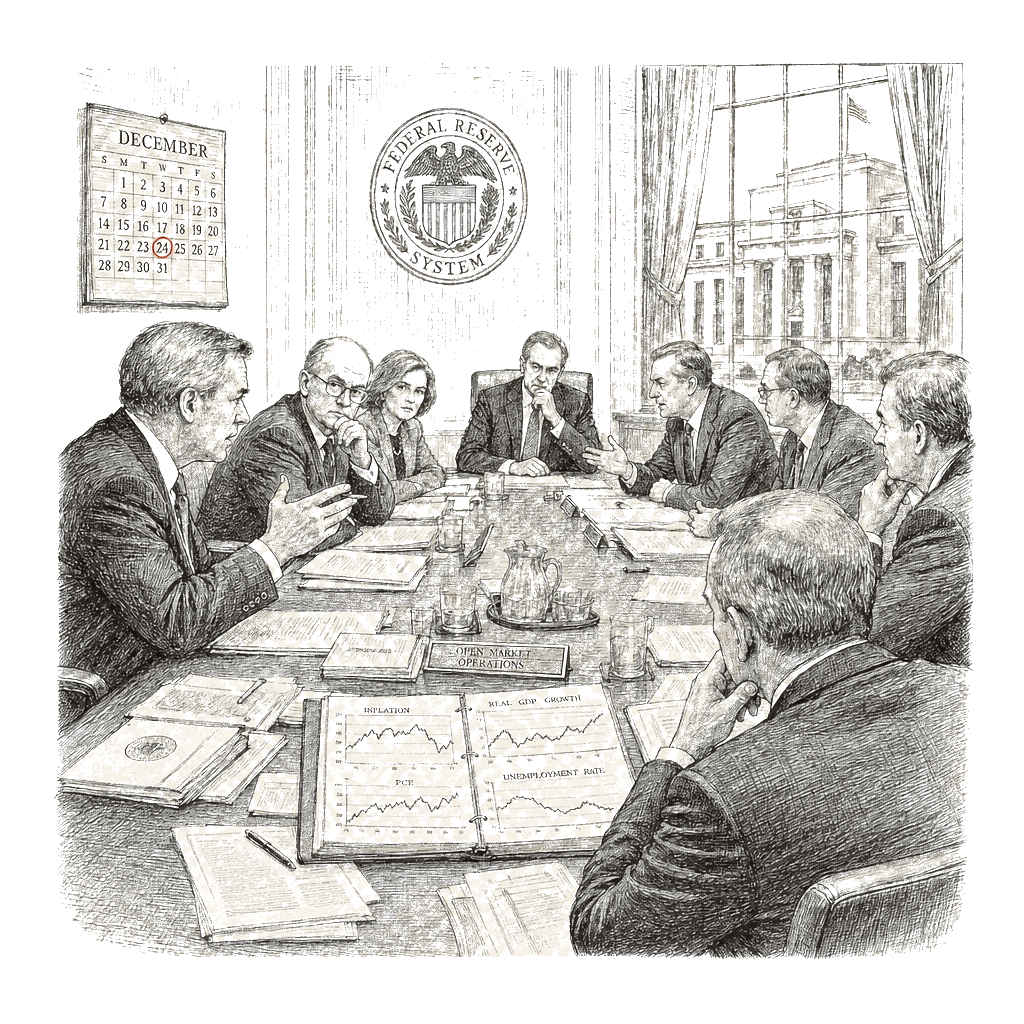
Federal Reserve officials were deeply divided over the central bank’s December interest rate reduction, with some who voted for the quarter-point cut saying they could just as easily have backed holding rates steady, according to meeting minutes released Tuesday.
The 9-3 vote at the December 9–10 Federal Open Market Committee meeting — an unusual level of dissent for a body that typically acts by consensus — reflected a committee split over which posed the greater threat to the economy: a weakening job market or inflation that remains above the central bank’s 2% target.
The minutes laid bare a Fed in which the path forward is genuinely unsettled, with policymakers working from economic data they described as outdated because a six-week government shutdown had delayed key reports on jobs, prices, and growth.
How officials voted
The minutes do not identify officials by name, but voting records are public. Two policymakers dissented in favor of holding rates unchanged: Jeffrey Schmid, president of the Federal Reserve Bank of Kansas City, and Austan Goolsbee, president of the Chicago Fed. A third dissent came from Fed governor Stephen Miran, who was appointed by President Donald Trump in September; Miran favored a larger, half-point reduction.
The remaining nine members supported the quarter-point cut, though the minutes said some of them wanted to wait for more economic data before making further moves.
The shutdown’s role
A six-week government shutdown complicated the December deliberations by delaying the release of economic reports on jobs, inflation, and growth. The government was forced to estimate many price and employment figures rather than measure them directly, economists said, leaving policymakers with an incomplete picture at their meeting earlier this month.
The labor market picture
Government data showed employers cut about 40,000 jobs in October and November combined, while the unemployment rate rose to 4.6%, a four-year high, according to Federal Reserve data. Fed Chair Jerome Powell said after the December 10 meeting that the monthly job-gain figure for April through September — roughly 40,000 — could be revised lower by as much as 60,000, which would mean employers had actually shed an average of 20,000 jobs a month during that stretch.
“It’s a labor market that seems to have significant downside risks,” Powell told reporters. “People care about that. That’s their jobs.”
The inflation picture
Annual headline consumer inflation cooled to 2.7% in November, down from 3% in September, according to government data, though economists cautioned the November reading was likely distorted by the shutdown. The Fed’s preferred inflation gauge — core personal consumption expenditures, which strips out food and energy prices — ran at approximately 2.83% on an annual basis as of the article’s publication date, according to Federal Reserve data, remaining above the central bank’s 2% target.
The tension between the two indicators lies at the heart of the committee’s division. A weaker job market would typically push the Fed to reduce borrowing costs more quickly; stubbornly elevated inflation would argue for holding rates higher.
A divided view of 2026
At its December meeting, the Fed also released quarterly economic projections that illustrated the depth of the split. Seven officials projected no rate cuts in 2026, eight forecast two or more reductions, and four supported just one cut.
When the Fed reduces its key rate, lower borrowing costs can follow over time for mortgages, auto loans, and credit cards, though market forces also shape those rates. The effective federal funds rate averaged 3.88% in December, according to Federal Reserve data, reflecting a blend of days before and after the mid-month rate reduction.