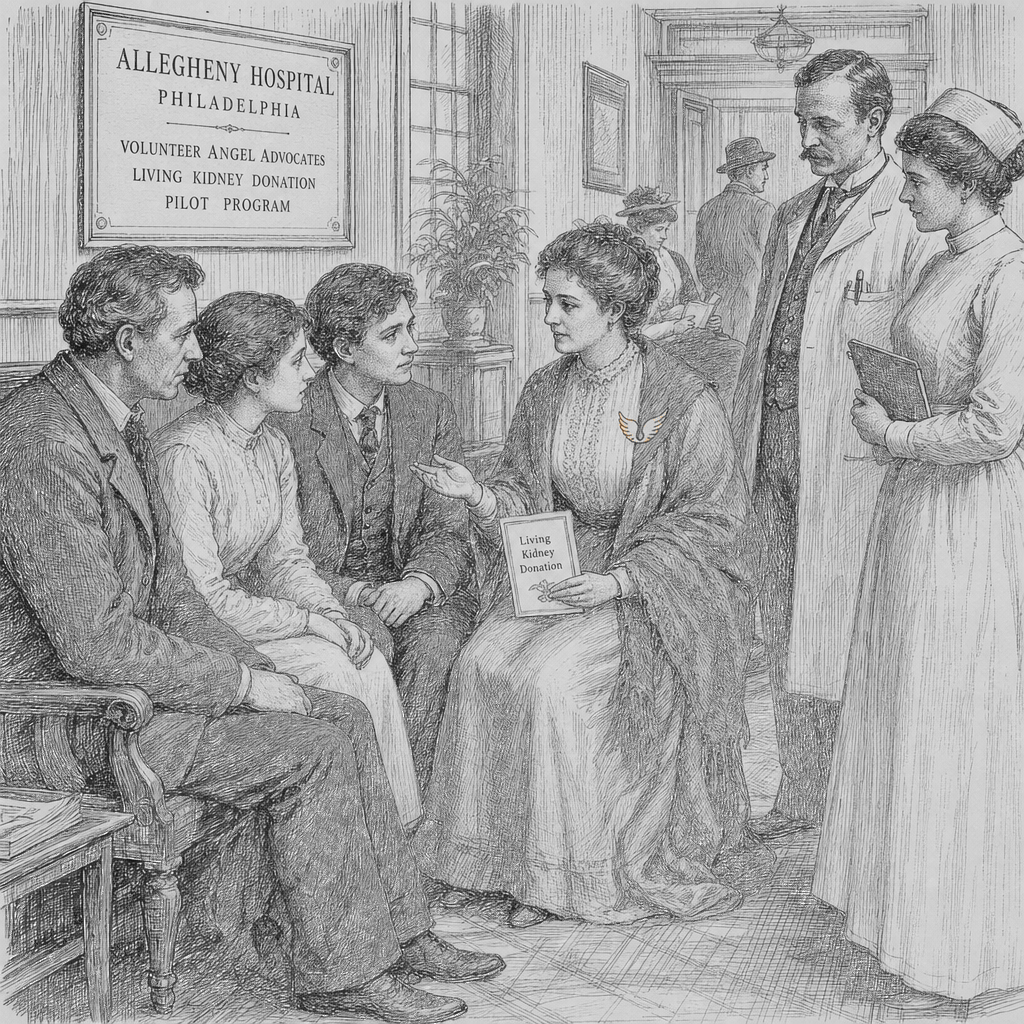
HARRISBURG, Pa. — A pilot program at three Pennsylvania hospitals is testing whether volunteer strangers — dubbed “angel advocates” — can use their own social media networks to help kidney patients with limited social connections find living donors.
The Great Social Experiment, founded by Los Angeles filmmaker David Krissman, launched in May 2025 with 15 patients at Temple University Hospital, UPMC-Harrisburg and Jefferson University Hospital in Philadelphia. The Gift of Life Donor Program’s foundation backed the effort with a grant of more than $100,000.
Early results show at least three patients have found donors. Two of five Temple patients have found living donors, with one preparing for surgery, according to Ryan Ihlenfeldt, the hospital’s director of clinical transplant services. One of five UPMC-Harrisburg patients has already received a transplant.
“This is the first of its kind that I’m aware of,” said Richard Hasz Jr., chief executive of the Gift of Life Donor Program. “That’s why, I think, the foundation was so interested in doing it — studying it and hopefully publishing it — so we can create that blueprint, if you will, for the future.”
The scale of the shortage
About 90,000 people in the United States are on a waiting list for a kidney transplant. Of roughly 28,000 kidneys transplanted last year, most came from deceased donors; about 6,400 came from living donors. Thousands of people die each year waiting.
Living donor kidneys offer advantages: they can be a better immunological match, allow the transplant team to plan surgery timing, and tend to last longer on average, according to the Gift of Life foundation.
“We know that patients who are waiting don’t always have the energy or the resources to do this themselves,” Hasz said.
How the program works
Krissman and his team produce videos and other materials to spread each patient’s story across social platforms, combining that outreach with efforts to mobilize the patient’s existing connections.
“Most patients are too sick to do this on their own — many don’t have the skills to do it on their own,” Krissman said.
The approach grew from Krissman’s own experience with debilitating illness about two decades ago. After producing a podcast on kidney transplantation, he recruited four patients through Facebook and helped two of them find donors. A subsequent pilot in North Carolina with three patients — which concluded last year — matched all three with living donors.
Angel advocates are unpaid volunteers who share patients’ stories through their own networks. Francis Beaumier, a 38-year-old information technology worker from Green Bay, Wisconsin, joined as an angel advocate after previously donating a kidney and part of his liver. He called the program “a great little way for everyone to make a small difference.”
Holly Armstrong, who lives in Lake Wiley, South Carolina, also serves as an angel advocate following her own experience as a living donor. “Some people might just keep scrolling,” Armstrong said. “But there might be someone like me, where they stop scrolling and say, ‘This boy needs a kidney.’”
Patients still seeking matches
Fernando Moreno, a 50-year-old truck driver from Vineland, New Jersey, has been on dialysis for about two years. His father died of kidney failure at 65. After the Philadelphia hospital where he receives treatment connected him with the program, Moreno said the angel advocate approach has given him renewed optimism.
“This process is great,” Moreno said. “I’m just hoping there will be somebody out there that’s willing to take a chance.”
Ahmad Collins, also 50, is a city government worker and former Penn State linebacker who has needed 10 hours of dialysis each night since a medical procedure left him with damaged kidneys. At a kickoff event in Harrisburg, he described what an advocate could mean to a patient.
“They can be a superhero, so to speak,” Collins said. “They can have the opportunity to save somebody’s life, and not too many times in life do you have that opportunity.”
Donor surgical risk declining
A study released last year tracked 30 years of living kidney donations and found fewer than 1 in every 10,000 donors died within three months of surgery — down from a previous rate of 3 deaths per 10,000. Researchers credited newer and safer surgical techniques for the improvement.
The National Kidney Foundation requires living donors to be at least 18 years old, though some transplant centers set the minimum at 21. Potential donors are screened and can be disqualified for uncontrolled high blood pressure, diabetes, cancer or smoking.
Becca Brown, director of transplant services at UPMC-Harrisburg, said she sees broader potential in the model.
“There’s potential for this to really snowball,” Brown said. “I’m anxious to see what happens and if we can roll it out to other patients.”