-
-
Summary
-
- Subtype: fact
-
- Article presents significant development with named actors and concrete outcomes.
- A Minneapolis Lutheran church …
-
Sessions in the sanctuary
- About 30 congregants attended the first well-being session in March, according to the Rev. Hierald Osorto.
Sessions in the sanctuary
About 30 congregants attended the first well-being session in March, according to the Rev. Hierald Osorto.
“It was as if they were able to exhale a big breath,” Osorto said of that response.
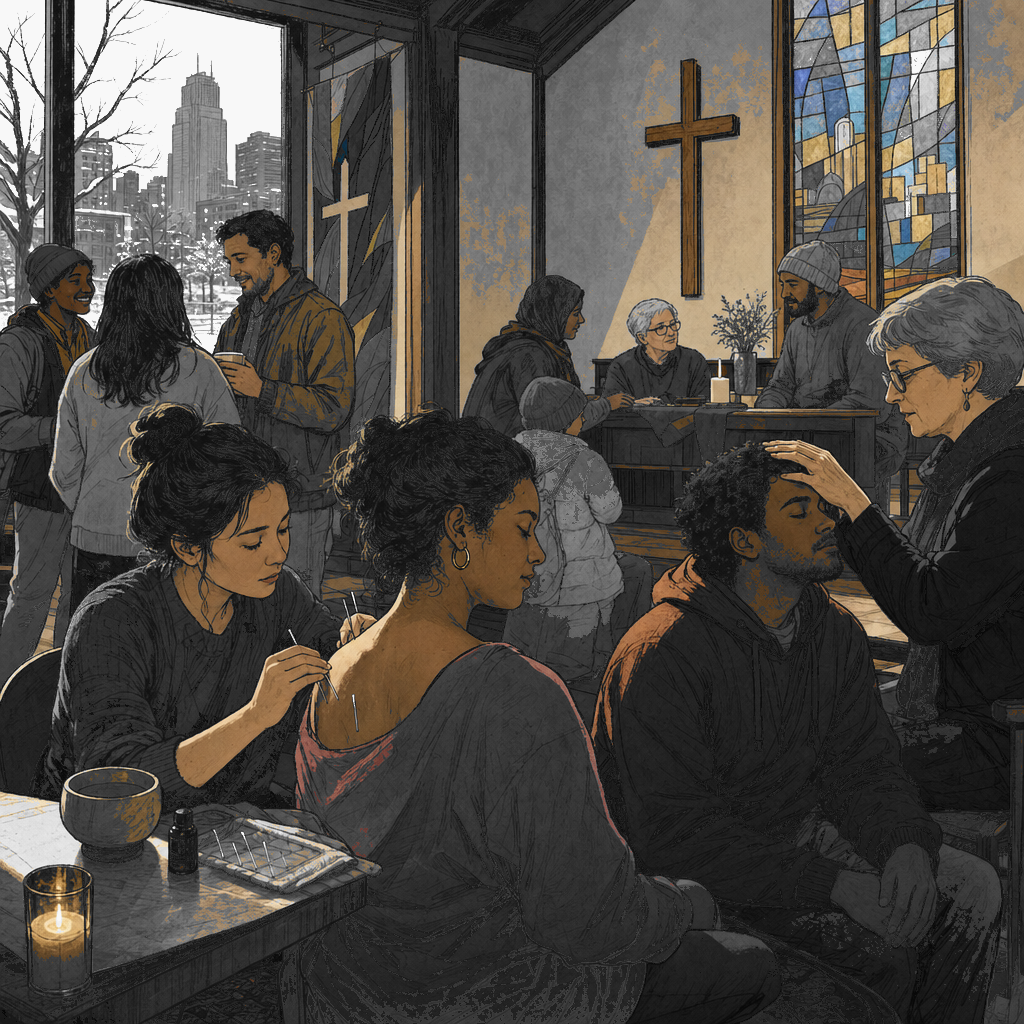
At a recent session, the altar table and Easter lilies were moved aside to accommodate seven acupuncture chairs arranged in a circle facing the central cross. Three massage tables placed before the pews served Reiki clients, with practitioners positioning their hands on or near the body’s energy centers.
“To see this space be quite literally a place of healing, in the place where we talk about it right at the altar, it moved me to tears,” Osorto said.
The church organized the sessions through a partnership with Odigo Wellness. Guadalupe Gonzalez, a bilingual Reiki practitioner with that organization, said she had initial reservations about working in a large open space with light flooding in and people moving through.
“But the sanctuary has a very nice, very positive energy,” Gonzalez said. “As practitioners we feel a lot of emotions.”
Gonzalez described a spirit she encounters among those seeking the sessions: “People feel hopeless, but they have to keep fighting.”
Congregants’ accounts
Lizete Vega, the church’s family engagement coordinator, said the program responds to a need she sees throughout the congregation.
“We have to feel well to respond well, not with panic and fear, which leads to nothing good,” Vega said. “People here feel that they’re protected and can be cared for spiritually, emotionally and physically.”
Several congregants who attended a recent two-hour session described similar experiences. Martha Dominguez, a Mexican immigrant, said she had never imagined a church would provide such services.
“Yes, it helps so much,” Dominguez said. “It takes the stress away from you.”
Limber Saliero, a roofer from Ecuador who has worshipped at St. Paul’s for more than a year, said he had not heard of acupuncture before the session.
“I felt like an energy that was flowing into me,” he said.
Vanessa Arcos attended with her sister and father for acupuncture, while her mother received Reiki. The Arcos family began attending the church the week they arrived in Minnesota from their home state of Guerrero, Mexico, almost a decade ago.
“It felt very peaceful, very safe,” Arcos said. “It’s important to do little things for yourself.”
Broader mental health context
Wellness practitioners and mental health clinicians say anxiety and depression among those they serve in migrant communities have spread and intensified in 2025, the Associated Press reported.
Migrants frequently arrive carrying severe trauma from violence in their home countries as well as dangers encountered along routes to and through the U.S. border, practitioners say. Fear of deportation compounds that prior trauma, said Noeline Maldonado, executive director of The Healing Center in Brooklyn, New York, which serves domestic and sexual violence victims. That fear makes safe spaces for wellness work essential, she said.
Cheryl Aguilar, director of Hope Center for Wellness in the Washington, D.C., area, said her organization has partnered with churches to provide mental health programs. Ongoing shifts in immigration policy are central to the stress her clients experience, she said.
“Uncertainty is the biggest thing,” Aguilar said.
Sarah Howell, a clinical social worker in Houston with more than a decade of experience in migration-related trauma, described the pace in unambiguous terms.
“It’s nonstop work, nonstop fear,” Howell said. “Every issue seems bigger.”
Howell said many of her Texas clients are recognizing they cannot sustain a state of constant alarm, making the respite offered by wellness programs increasingly essential to their functioning.
Revised federal immigration guidelines now reportedly provide more leeway for enforcement in or near houses of worship, according to the Associated Press — a development that has heightened anxiety in faith communities that have historically offered refuge to immigrants. St. Paul’s has continued to expand its services in response, adding the wellness sessions alongside existing humanitarian, financial, legal, and pastoral ministries.
An outdoor mural at the church shows two traditional Swedish Dala horses flanked by the Spanish words “sanación” — healing — and “resiliencia” — resilience.