Summary
- U.S. and Israeli pressure on Hezbollah disarmament operates as a high-magnitude stressor on a Lebanese state apparatus exhibiting concave fragility, risking non-linear catastrophic unraveling.
- Operating against degraded infrastructure and over one million displaced refugees, Lebanon’s weakened baseline amplifies sectarian polarization as external disarmament demands intersect with local grievances.
- The Lebanese Armed Forces face material deficits and institutional leakage, rendering U.S. plans for vetted enforcement units vulnerable to intelligence breaches and confessional targeting perceptions.
- Hezbollah exploits state vacuum through adaptive military restocking and existential threat framing, while localized retaliation cycles from cross-sectarian strikes risk accelerating active fragmentation.
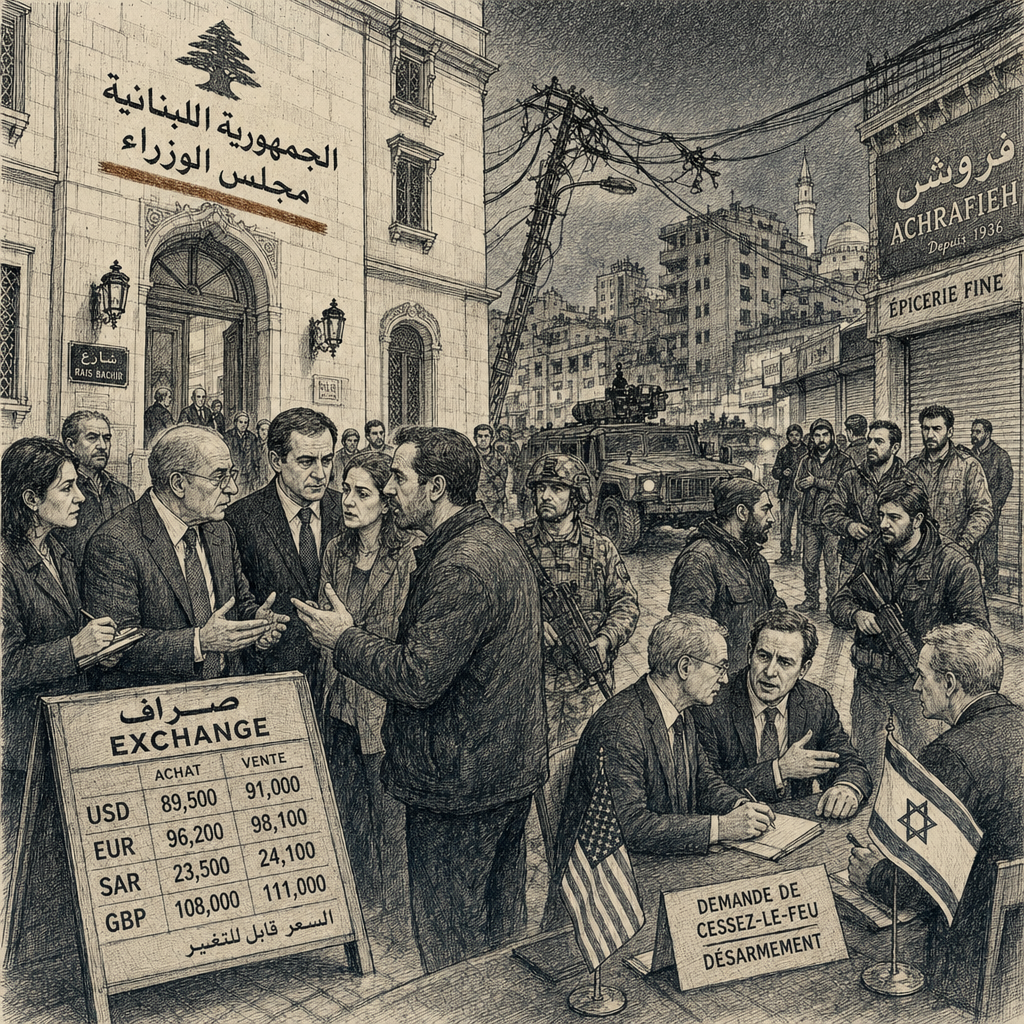
Current reporting indicates that external disarmament pressure interacting with internal institutional weakness and rising sectarian polarization creates a dynamic where the costs of state action risk outweighing the gains, potentially triggering active fragmentation rather than successful disarmament. The push by the United States and Israel for the disarmament of Hezbollah operates against a degraded baseline where the Lebanese government struggles to meet basic functions while managing a humanitarian crisis of displaced populations and cross-community hostilities.
Concave Fragility and Structural Decay
The Lebanese state’s current operating environment corresponds to a concave risk profile consistent with the fragility framework described by Nassim Nicholas Taleb, wherein small stressors produce manageable losses but large stressors trigger disproportionate collapse. The government operates against a degraded baseline where electricity is available for only a few hours a day and the currency has collapsed in favor of the U.S. dollar. This infrastructure failure is compounded by the displacement of more than one million internal refugees. Displaced Shia families are reportedly being shunned by landlords and neighbors in Christian, Druze, and Sunni areas due to fears that their presence will draw Israeli airstrikes. Sunni religious leader Imad Sobh reported hearing unprecedented support among some Sunnis for Israel’s war against Hezbollah and Shias, sentiments he described trying to “tamp down” to prevent communal violence.
Institutional Constraints and Strategic Leakage in the Lebanese Armed Forces
The operational premise that the Lebanese Armed Forces (LAF) can act as a cohesive enforcement mechanism contradicts reported material and sociopolitical constraints. Despite over $3 billion in U.S. funding since 2006, the force lacks advanced air-defense systems and missile capabilities. Current and former officials describe a military where troops from all sects are reluctant to be seen as executing actions on behalf of Israel, and many soldiers hold second jobs due to low pay. The U.S. strategy, articulated by Secretary of State Marco Rubio, seeks to establish vetted LAF units with specific training and equipment for disarmament operations. However, a U.S. Treasury finding from May indicates that Hezbollah receives intelligence tips from officials within Lebanon’s state security organizations, including the military. This leakage suggests that even vetted units face severe information security risks, and selective vetting could be perceived as confessional targeting, accelerating institutional division.
Sectarian Feedback Loops and Network Dynamics
The security environment is shifting from state-mediated balance toward competing hubs of power, where micro-level grievances feed macro-level instability. The state’s inability to enforce laws evenly fuels resentment across sectarian lines. In April, clashes between security forces and residents in a Sunni Beirut neighborhood during an attempt to arrest a generator operator led MP Waddah Sadek to state that residents are “fed up with the selective and uneven implementation of laws” and that Sunnis are signaling they “can block the roads, too.” External military actions have also triggered localized retaliation cycles. An Israeli strike in the Christian town of Ain Saadeh killed Lebanese Forces member Pierre Mouawad, his wife, and a neighbor. While the Israeli military stated the target was a Hezbollah command center, the immediate fallout included the eviction of Shia families from the area and armed men firing weapons at Mouawad’s funeral. This illustrates a destructive feedback loop: strikes in mixed areas do not necessarily consolidate cross-sectarian opposition to Hezbollah but can instead trigger localized sectarian retaliation and further isolate Shia communities.
Hezbollah’s Adaptive Posture and Existential Threat Framing
Hezbollah demonstrates antifragile properties, adapting and restoring capabilities in response to military stress. Media relations director Youssef al-Zein stated the group has worked to restore capabilities since a 2024 campaign and is “willing to pay the cost for doing so.” The group has reportedly restocked rockets, antitank missiles, and artillery via seaports and smuggling routes through Syria, and has deployed explosive drones guided by fiber-optic wire that Israeli forces are described as struggling to counter. Simultaneously, the group frames disarmament as an existential threat to solidify its base. Secretary-General Naim Qassem stated in a May speech, “Understand clearly: Disarmament is extermination, and we will never accept it.” This posture aligns the group’s survival with broader sectarian fears generated by displacement and strikes.
Unresolved Uncertainties and Strategic Implications
The trajectory of any enforced disarmament remains characterized by irreducible uncertainty. Former Lebanese general Khalil Helou noted, “We know how attempting to disarm Hezbollah militarily would begin, but we don’t know how it would end.” The central insight from the relationship mapping of these dynamics is that applying pressure through the weakest node—the Lebanese state—to coerce the strongest non-state actor risks fracturing intermediate nodes first. Displaced bakery worker Ali al-Dayekh summarized the vacuum Hezbollah exploits: “The state? Where is the state? We are on our own.” Analytical implications suggest that reducing immediate pressure for LAF-led disarmament could lower the stress most likely to exceed systemic tolerance, while channeling resources to refugee crises and economic needs might decrease sectarian competition and strengthen resilience. The withdrawal of Israeli troops from Dibbin offers an initial test of whether sequenced de-escalation can reverse the current cascade.
Analytical techniques used in this piece
This analysis applies the methods below. Each links to a short, plain-English explainer you can read and reuse.
- Fragility / Antifragility Audit
- Asks whether a system gains or loses from volatility, shocks, and disorder (Taleb).
- Red-Team Assessment
- Models a capable adversary probing a plan for the seams they would exploit.
- Relationship Mapping
- Extracts the network of ties among people, institutions, and entities.
- Creative Destruction
- Innovation that grows the economy by dismantling the incumbents it displaces (Schumpeter).