Summary
- Iran fires missile salvos at Israel following an Israeli airstrike that targets a Beirut Hezbollah command center.
- Conditional ceasefire architectures generate structural contestability that allows alleged treaty breaches to predicate kinetic escalation.
- Thomas Schelling’s deterrence framework explains how proxy strikes trigger direct state responses that preserve alliance credibility.
- Coordinated military signaling across air and maritime theaters links regional conflict dynamics with global energy market leverage.
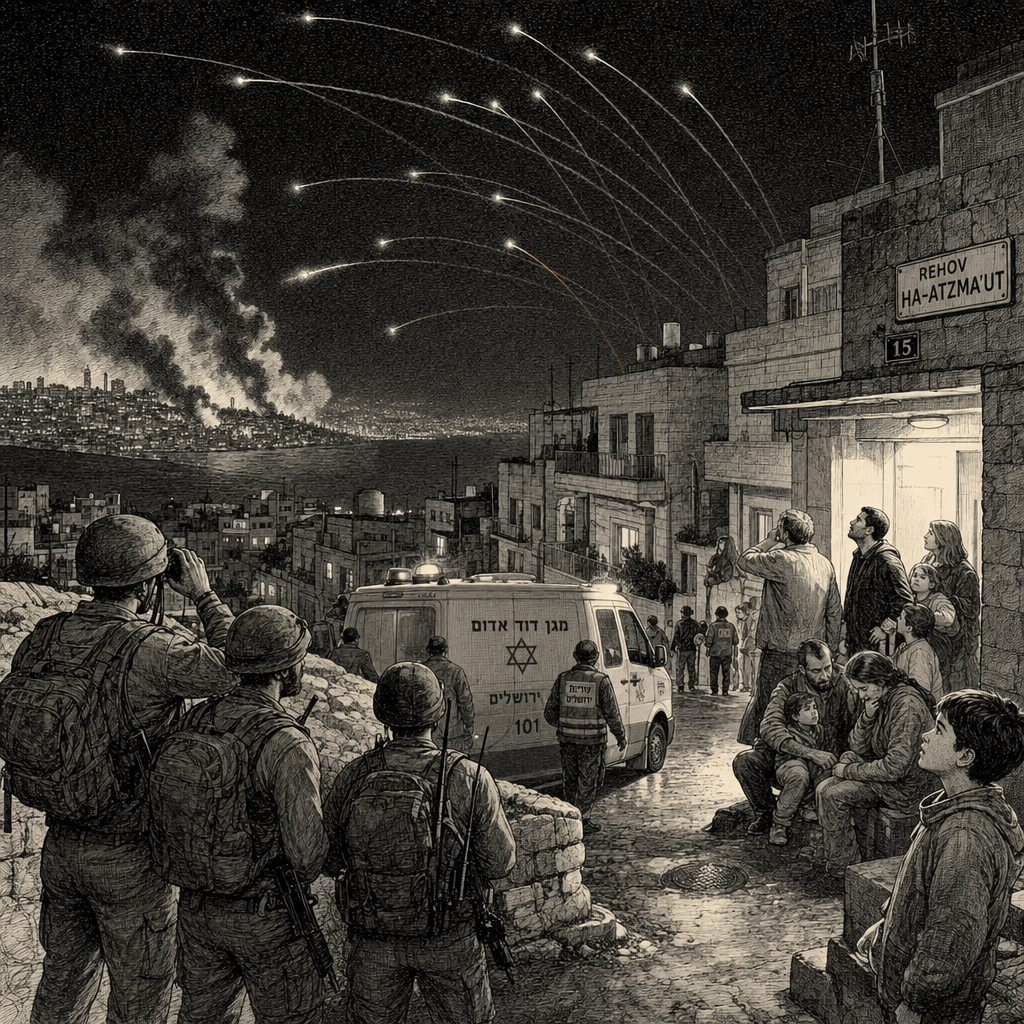
Iran launches at least three distinct waves of missiles toward Israel on June 7, 2026, after an Israeli airstrike targets a Hezbollah command center in Beirut’s southern suburbs, according to statements from Israel’s defense establishment and The Wall Street Journal. Israeli air defenses intercept the incoming projectiles without reported injuries, while the earlier strike kills two people and wounds twenty, Lebanon’s health ministry reports. The exchange occurs despite active April 2026 U.S.-Iran and recent Israel-Lebanon ceasefire frameworks, indicating that conditional truce architectures generate structural contestability where each side alleges prior breach to justify kinetic responses. The sequence demonstrates how calibrated military signaling and cross-theater economic coercion operate simultaneously to test established deterrence boundaries without immediately triggering broader war.
Chronological Sequence & Immediate Aftermath
On June 7, 2026, Israel conducts an airstrike in Beirut’s southern suburbs targeting what Prime Minister Benjamin Netanyahu identifies as a Hezbollah command center. The strike results in two deaths and twenty wounded, according to Lebanon’s health ministry. Israel’s military states the operation responds to Hezbollah rockets fired into northern Israel, which Israeli air defenses intercept without reported damage. Subsequently, Iran launches at least three distinct waves of missiles toward Israel. Israeli air defenses intercept all incoming projectiles, and authorities report zero injuries resulting from the Iranian strikes. Following the missile attacks, Israel announces the suspension of schools across the country, signaling anticipation that hostilities may continue. The Israel Airports Authority confirms that normal commercial activity persists at Ben Gurion International Airport. Prior to the kinetic exchange, unnamed Iranian officials reportedly tell The Wall Street Journal they have vowed a “decisive and painful response” to ongoing Israeli operations inside Beirut.
Ceasefire Architecture & Conditional Violations
The kinetic exchange unfolds despite the existence of two sequenced, U.S.-brokered or endorsed truces: an April 2026 ceasefire between the United States and Iran, and a more recent Israel-Lebanon agreement. Terms of the Israel-Lebanon truce, reported by The Wall Street Journal, condition an Israeli pledge not to strike Beirut on Hezbollah’s cessation of attacks against Israel proper. The conditional architecture of these truces introduces structural contestability; alleged violations on one side provide the predicate for kinetic responses, such as the Beirut strike, which subsequently trigger broader escalations including Iranian missile salvos. Senior officials in Tehran, who have sought a halt to Israeli military operations inside Lebanon as part of broader peace negotiations with Washington, oversee military actions that proceed despite the active U.S.-Iran ceasefire. This sequence highlights how conditional agreements generate overlapping claims of breach, allowing multiple actors to frame offensive operations as retaliatory compliance measures.
Strategic Frameworks & Deterrence Dynamics
The observed sequence aligns with Thomas Schelling’s deterrence framework, demonstrating a calibrated action-reaction pattern wherein strikes on proxy command structures trigger direct state-level responses intended to preserve alliance credibility and test established truce boundaries. Iran’s public justification operationalizes Alexander George’s coercive diplomacy theory by conflating kinetic pressure in the Levant with economic chokepoint coercion at the Strait of Hormuz. Tehran treats air and maritime theaters as interconnected bargaining spaces rather than isolated military domains. The Strait of Hormuz serves as a critical artery for global oil exports; invoking a blockade in this corridor threatens international energy markets and amplifies Tehran’s leverage in broader ceasefire negotiations. The dependency structure reflects Robert Jervis’s security dilemma, wherein rules designed to manage risk instead generate new vectors for perceived threat, enabling each state to plausibly claim the opposing side breached the truce first. Concurrently, U.S. Central Command publishes a video on Sunday featuring American fighter jets accompanied by the statement, “U.S. forces across the Middle East remain vigilant and ready.” This messaging operates within recognized traditions of forward-deployed power projection intended to shape adversary risk calculations during periods of heightened alert.
Escalation Management & Regional Signaling
Mohammad-Bagher Ghalibaf, identified as Iran’s top negotiator, states that the “U.S. blockade of the Strait of Hormuz and what he described as the U.S. green light for the Israeli strike in Lebanon” transform American and Israeli regional assets into legitimate targets. The Israeli prime minister’s office and the White House decline to respond to media requests for comment regarding whether U.S. authorities approved the Beirut strike, according to The Wall Street Journal. The absence of casualties from the intercepted Iranian missile waves, paired with controlled domestic infrastructure adjustments within Israel, indicates both states are operating within parameters designed to test defensive thresholds and political resolve without initiating total war. Available reporting distinguishes between strategic signaling and kinetic escalation, leaving formal questions of proportionality unaddressed by official public statements. Historical patterns observed in comparable regional military episodes suggest such controlled exchanges frequently function as renegotiation mechanisms for the underlying terms of engagement between competing state and non-state actors.
Analytical techniques used in this piece
This analysis applies the methods below. Each links to a short, plain-English explainer you can read and reuse.
- Domain Induction
- Builds a working mental model of a domain from the ground up.
- Quick Orientation
- A fast lay-of-the-land read of an unfamiliar domain.