Summary
- Israel, Hezbollah, the United States, and Iran sustain military pressure under formal ceasefire frameworks to secure territorial control, leverage negotiations, and maintain political narratives without triggering full-scale war.
- Ongoing low-intensity violence, buffer-zone expansion, and mutual maritime blockades institutionalize chronic civilian displacement and degrade the diplomatic utility of future truce agreements.
- Differential analysis suggests the ceasefires have evolved into structural equilibria that prioritize strategic attrition and operational cover, while spatial transformations in Gaza, Lebanon, and the Strait of Hormuz lock the region into a managed-conflict geometry.
- Diagnostic incidents will determine whether sub-state spoiler dynamics or deliberate territorial reconfiguration primarily drive the permanent armed non-peace across the region.
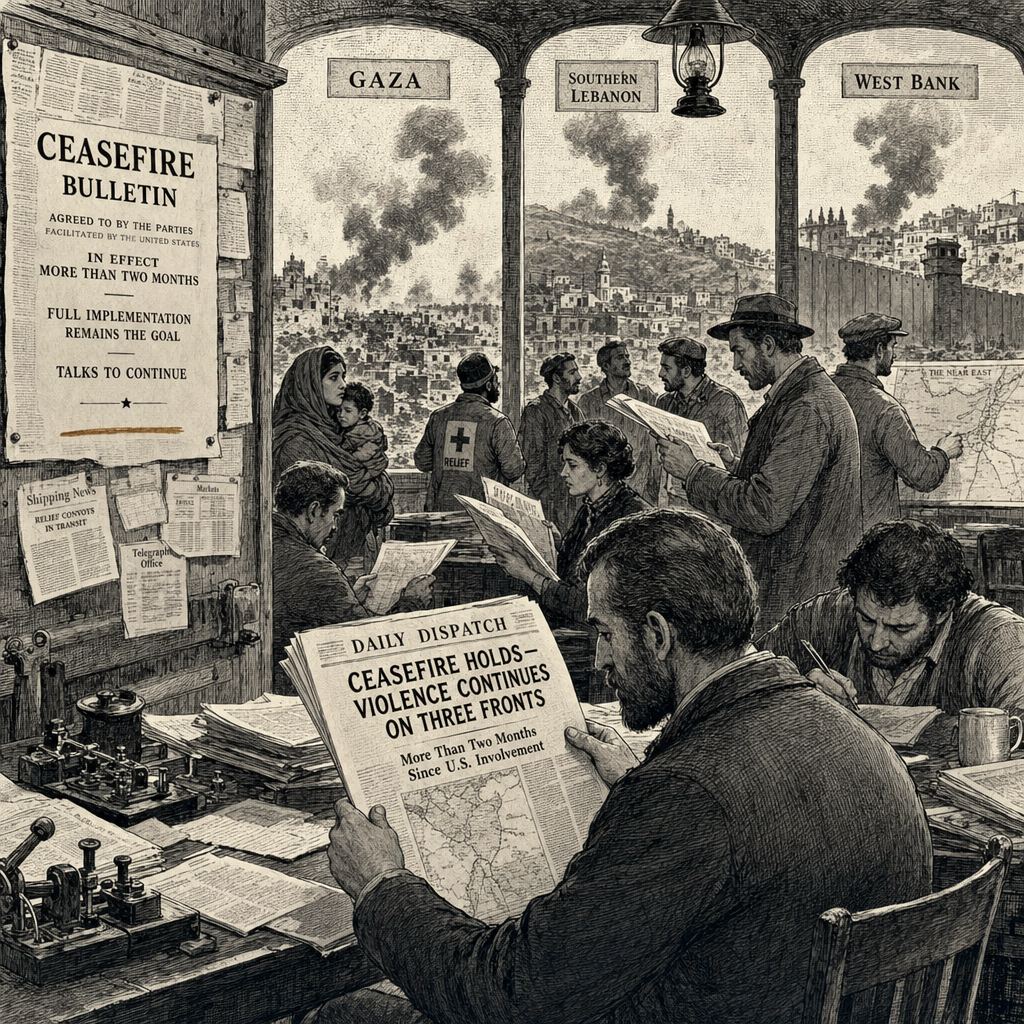
How you frame a ceasefire determines what you expect next. Is it a pause toward negotiated settlement, or infrastructure for permanent conflict? A Wall Street Journal assessment published June 3 examines three ceasefires—in Gaza, Lebanon, and the Strait of Hormuz—and finds evidence that they function more as permanent structures for sustained military pressure than as temporary pauses toward resolution.
The reporting indicates that in all three zones, the truces enable sustained military engagement that advances territorial control and negotiating leverage while staying beneath full-scale war. The visible consequence is immediate. According to Lebanese health authorities, more than 3,000 people have been killed in Lebanon since March and over one million displaced. Palestinian health authorities report hundreds of Palestinians have been killed in Gaza since the ceasefire took effect, and humanitarian conditions remain severe. The pattern is consistent across all three theaters: the peak death tolls of open war have transformed into chronic low-intensity killing, displacement persists, and military positions supposed to be temporary now feel durable.
This matters because once a ceasefire hardens into geography—a buffer zone that stays, a border that shifts, a blockade that holds—it becomes difficult to undo. The diplomatic utility of future truces declines as participants learn that ceasefires can be exploited for territorial advantage without triggering collapse. Mediators lose credibility. The accumulation of military infrastructure—buffer zones, naval positioning, missile emplacements—creates tension where short-term tactical leverage permanently alters borders. Analysts note this dynamic transforms contested sovereignty into partitioned militarized zones, making a return to pre-conflict boundaries improbable and turning temporary truces into de facto territorial division.
The cascading effects—spanning casualties, market distortion, and entrenchment of ungovernable territories—present a medium-term trajectory toward institutionalized armed non-peace. The available evidence suggests these structural shifts will not self-correct, locking the region into a managed-conflict geometry resistant to comprehensive settlement.
What the Truces Enable
The persistent low-intensity violence delivers distinct advantages to each major actor. In Gaza, Israel conducts targeted operations against Hamas militants under the cover of a ceasefire, avoiding the domestic and international political costs of full-scale war. The framework permitted the recent killing of Hamas military chief Mohammed Odeh, less than two weeks after the death of his predecessor. Simultaneously, Israel deepens territorial control within the enclave, expanding into areas previously held by Hamas and reconfiguring the operational landscape to favor the stronger military actor.
In Lebanon, Hezbollah sustains political standing through a strategy framed as a defensive response to Israeli incursions. By launching explosive drones at Israeli military positions and northern communities, the group strengthens its resistance narrative, which analysts indicate undermines the authority of Lebanon’s fragile central government. Israel responds with expanded airstrikes and consolidation of a buffer zone along the border, creating a permanent spatial fact that secures its military advantage. The sustained violence fuels continuous recruitment cycles for non-state armed groups, providing the manpower required to maintain the resistance posture.
In the maritime theater, both the United States and Iran derive strategic leverage from the enforced impasse. Iran utilizes its control over the Strait of Hormuz to maintain elevated global oil prices and restrict shipping passage, while the United States blocks Iranian vessels from accessing ports. The Wall Street Journal reported that despite recent clashes—including Iranian ballistic missile strikes on U.S. bases in Bahrain and Kuwait, and U.S. attacks on an Iranian military control station and an oil tanker—Washington and Tehran appear eager to avoid a return to full-scale war. The mutual blockade embeds the conflict into global energy and logistics networks, functioning as a preferred equilibrium for actors seeking to sustain pressure without incurring the total costs of declared warfare.
Why the Violence Persists
Multiple hypotheses account for the ongoing hostilities under the truces. One hypothesis holds that the stronger military actor exploits the ceasefire to conduct targeted operations under a defensive frame, producing asymmetric violation patterns. A competing hypothesis suggests the violence serves as strategic pressure designed by both sides to extract concessions without returning to total war; this aligns with official characterizations of recent actions as “limited and defensive” and coincides with ongoing negotiations over maritime access and nuclear sanctions.
A third hypothesis attributes the escalation to sub-state spoilers—such as Hezbollah military wings or Hamas factions—driving tit-for-tat cycles that central governments do not fully control, which would produce symmetric patterns of engagement. The hypothesis that ceasefires lack independent monitoring, verification, and sanctioning capacity appears less diagnostic in this context. Observed violations are concentrated in specific corridors and synchronized with political objectives rather than distributed randomly.
An alternative reading suggests the ceasefires were either designed to function as, or have evolutionarily become, permanent liminal states—a structural equilibrium that serves as a preferred mechanism to sustain military pressure without the political and economic burdens of full-scale war. This interpretation is supported by the absence of escalation to pre-ceasefire intensity and is compatible with the observed territorial reconfiguration and blockade entrenchment. A sixth hypothesis maintains that gradual de-escalation remains plausible, framing current violence as a necessary step-down from open war that may decay into stable peace absent new triggers, though the scale of displacement and newly established territorial controls complicate this trajectory.
Diagnostic conclusions diverge among analysts. One reading finds the evidence best supports a hybrid of sub-state spoiler dynamics and structural equilibrium, with enforcement incapacity acting as an enabling condition. Another assigns the highest explanatory weight to strategic attrition for leverage combined with operational definition mismatches as the primary drivers of persistent violence. The reporting indicates that future incidents will serve as diagnostic indicators: an Israeli strike targeting a Hezbollah political figure would support the exploitation hypothesis, a coordinated Hezbollah rocket barrage deep into Israeli cities would favor spoiler-driven spiral analysis, and an attack on a civilian vessel unflagged by either side would point toward ungoverned chaos.
Physical Territory Sustains the Conflict
How territory is reorganized shapes what comes next. When a ceasefire produces geographic configurations that favor one party’s security through surveillance, buffer zones, or blockades at the direct expense of the other’s spatial and psychological integrity, the arrangement itself generates the friction required to justify its perpetuation.
In the Strait of Hormuz, the waterway functions as an absolute maritime choke point with no viable detour. Ordinary passage is subordinated to military posture, transforming the nominal ceasefire into a codified alert status. Along the Israeli-Lebanese border, the buffer zone constructs a new hard edge that interrupts geographic and social continuity. This spatial intervention fragments the mental maps of inhabitants, violates established intimacy gradients in border communities, and through the displacement of over one million people produces a severing of intimate domestic spaces that renders the resulting architecture of exclusion geographically durable. In Gaza, the environmental conditions eliminate restorative properties of space. The prevailing local spatial character is one of suspended emergency, foreclosing any sense of intimate immensity and trapping the civilian population in a state focused purely on bodily survival.
The accretion of these spatial fractures across all three theaters suggests that the physical and psychological environments have been fundamentally altered in a manner that sustains the conflict independently of diplomatic negotiations. Any future political agreement failing to rebuild foundational spatial qualities—prospect, refuge, gradation, and enclosure—will be experienced by inhabitants as an operational extension of war.
This is a Main Street Independent analysis: it examines how a story is told — its sources, its words, and what it leaves out — not whether the facts are in dispute. It makes no claim about anyone’s intent.
Analytical techniques used in this piece
This analysis applies the methods below. Each links to a short, plain-English explainer you can read and reuse.
- Consequences & Sequels
- Plays a decision forward to its first- and second-order consequences.
- Differential Diagnosis
- Lists the candidate explanations for a symptom and rules them out one by one.
- Genius Loci — Sense of Place
- Reads the character and felt quality of a place.