
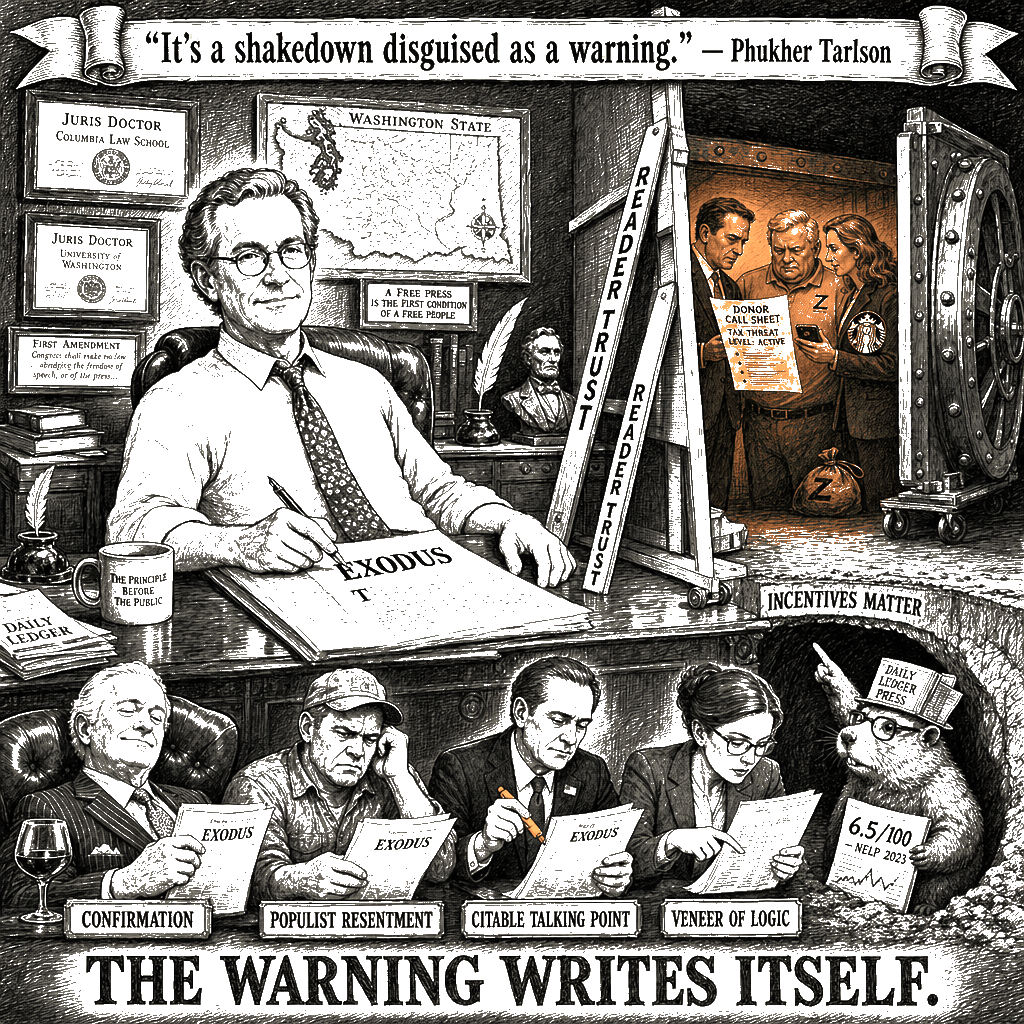
James Freeman is running a donor-class propaganda campaign to kill Washington’s millionaire tax. His Wall Street Journal column, published June 8, 2026, takes a levy that will not take effect until 2028 and declares it already destroying the state economy. The piece assembles the standard toolkit—anecdote, euphemism, threat-inflation, selective reading of government documents—and deploys them in the familiar rhythm of the editorial page’s four-audience machine. I built versions of this narrative apparatus during my cable years. This column walks through the piece as it appears, naming each technique as it hits the page.
The state of Washington’s misguided new millionaire’s tax isn’t due to take effect until 2028. But already the new exaction seems to be succeeding wildly at proving that incentives matter. Many of Washington’s most successful people keep relocating to states without income taxes. — opening paragraph
“Misguided” and “exaction” are the relabeling—the same referent as “a tax on income above one million dollars” arrives pre-framed as an affliction and a punishment. The Journal editorial page’s signature move, frame-engineered relabeling (WSJ §4.1), opens the piece as it opens hundreds of others: the preferred term constructs a moral universe in which the donor class’s preferred rates are baseline-virtuous and any deviation is deviant.
Then the threat-inflation: the tax, not yet in effect, is already “succeeding wildly” at driving people out. The claim is unsupported, but the sentence shape delivers the conclusion—incentives matter, the tax is failing—before the reader has seen a single piece of verifiable evidence. In the cable years we called this loading the dock: put the freight on the frame before the audience sees the truck. The operator’s trick is to state the scare headline as established fact inside the first breath, so the rest of the column feels like documentation rather than assertion.
Freeman is speaking to all four of the page’s audience layers simultaneously—the multiple-audience-targeting analytic (WSJ §4.3). The wealthy reader hears confirmation that the tax is driving away her peers and is therefore illegitimate. The populist base hears that Democrats are punishing success. The political class gets a citable line for the next donor briefing. The technocratic class gets the veneer of economic logic—incentives matter. Four distinct messages in one sentence. The craft is real, and so is the function.
And the heavier lift here is the causal inversion. The tax does not take effect until 2028. The piece claims the exodus is already happening because the political signal has been sent. Operators call this front-running the regulatory environment, and it is a standard play: declare the population fleeing before the policy exists to manufacture a self-fulfilling prophecy. The piece confuses political posturing with macroeconomic reality. Washington’s own revenue modeling projects the levy will collect approximately $3.5 billion to $4.5 billion annually from the top bracket—funding school meals, childcare, and family tax credits—a figure the column buries beneath its panic.
Now Rich Barton, co-founder of the real-estate website Zillow, posts on X: “Viva Las Vegas! Who wouldn’t be excited to go where achievement is welcomed rather than punished?” Not that we should always expect a detailed explanation of the barriers the state of Washington and the city of Seattle have lately been erecting in the way of entrepreneurs. — second paragraph
A single tweet from a billionaire relocating to a no-income-tax state is presented as evidence of a systemic exodus. This is the anecdote-as-trend move—the hasty generalization (Bad-Faith Catalog: hasty_generalization) in which the vivid single case does the persuasive work the missing denominator would undo. We don’t get migration numbers. We don’t get net inflows by income bracket. We don’t get the base rate of millionaires leaving Washington before the tax was proposed. We get a tweet from a Zillow co-founder and a Vegas cheer.
The operator’s-eye view on this is straightforward: we used to drop a single tech-founder anecdote into every newsletter because it tested better with the donor class than aggregate state-GDP data. It tests better because it feels personal, but the move relies on the reader’s inability to distinguish between an individual optimizing his personal tax jurisdiction and systemic capital flight. The piece treats them as the same thing. That is the graft.
And “where achievement is welcomed rather than punished” is the donor class’s own euphemism. Paying a 9.9% tax on the portion of income above $1 million is renamed punishment, as if the schools, roads, and courts that made Zillow possible were a gift freely given. The technique is Bandura’s moral justification: tax avoidance becomes a defense of achievement against an ungrateful state. I built versions of this exact move for cable hits—the trick is to name the ask as an attack so the refusal feels noble instead of selfish.
In a recent Journal op-ed, new Florida resident and former Starbucks CEO Howard Schultz wrote that his “decision to leave had much to do with family choices and my stage of life.” Mr. Schultz then proceeded to explain how hostile to growth state and local policymakers in Washington have been lately. Starbucks for its part has been expanding its corporate footprint in Tennessee, another state that is sensible enough to avoid income taxes. — third paragraph
Schultz’s own words say the move was about family and life stage. Freeman acknowledges that, then immediately uses the Schultz anecdote as if the hostile-to-growth talking point were the real reason. I drafted op-seeds using this exact bait-and-switch for a decade: let the subject offer a polite, personal reason for a corporate move, then overwrite it with the ideological payload in the very next sentence. The Journal gives the reader both the human-interest cover story and the partisan frame, trusting the reader to absorb the partisan frame and discard the personal one.
The structure is a motte-and-bailey (Bad-Faith Catalog: motte_and_bailey): the defensible claim is “Schultz left for personal reasons”; the controversial claim is “Washington’s tax policy is driving away entrepreneurs.” The bailey is advanced through the Schultz citation; the motte is the family-and-life-stage line, available if challenged. This structural ambiguity is what makes the technique operationally resilient—it provides plausible deniability while loading the headline frame. Schultz is a founder who moved years ago for entirely different reasons. Starbucks’ expansion in Tennessee is a corporate operational decision, not a billionaire fleeing a millionaire’s tax that does not exist yet. The piece stitches them together to build the exodus narrative. It’s a shakedown disguised as a warning.
“Sensible enough to avoid income taxes” is another relabeling pass. Tennessee’s tax structure—no income tax, heavy reliance on regressive sales and property taxes—is reframed as sensible, while Washington’s attempt to fund essential services through a highly progressive tax is reframed as hostile to growth. The vocabulary supplies the permission structure: the reader who feels guilty about supporting tax avoidance is told she’s actually supporting good sense.
Meanwhile back in Olympia, the administration of the Democrat presiding over Washington’s latest frenzy of tax hiking is implicitly acknowledging that the real problem is spending. Gov. Bob Ferguson’s Office of Financial Management admits in a recent letter to state agencies: “To be direct, there will be significant budget shortfalls next biennium in both operating and transportation budgets.” “Key contributing factors to our budget challenges include costs for providing essential services that are far outpacing revenue,” says the letter from director K.D. Chapman-See, who proceeds to blame everything under the sun except Mr. Ferguson and his Democratic predecessors, who created this fiscal mess. — fourth paragraph
This is the piece’s most instructive move, because the letter Freeman quotes doesn’t say what he claims it says. The director’s letter states that the costs of essential services are outpacing revenue—which is, exactly, an argument for the revenue increase Freeman is attacking. The state has a budget gap because its tax system did not keep pace with the cost of providing services to a growing population. The millionaire tax is the fix. The letter describes the problem the fix was built to solve.
Freeman reframes this as an admission that spending is the problem—the Austerity-Thrift Archetype, WSJ §4.2—and that the Democrats who “created this fiscal mess” are to blame. The reframe is a textbook strawman plus Bandura’s attribution of blame: the revenue shortfall is caused by inadequate taxation, not excessive spending, but the argument relocates the cause to the Democrats’ “frenzy of tax hiking.” The actual budget history—decades of tax cuts for the wealthy, the structural under-taxation that leaves blue states scrambling—is invisible.
I recognize the structure because I helped design it. The job of the editorial-page piece, in moments like this, is to take the government’s own fiscal documents and reverse their meaning—to make the evidence for the tax read as evidence against it. The operator’s-eye-view: you pull the most damaging sentence from the source, quote it faithfully, and then attach a conclusion the source doesn’t support. The reader remembers the quote as proof of your argument; the quote’s actual meaning is erased by the paragraph’s framing. The trick works because the reader trusts the quotation marks and stops reading the sentence inside them.
And Washington generates its revenue overwhelmingly through a regressive sales tax that disproportionately burdens the working class—precisely the structural inequality the millionaire’s income tax was designed to offset. When Freeman asks “how can there be a budget problem now that the state imposes some of the heaviest tax burdens in the country?” he is deploying selective arithmetic. The heaviest burdens fall on working families at the register, not on the millionaires he is defending.
Before state bureaucrats spend any more time fighting over the new revenue they hope to extract from the state’s millionaires in 2029, they might want to see if any millionaires are still living in Washington. — closing lines
Freeman says 2029, but the tax actually takes effect in 2028, skewing the scare by a year before the argument starts.
The final sentence is the threat-inflation closer in its purest form—WSJ §4.13—designed for retransmission: short, declarative, quotable. The phrase “hope to extract” renames a duly enacted tax as a presumptuous grab, and “if any millionaires are still living in Washington” inflates an anecdotal trend into a civilizational endpoint. The closing line is a cartoon joke that the target population will have vanished. It inflates the stakes from a narrow policy debate into an existential threat, licensing the entire column with a fantasy of a hollowed-out state. The piece ignores the documented projections and replaces them with a threat.
So here is what Freeman’s 600 words actually amount to, taken together.
He takes a revenue measure—a 9.9% tax on the portion of income above $1 million, designed to fund school meals, childcare, and family tax credits—and calls it an “exaction,” a “punishment” of achievement, a driver of “exodus.” He cites a billionaire’s tweet, a CEO’s family move, and a government letter that admits revenue is insufficient, and stitches them into a narrative that the tax is already failing and the real problem is Democratic spending. Every tool in the page’s catalogue—frame relabeling, multiple-audience messaging, the weaponized use of a government document, the threat-inflation closer—is deployed to protect the single interest the Journal’s editorial page exists to serve: the right of the wealthy to keep a larger share of the revenue that funds the public goods their businesses depend on.
The piece is not an analysis of policy. It is a ransom note. It says: pay us in silence, or we will leave, and when we leave, we will say it is because you are ungovernable. The operation works because it lets the reader feel that opposing the tax is a defense of achievement rather than a defense of accumulation. The donors get the policy; the audience gets the feeling. That is the whole arrangement.
— Phukher Tarlson