
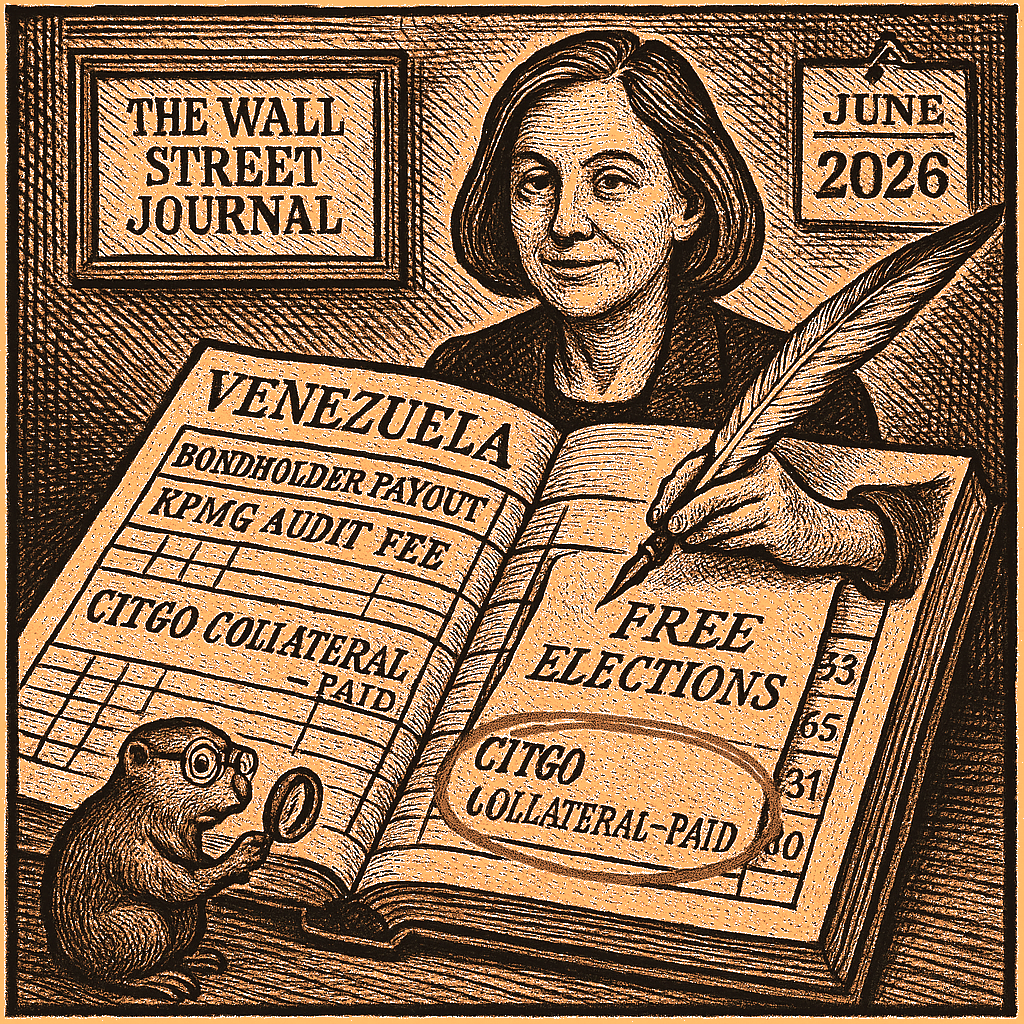
To read Mary Anastasia O’Grady’s Monday column — “Why Can’t Venezuela Hold an Election?” — is to watch a seasoned operator run a play I recognize from the inside. The play is called democracy-without-the-people. The reader is walked through a sequence of carefully selected facts, each one true in isolation, and arrives at the destination the column has prepared: that the only honest course is immediate free elections. The column is a piece of propaganda, and I helped build versions of this technique. I’ll show you the trick.
Secretary of State Marco Rubio ended up looking as if he was in over his head in front of the Senate last week, apparently because he was gulled by Venezuelan officials. He told the Foreign Relations Committee that the notorious El Helicoide prison in Caracas had been closed thanks to U.S. intervention after the Jan. 3 capture of dictator Nicolás Maduro. The statement caused an uproar from advocates of prisoners still detained in the facility infamous for torture. Venezuelan jackboots swooped in Tuesday night to transfer the El Helicoide population to other prisons. — opening paragraphs
The column opens with the gulled-official frame — a variant of the strawman technique [WSJ §4.6] that O’Grady has deployed across decades of Latin America coverage. Rubio said El Helicoide was closed; the prisoners were moved elsewhere; therefore Rubio is a mark. But the column does not ask whether the transfer was a response to U.S. pressure, whether conditions at the new facility differ, or whether any releases accompanied the move. The prison transfer isn’t betrayal; it’s the occupation’s operating model. We used to call this “institutional continuity” in the cable years. You don’t fire the torturers when you’re installing a new regime; you just change who signs their paychecks. The column treats the unchanged security apparatus as a surprise betrayal, when it is actually the baseline condition of the occupation.
Mr. Rubio was on Capitol Hill to answer questions about foreign policy, and that included Venezuela. President Trump says the U.S. now runs the country. Florida Sen. Rick Scott asked how it’s going. “It’s been five months, and I think Venezuela is in a better place today, and in a better trajectory today than it was five months ago,” Mr. Rubio said. “Now, is it where it needs to be? Is it where it needs to ultimately wind up? The answer is, of course, no. Ultimately, in order to truly transition, they have to have multi-party, free, and fair elections.” Mr. Rubio’s testimony was refreshing because he acknowledged that the job is far from finished. But peel back the veneer, and his views on Venezuela are also unsettling. — paragraphs 3–6
Here is the pivot — the motte in the motte-and-bailey structure [Bad-Faith Catalog: motte_and_bailey]. The column concedes that Rubio said something “refreshing.” The strong claim is that his views are “unsettling.” I used this in cable segments for years: concede the weakest version of the opponent’s position, then spend the remaining time demolishing a version you constructed. It’s effective because the concession looks like fairness and the destruction looks like analysis.
But watch what the column does with the election demand itself. A military occupation of a sovereign state — a U.S. seizure of a foreign head of state on January 3 — is acknowledged, then immediately treated as background. The occupying power’s demand for “free and fair elections” is framed as a sign of restraint, not coercion. By demanding elections only after the occupation is entrenched, the column turns the sequence itself into a threat: occupation first, then the demand that the victim vote on the occupation’s terms. You cannot hold free elections while U.S. auditors control your national oil revenue. When the ballot box is a decoy, the demand for “fairness” is a stall tactic.
Fair enough. But they also require political will, and there’s no sign of that from Ms. Rodríguez and her team of chavistas. They seem to be biding their time in the hope that Mr. Trump fades away. Interior Minister Diosdado Cabello is still on duty to make sure she doesn’t go soft. With a grip on at least half the country’s security forces and the paramilitary, his troops stand in the way of a liberated Venezuela. Short of landing an invasion, the Trump administration isn’t sure what to do about them.
This is the column’s load-bearing move — democracy-requires-political-will — and it is the suppressed variable laid bare [Suppressed Variable §5.1]. Observe what the frame omits. The column does not ask whether the Venezuelan opposition commands majority support after two decades of chavista governance. It does not ask whether María Corina Machado, who lives in exile and has promised to return “in the coming weeks,” has a political base inside the country that can win an election. It does not ask whether the Rodríguez government, for all its authoritarian features, retains substantial popular support — the kind that kept chavismo in power through multiple elections that, before 2024, were judged by most international observers to meet baseline standards. The column simply asserts that “political will” is absent, as if the will to hold elections were a personal attribute of Delcy Rodríguez rather than a structural question about who would win them.
The technique isolates one true variable — the regime’s lack of enthusiasm for elections — and suppresses the invalidating one — the opposition’s electoral weakness. The reader is left with the impression that elections are being prevented by a clique of thugs; the reader is not invited to consider that the clique might win an election anyway. The operator’s-eye-view reads the paramilitary complaint as a confession: the U.S. and the Journal both know that dismantling Cabello’s security apparatus would mean actually building a state from scratch, rather than just taking the keys to the vault. The “liberated Venezuela” they want is one where the military protects the foreign contracts but the voters are kept away from them. The column asks for liberation while endorsing a garrison.
To keep busy, Trump insiders are facilitating negotiations between bondholders and the Rodríguez clan to restructure more than $150 billion in debt owed by the government and the state-owned oil company. In May a delegation from Caracas met in Washington with the International Monetary Fund. This high finance is all in the name of “recovery.” But the sequence is wrong. Only an elected government can rebuild the rule of law and make Venezuelan commitments.
“Only an elected government can rebuild the rule of law and make Venezuelan commitments.” This is the cui bono reveal, and O’Grady says it after cheerleading a May meeting between Caracas, the IMF, and bondholders to restructure $150 billion in debt. She complains that doing the debt restructuring with the junta is premature because only an elected government can legitimize the contracts. Her demand for the election is a demand for the rubber stamp.
The column does not ask who the bondholders are, what they paid for the debt, or why they are owed $150 billion by a government that was under U.S. sanctions. The bondholders are mostly distressed-debt vulture funds that bought Venezuelan sovereign and PDVSA bonds at deep discounts; what they fear is not dictatorship but repudiation. O’Grady’s pivot from “only an elected government can rebuild the rule of law” to “make Venezuelan commitments” is the lexical trace of this reduction: “rule of law” is operationally defined as creditor payment security. It isn’t that she is afraid of democracy; she is afraid of an election where the voters might actually cancel the debt contracts or nationalize the oil instead of handing it over [WSJ §A.4, Selective Moral Outrage]. The election is demanded because it is the only way to permanently lock in the $150 billion in sovereign asset transfers that are already queued up.
Mr. Trump talks about Venezuela like a real-estate mogul perpetually bottom-fishing for a deal. His measure of success seems to be whether American oil companies have profitable arrangements with the regime. Ms. Rodríguez understands this. She’s cooperating with players like Chevron, not least because, with sanctions lifted, oil exports again produce hard currency at market prices. Dollar flows from oil are now controlled by the U.S. and audited by KPMG. That means they aren’t being stolen by regime insiders anymore. We’re told the Rodríguez government is using them to pay for imports and otherwise stabilize the economy.
The column’s most effective passage is also its most revealing. “Bottom-fisher” is well-observed; the observation that Rodríguez is cooperating with Chevron is accurate. But the indignation at oil-company profits sits uneasily with loyalty to a publication whose editorial page has spent decades defending U.S. oil companies’ right to operate anywhere in the world, under any government, with minimal restriction — a pattern visible from Ecuador’s Oriente fields to Myanmar’s Yadana pipeline — treating “the contract is enforceable” as the overriding principle. The column’s objection is not to oil-company profits; it is to oil-company profits that flow through a chavista government rather than through an opposition-led one. The column is an argument about who gets the rent, not about whether the rent should exist.
And then the frame-engineered relabeling [WSJ §A.1] at its purest. “Dollar flows from oil are now controlled by the U.S. and audited by KPMG. That means they aren’t being stolen by regime insiders anymore.” Before the U.S. takeover, oil revenue was “stolen.” Now that a Big Four accounting firm audits flows controlled by Washington, it’s “stabilizing the economy.” It is a shakedown wrapped in a spreadsheet. Chevron cooperates not out of charity, but because with sanctions lifted, the hard currency flows directly to the creditor class. KPMG is just the bouncer at the vault door. The column concedes a genuine improvement — revenues are no longer being stolen — but buries it mid-paragraph, because the column’s argument requires the concession to be minimized. This is distortion of consequences [Bandura, mechanism 7]: the improvement is framed as a technical detail that does not change the larger picture. The larger picture is that the U.S. is being played; the improvement is evidence that the regime is cooperating with the U.S. — which is exactly what the column’s own argument says the regime is not doing. The contradiction is visible if you read the column as a document rather than as a mood.
Chavistas are said to be unhappy with where Ms. Rodríguez is taking the country. But she can point to her continued crackdowns on the opposition. It’s true, as Mr. Rubio said, that hundreds of political prisoners have been released since the start of the year and that some of them are important government critics. But the regime still holds more than 400 dissidents. And those who are no longer behind bars are often subject to gag orders, travel bans and orders to periodically appear in court. They haven’t regained their freedom. Neither has Venezuela.
The closing line — “Neither has Venezuela” — is the threat-inflation closer [WSJ §4.13]. Short, declarative, engineered for retransmission. The 400 remaining prisoners become evidence that the country is unfree, and the unfreedom becomes evidence that the intervention has failed. But the column does not ask whether 400 is a smaller number than the thousands held under Maduro. It does not ask whether released prisoners under gag orders and travel bans are in a meaningfully different condition than they faced under torture and disappearance before January. It does not ask whether a country that has released hundreds of political prisoners and submitted its oil revenues to external audit is, in any meaningful sense, on a trajectory toward liberalization.
The column’s refusal to ask these questions is the operation. When you run a country through its interim authorities, a gag order isn’t a human-rights violation to you; it is risk management for the debt restructuring. The KPMG-audited revenue stream that O’Grady concedes is no longer being stolen is the very mechanism funding the prisoner releases and prison transfers — improvements that the “gulled” frame requires her to treat as irrelevant. The column asks why they are still waiting to go to the ballot box while the interim government silences the only people who could organize the ballot. The gag orders aren’t a sign the election is coming. They are a sign that the election is being engineered.
The column is defending the opposition’s political position, not Venezuela’s democratic prospects. It deploys the democracy frame to demand elections that the opposition would likely lose, while suppressing the opposition’s electoral weakness and the creditor class’s interest in a legitimate government that can honor $150 billion in debt. The column is not about Venezuela. The column is about who gets to define what “democracy” means in a country the U.S. seized, and the answer the column supplies is that democracy means the opposition wins, the bondholders get paid, and the oil flows through the right channels.
So here is what the piece actually is, taken together. It takes a conquered country, hands the keys to an interim junta, audits its checkbook with KPMG, auctions its oil to Chevron, and then asks, with a perfectly straight face, why they are still waiting on the ballot box. The column wants the aesthetic of democracy without the democratic input — the polling place without the political risk. You don’t get free and fair elections when the ballot box sits inside a debt-restructuring facility. The Journal doesn’t want Venezuela to vote. The Journal wants Venezuela to pay. That is the ledger. That is the election.
— Phukher Tarlson