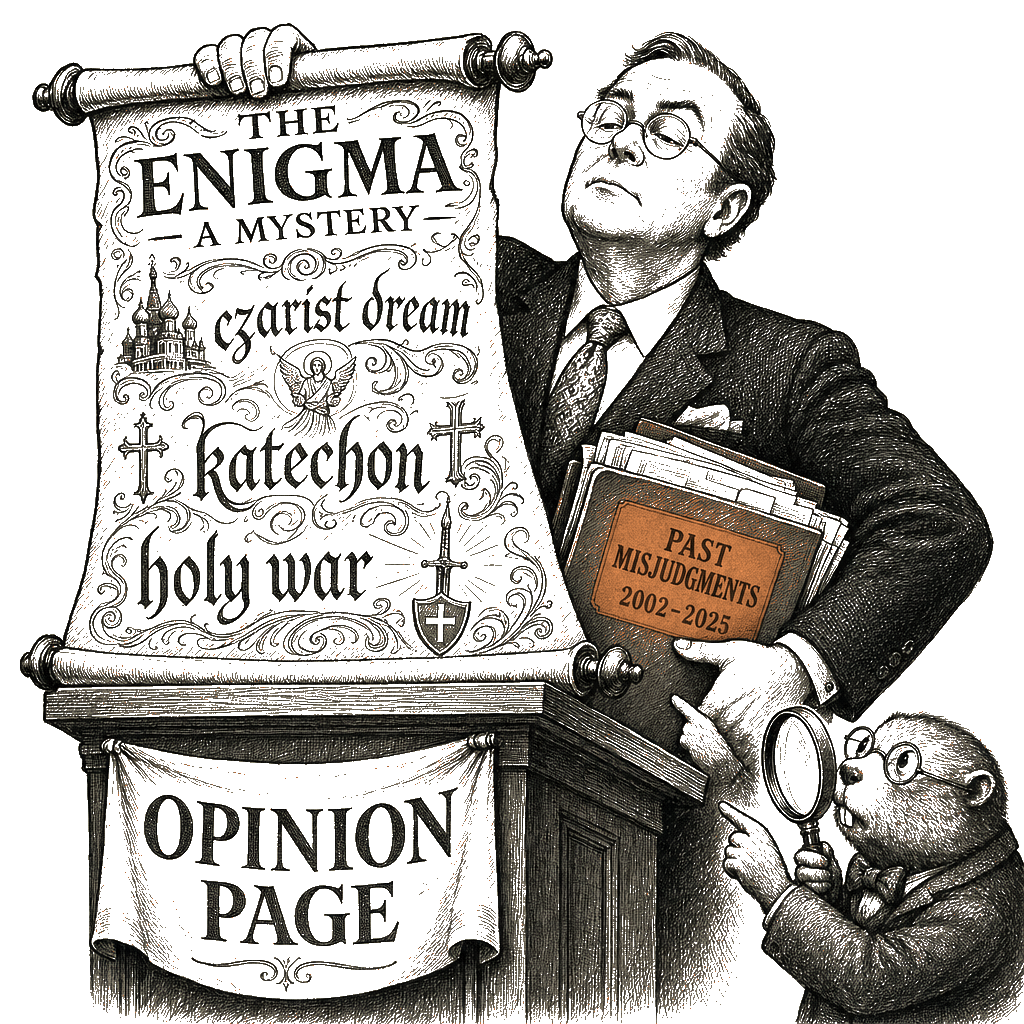
Barton Swaim converts a quarter-century of Western diplomatic failure with Vladimir Putin into a theological mystery in his June 5, 2026, opinion column for the Wall Street Journal. By framing the Russian president as a reincarnated czar driven by eschatological Orthodoxy rather than material policy interests, Swaim builds a permission structure that insulates Western leaders from charges of institutional incompetence while simultaneously offering the current administration a backhanded pass for its own persistent misreadings. This is a permission structure in reverse—not permission to feel righteous about a policy, but permission to keep getting it wrong without cost. The piece deploys elite authority citations, selective-ledger construction, multiple-audience-targeting, and the mystique-of-the-adversary trope. The following excerpt-by-excerpt autopsy walks through the mechanics as they appear.
After the terrorist attacks of Sept. 11, 2001, a worry circulated among foreign-policy analysts that the aims and decision-making processes of Islamic jihadists confounded our attempts to penetrate them—unlike those of the Soviets, which, however perilous, we at least understood.
But did we? American commentators and policymakers have long assumed that they understood Russian strategic thinking better than they did. To this day, despite the temptation to assume the reasoning of Russian leaders more or less comports with Western norms, the Kremlin’s intentions remain “a riddle wrapped in a mystery inside an enigma,” as Winston Churchill memorably put it.
The Unfathomable Enemy frame — Bad-Faith Catalog: frame_engineered_relabeling; WSJ §A.1 — operates here through the Churchill quotation. Swaim establishes from the first paragraph that the Russian leader is a puzzle box no Western mind can crack. The failure of an entire generation of Russia specialists is reframed not as misjudgment but as the intrinsic inscrutability of the target. In the cable years, we called this the Rumsfeld flip: turn a known failure into an unknown unknown, and the people who failed become the people who ponder. When you can’t explain why your adversary outmaneuvered you across three administrations, you declare him an enigma. It moves the failure from the planner’s desk to the adversary’s soul. For an editorial page that spent the 2000s and 2010s publishing sanctions-and-integration arguments about Putin-the-rational-actor, the enigma pivot retroactively insulates that archive from the charge that it was wrong about the man from the start. The Churchill quote becomes the permission structure: if even the great man said it’s a riddle, then being wrong about Putin for a quarter-century is not incompetence, it’s the human condition.
The operation Swaim is running, we can already see, is to shield the commentariat that paid his salary for two decades from having to say “we were wrong.”
The habit lives on in the current U.S. administration. President Trump sagely dismisses the sincerity of Iran’s jihadist regime. Talk of an impending “deal” aside, all my reporting suggests he has no regard for the words of Iran’s leaders. Yet Mr. Trump persists in the belief that Vladimir Putin would negotiate in good faith, according to Western notions of interest, if only he thought he could. Recall a social-media post in August of last year in which Mr. Trump said the war could end “almost immediately” if only Ukraine would relinquish its claims on Crimea and forswear its ambition to join the North Atlantic Treaty Organization.
Credulity about Russia is a bipartisan affair. Recall the preposterous “reset” button Secretary of State Hillary Clinton presented to her Russian counterpart, Sergei Lavrov, in 2009, or her successor John Kerry’s expression of outrage after Mr. Putin annexed Crimea in 2014: “You just don’t in the 21st century behave in 19th-century fashion by invading another country on completely trumped-up pretext.”
This paragraph is a master-class in multiple-audience-targeting — WSJ §A.3. The anti-Trump reader gets “look how naive the president is.” The Trump-loyal reader gets “Trump sagely dismisses” Iran and a reminder that Democrats brought a toy button to a knife fight. The foreign-policy class gets “bipartisan affair”—a soothing assurance that everybody messes up Russia, so nobody is singularly responsible. And the populist base gets “preposterous ‘reset’ button,” a crisp grievance pellet. In the cable years we called this running four channels on one signal; the different audiences never compare notes because they’re each hearing the sentence meant for them.
The Selective Outrage and the Whistle-Spot Technique — WSJ §4.4 (the deficit double standard) + WSJ §4.9 (the “blue-state failure” frame) — targets the out-party’s diplomatic missteps while bracketing the in-party’s complicity. Swaim catalogs the failures of Democratic secretaries of state — the reset button, the outraged 19th-century quote — as proof of “bipartisan credulity.” The operation is the ledger-selection move: cite the visible missteps of the opposing coalition to establish the baseline of incompetence, then pivot to the current administration’s missteps as a tragic character flaw of the president rather than a systemic failure. We knew how the ledger worked when we built it. The reader is meant to nod along at Clinton and Kerry while the Trump misreadings get queued for a different, softer register later in the piece.
The “credulity about Russia is a bipartisan affair” frame is the piece’s load-bearing dodge. It converts what was, in fact, a Republican-led policy choice — the 2002 withdrawal from the ABM Treaty, the 2008 NATO-expansion promise to Georgia and Ukraine, the 2014 sanctions regime, which critics argue stopped at the oligarch tier — into an equal-opportunity fog. Swaim doesn’t engage the content of the Clinton reset or the Kerry rebuke; he just hangs them on the wall as exhibits of the same sin. That’s whataboutism as house style — Bad-Faith Catalog: whataboutism, subspecies both-sides-deployed. Not the crude “but her emails” variety, but the more refined kind: “Both parties have been credulous, therefore my own party’s credulity isn’t news.” The cui bono finding is straightforward: protect the institutional continuity of the page’s foreign-policy preferences by blaming the messengers for the message’s failure. The page’s foreign-policy preference is NATO expansion and a forward-leaning posture on Russia; the diplomatic failures that produced the invasion threaten that preference’s credibility, so the column redirects the threat onto the diplomats’ cultural deafness.
A book published last month in the Netherlands reminds us how vast is the difference between the West’s conceptions of interest and Mr. Putin’s. “Poetins Tsaristische Droom,” or “Putin’s Czarist Dream,” contends that Mr. Putin’s outlook has evolved, over the quarter-century in which he has ruled, into a spiritual amalgam every bit as eschatological as that of Iran’s mullahs. The authors, Beatrice de Graaf and Niels Drost, both of Utrecht University, think Western observers have missed a major component of the Russian dictator’s worldview. … He spoke of Alexander I and Europe joining to defeat Napoleon.
… His rhetoric took on elements of Eastern Orthodoxy and of darkness and light. “He began to speak often of ‘evil.’ Russia for him was a ‘beacon of light’ that would save the world from evil,” …
The “study shows” ledger — WSJ §A.5 — deploys here with precision. Swaim hangs his entire frame on one Dutch book whose central thesis — Putin is a mystical autocrat operating on a different spiritual plane — is exactly what the Journal’s editorial page has been trying to sell since at least 2014. The source is perfectly pitched to the technocratic segment of the readership: a Utrecht professor, a Clingendael fellow, a computational analysis of 11,000 public statements. The scanner will register “data-driven scholarship,” not “finds exactly the story the page wanted.”
But here is the operator’s-eye-view on books like this. When a think-tank or opinion-page ecosystem wants to harden a narrative it has already chosen, it commissions or elevates work that gives that narrative the weight of scholarly authority, and then it cites that work as independent evidence. The fact that de Graaf and Drost have done real research doesn’t change the circuit: the Journal selects the book that matches the pre-existing editorial line, and the book’s findings are then fed back as confirmation. We did this in the cable years with polling firms, and we did it on the editorial page with commissioned white papers. The document is real; the selection is the operation.
The Authority Deflection and the Theology Escape Hatch — Bernays-Lippmann-Schmitt lineage (expert consensus as debate closer) — deploys de Graaf and Drost to shift the analytic axis from material strategy to spiritual destiny. This is the permission structure at the heart of the column. If Putin is moved by statues, holy water, and the ghost of Alexander I, then the Western diplomats who treated him as a rational actor negotiating over sanctions and borders weren’t incompetent; they were just culturally tone-deaf. The piece converts a policy failure into a clash of civilizations. The receipt is the book’s central claim — that more than 3,000 of Putin’s speeches reference czars — which Swaim elevates to the level of primary causation. The analytic engine ignores the simpler explanation: a former intelligence officer uses imperial nostalgia and religious signaling to consolidate domestic power and justify territorial expansion, and Western leaders play along because the alternative is confronting the expansion. Swaim needs the theology to be sincere because if it’s just a consolidation-and-justification toolkit, the diplomatic failures are no longer about cultural tone-deafness — they’re about Western leaders choosing not to confront a territorial power play they had every tool to read.
Mr. Putin “allowed people—he didn’t do it himself, he allowed others—to call him katechon.” This Greek word, usually defined as “restrainer” or “one who withholds,” appears in 2 Thessalonians 2… For Mr. Putin’s nationalist supporters, he fills the role anew. Which explains, Ms. de Graaf says, why his top aides and allies… justified the 2022 invasion in part by alleging “satanic” activity in Ukraine. To Western ears that sounded risible, but for Putinists attuned to Orthodox political theology—and for the Russian president himself—the idea is entirely valid.
“For him,” Ms. de Graaf says, “the war in Ukraine really is a holy war.” … “In the East, the emperor has the power to define what is evil and crush it.”
The Holy-War Relabel — WSJ §4.1 (frame-engineered relabeling) + Bandura: Moral Justification — recasts a territorial invasion as an eschatological necessity. Swaim leans hard on the katechon framing, the restrainer of evil from Pauline eschatology. The technique is the elevation of adversary propaganda to the status of unchallengeable motive. By treating the “satanic activity in Ukraine” justification as “entirely valid” within Putin’s worldview, the column grants the propaganda its own hermetic seal. In the cable years, we used this move when operators wanted to tell the audience that the adversary couldn’t be bargained with because their grievances were infinite. The receipt sits in the de Graaf interview quoted at length: Swaim asks how sincere the theology is, De Graaf says she can’t read his mind but the alignment of deeds and words suggests belief, and the column accepts the theological framing as the operational reality. It’s a move that tells the reader: don’t bother looking for the diplomatic off-ramp, because the driver believes he’s on a crusade.
Now the piece tips into full threat inflation — WSJ §A.13. By the time the reader reaches “holy war” and the czar who “crushes evil,” Putin has been lifted out of the category of adversary and into the category of apocalyptic figure. That move does two things. For the hawkish donor-class reader, it justifies whatever military-industrial outlay is coming next — you don’t haggle with the Antichrist. For the populist base, it provides a Christian-inflected permission structure: this is not a territorial war for resource corridors, it’s a spiritual war against satanic forces. The Journal has been running this register since at least the 2014 annexation of Crimea, and Swaim’s piece is a pure-form instance of it.
American analysts sometimes debate whether this or that rogue regime or dictator … is a “rational” actor. Almost always the topic assumes a Western liberal-democratic definition of rational, which makes the question pointless. Ms. de Graaf is similarly skeptical of the question’s usefulness and helpfully describes what she calls “epistemic” rationality…
This is a strawman with an escape hatch — Bad-Faith Catalog: strawman, motte_and_bailey. Swaim reduces the entire Western analytical tradition to a caricature — “the West assumes Putin thinks like a Western liberal” — and then beats it to death with the de Graaf testimony. The strawman works because it flatters the reader: we are too sophisticated to fall for the rational-actor trap; we see the deeper spiritual truth. But the actual analytical question is whether Putin responds to material incentives — sanctions, military pressure, diplomatic isolation — alongside his ideological ones, a question the piece never engages. The motte-and-bailey is visible: the bailey is “Putin can’t be negotiated with because he’s a holy warrior”; the motte is “he operates under a different form of rationality.” If you question the bailey, you get handed a lecture on epistemic frameworks, and the column’s policy conclusion — don’t expect a deal — survives untouched.
Mr. Trump, despite Democratic accusations of “collusion” with the Russians in 2016, exhibited more shrewdness on Russian matters than his predecessors, by withdrawing from the 1987 Intermediate-Range Nuclear Forces Treaty on grounds that Russia had repeatedly broken it, by destroying Russian-backed mercenaries in Syria in 2018, and, of course, by sending weaponry to Ukraine. Yet Mr. Trump has just as frequently behaved as though the Russian tyrant desires “peace” as an end in itself.
Lately Russia has seemed to lose its way in the war … American leaders may expect Mr. Putin to respond to these circumstances in what they deem a “rational” way, by acknowledging battlefield realities and looking for ways to cut his losses and save face. But a reimbodied czar, a man empowered by God to restrain evil and protect Russia from satanic influence, probably won’t conform to expectations.
The Favorable Ledger and the Fatalism Close — WSJ §4.7 (No-True-Scotsman / goalpost shifting on rationality) — constructs a “shrewd” Trump while bracketing the persistent appeasement, then lands on fatalism. Swaim lists the INF withdrawal, the Syria strike, and the Ukraine weapons transfers as evidence of Trump’s shrewdness, then immediately undercuts it by noting Trump still thinks Putin wants “peace.” The closing does double duty. It burnishes Trump’s credentials, protecting the piece from accusations of anti-Trump bias while still advancing the overall “Russia is an unfathomable evil” thesis. Then comes the turn: Putin is a “reimbodied czar, a man empowered by God to restrain evil and protect Russia from satanic influence” who “probably won’t conform to expectations.” This is the threat-inflation closer in its perfected form — WSJ §A.13 — and it is designed to be lifted onto social media as the takeaway.
The operator reads this as the absolution drop. The current administration won’t be blamed for failing to end the war, because the war is now framed as a theological standoff with a figure who “probably won’t conform to expectations.” The piece closes by removing the expectation of accountability from the diplomatic table. The cui bono is clear: the page gets its preferred narrative — that Putin is an unappeasable spiritual force, that the administration tried to be tough but even its shrewdness couldn’t crack the mystic shell, and that the war will grind on because the adversary is operating on a plane of divine compulsion. The practical effect is to license any level of Western military commitment and to insulate the pundits who will advocate it from having to weigh costs.
So here is the operation, stripped of the scholarly drapery.
Swaim, on behalf of the page that has spent twenty-five years getting Putin wrong while attacking anyone who got him right as soft or naïve, writes a column that says: nobody could have gotten Putin right, because he’s not a rational actor, he’s a czar on a divine mission. The Wall Street Journal spent twenty years framing Vladimir Putin as a rational market actor who could be integrated into the global order, provided the right sanctions and the right treaties were in place. Now that the integration has produced an invasion, the page pivots: Putin is not a rational actor at all. He is a czarist mystic, a holy-war executor, a man sprinkling holy water and invoking 2 Thessalonians while the ruble burns. The reader who swallowed the “rational actor” frame for two decades gets a new frame just in time to explain why it was wrong.
The failure of the foreign-policy class is repackaged as the inscrutability of the adversary, and the people whose advice produced the failure are positioned once again as the experts on what to do next. “Credulity” is just a polite word for “we misread him, and we want to keep our seats at the table.” The shrewdness ledger for the current administration is padded with the weapons it sent; the credulity ledger for Democratic predecessors is padded with the reset button; and the piece lands exactly where the page always wants to land — the war is uncontainable, the adversary is a riddle, and the only rational response is to keep funding the conflict until theology exhausts itself.
The “riddle” Churchill spoke of was strategic: what would the Soviet Union do next? Swaim’s “riddle” is a different product altogether. It’s a device for making sure that the mistake of treating Russia as a permanent messianic enemy — instead of a country with interests that might be engaged — never gets interrogated at all. That’s not a riddle. That’s a cover story, built by the people who need it, for the readers who will never be told otherwise. This is the escape hatch the donor class built for its own foreign-policy record.
— Phukher Tarlson