
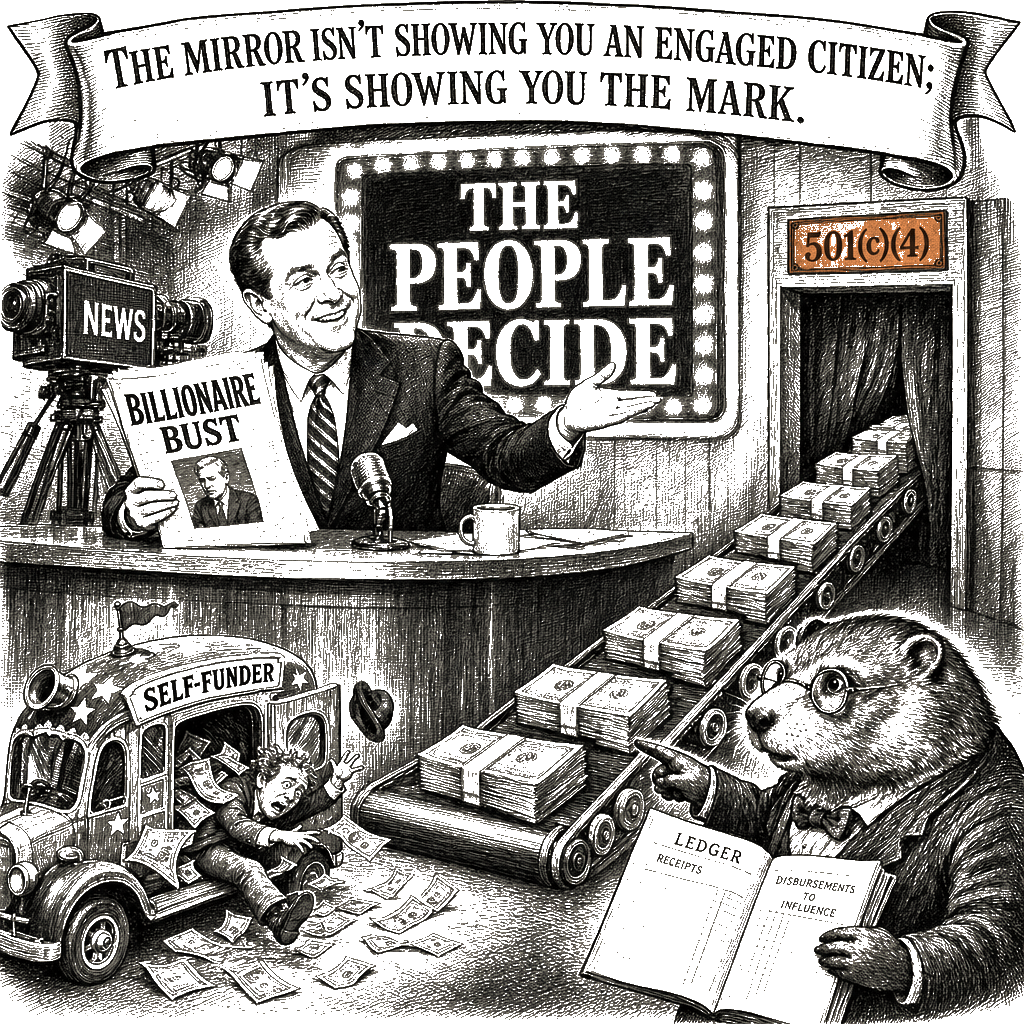
James Freeman launders donor-class impunity by celebrating a billionaire’s loss as populism while ignoring actual dark-money infrastructure. On Wednesday, the Wall Street Journal’s “Best of the Web” column executed a standard audience-management operation: pivot to a single high-profile loss from the donor class, declare the political system self-correcting, and let the reader feel righteous about the very machinery enriching the paper’s subscribers. We built identical narrative structures in the cable-news years — load the teleprompter with a visible billionaire failure, declare the electorate uncorrupted by money, and let the laugh substitute for scrutiny of the actual outside-spending apparatus. I know because I wrote versions of this argument for years: the column that takes one convenient data point, dresses it in populist language, and uses it to kill any discussion of the donor class’s favorite shield — secrecy. What follows is a paragraph-by-paragraph reading of the operation as it deploys.
Tuesday was a tough night for the cynics who like to present American politics as a rigged game operated for billionaires. From California of all places comes the refreshing reminder that money without a compelling message isn’t enough to win U.S. elections. The latest self-funding megaspender appears to have failed in his effort to buy a statewide office. Thank goodness the people still get to decide. — Tuesday’s opening grafs, Best of the Web, WSJ, June 3, 2026
The Multiple-Audience-Targeting Analytic — WSJ §4.3 — opens on three channels simultaneously. For the wealthy subscriber, the reassurance that the system still works and their donations aren’t the problem. For the populist base, the sneer at “California of all places,” the blue-state that can’t manage itself. For the technocratic reader, the premise that the entire campaign-finance debate can be settled by a single billionaire’s failure. Frame-engineered relabeling — [WSJ §4.1] — operates in unison: the structural reality of post-Citizens United campaign finance, where outside-money infrastructure, super-PAC bundling, and undisclosed donor-class coordination determine policy outcomes, is relabeled as a “rigged game operated for billionaires.” Freeman then reduces the entire architecture of capture to the easily refuted proposition of a “self-funding megaspender” trying to “buy a statewide office.” The move is the strawman — [Bad-Faith Catalog ID: strawman], selectional variety. The piece is not engaging the documented influence of dark money; it is manufacturing a version of that influence (the wealthy candidate writing personal checks) precisely because that version is the easiest to dismiss when it fails. In the cable-news control room, we called this “loading the decoy”: put all the rhetorical weight on the most visible, least effective form of capture, so that when it fails, you can declare the entire apparatus harmless. The public record for the California gubernatorial race shows that a super PAC called California Is Not For Sale, backed by the state Realtors association, the California Chamber of Commerce, and PG&E, poured thirty-two million dollars into ads opposing him alongside other ideological PACs. The piece omits that outside apparatus entirely. Freeman never engages the mountains of data showing that outside money dominates down-ballot races, that dark-money groups shielded his own outlet’s readers from disclosure in the last cycle, or that the threat of billionaire spending disciplines legislators before they ever reach the ballot. Those aren’t in the paragraph. They aren’t in the column. The operation is the omission.
“Appears” is a necessary qualifier because in California, vote counting can last for weeks as ill-considered rules for mailed and provisional ballots delay a decisive result. Barring a late-counting surprise, Golden State voters have wisely rejected a flawed candidate despite his overwhelming advantage in campaign financing.
Alexei Koseff reports for the San Francisco Chronicle: … Mr. Koseff adds that Mr. Steyer “poured more than the GDP of the island nation of Nauru into his quest to lead California, flooding the airwaves with ads and paying online influencers to promote him.”
Perhaps Mr. Steyer would have been better off buying Nauru. He wasn’t the only extravagant self-funder whose efforts proved self-defeating on Tuesday in California. — Middle section and Nauru pivot, Best of the Web, WSJ, June 3, 2026
The “ill-considered rules for mailed and provisional ballots” is the editorial board’s signature election-doubt seed (WSJ §4.13), placed early to inoculate the reader against the actual result while pretending to defer to it. The Nauru gag is Frame-Engineered Relabeling — [WSJ §4.1] — in its most seductive form: ridicule. Freeman turns a billionaire’s spending into a joke, a carnival attraction, so that the reader never asks what that spending does. Every dollar of Steyer’s that went to an influencer bought a real person’s endorsement; every ad bought a real audience’s attention. The joke hides the machine. The line “Perhaps Mr. Steyer would have been better off buying Nauru” is the tell — a throwaway gag engineered to produce the reader’s contempt. It works because contempt is easy, and contempt is a substitute for scrutiny. We sat in the control room and approved these exact throwaway lines, knowing the laugh they produced would carry the audience past the next block of copy without asking who the influencers were or what the airtime actually bought. It’s a con — relabeling the mechanics of policy capture as a punchline so the audience doesn’t have to look at the machinery. I remember the focus groups we ran in the early 2000s, testing this exact kind of “humor” — it’s calibrated to deflect attention. Make them laugh at the eccentric billionaire, and they never ask what the money actually bought, let alone think about the invisible cash flowing through dark channels. The column never mentions that Steyer, for all his blunders, is one of the few mega-donors who actually discloses his contributions — while the dark-money channels that Freeman’s editorial page has defended for two decades keep their donors completely hidden. The gag is the shield.
Regular Journal readers will recall Mr. Chakrabarti as the extremist who at least had the decency to admit the purpose of the Green New Deal. The Washington Post quoted him discussing the plan…
As for Mr. Steyer, readers will recall that he also had an expensive experience proving that money is not enough to win votes for president, either. A Journal editorial noted in 2020:
Perhaps he can always have Nauru. — Chakrabarti and 2020 recall, Best of the Web, WSJ, June 3, 2026
The Washington Post quoted nothing of the kind. What the Post actually reported Chakrabarti saying was that the Green New Deal “wasn’t originally a climate thing at all.” Freeman compresses that into “It’s not a climate plan. It’s a social-justice plan,” a loaded paraphrase that smuggles in the “social justice” boogeyman while pretending to cite a straight news report. The move is guilt by association — catalogued in the Bad-Faith Field Guide under informal fallacies as a form of poisoning the well — and the paraphrase itself is the Strawman. Freeman introduces a second billionaire, associates him with the phrase he has just fabricated for maximum audience revulsion, and then lets that association drip onto Steyer, who merely lost an election. The goal isn’t to analyze Steyer’s platform; it’s to make sure that anyone who hears “billionaire” also hears “extremist” — so that no one asks whether billionaires other than Steyer and Chakrabarti might have influence that matters. The word “extremist” signals to the base that the candidate is outside the Overton window, while the Green New Deal reference cues the donor subscriber that the paper still opposes climate regulation — a single line doing two jobs. We called this “flooding the secondary channel” when writing segment copy: if the primary argument (the populist decoy) is too thin to carry the whole column, open a second channel (the culture-war target) to carry the emotional load. The reader absorbs the emotional payload and walks away having processed neither the structural reality of campaign finance nor the substance of the climate policy being dismissed.
Speaking of Expensive Disappointments
Oliver Wainwright writes for the U.K.’s Guardian newspaper about his trip to Chicago’s new Obama Presidential Center. Mr. Wainwright interviews the center’s architect, Billie Tsien, and reports…
One can’t help but wonder if the building will someday tempt everyone involved to exclaim, “I didn’t build that!” Mr. Wainwright describes a visit inside the tower: — Obama Center digression, Best of the Web, WSJ, June 3, 2026
The Obama Presidential Center tangent is a Red Herring, pure and simple. Freeman has no argument about campaign finance that requires a federal building in Chicago; the detour is there to land a culture-war punch on Barack Obama and sneer at public architecture. The “I didn’t build that!” line — a mangled quote that the Journal has been repurposing since 2012 — serves the Austerity-Thrift Archetype [WSJ §4.2]: it mocks the very idea of collective investment, framing a museum for a former president as an extravagant folly while the column’s own readers benefit from infrastructure they’d never call an “expensive disappointment.” The red herring’s function is to keep the donor-class base’s resentments warm without ever making a policy argument. In editorial production, this sequence is the palate cleanser: a low-stakes cultural jab inserted to reset the reader’s tone so the next piece lands without fatigue. It is a nothing-burger dressed up as wit.
Did Executives Just Realize Texas Has No Individual Income Tax?
Stephanie Loder reports for NJ.com: — Texas income tax kicker, Best of the Web, WSJ, June 3, 2026
And here is the closing sleight. The column’s final section is a drive-by advertisement for Texas’s low-tax environment, framed as a news item. It has nothing to do with Steyer or campaign finance, but everything to do with what the whole column is actually selling: that wealth should face no taxes, and that the California ballot initiative, the wealth tax, the whole progressive apparatus is a fool’s errand. The question-as-headline is JAQing off — “just asking” — because it plants a conclusion without taking ownership of it. And look at the structure: the artifact text ends immediately after “Stephanie Loder reports for NJ.com:” — with no actual report. That emptiness is the technique. Freeman doesn’t need an argument or a data point; he just needs the headline, a low-tax grievance trigger, to do the work. The column’s architecture, from the first graf to this hollow closer, is a permission structure: spend all you want, don’t disclose a penny, and sneer at anyone who tries to make you. The piece opened by pretending to laugh at a billionaire’s failure; it closes by pointing the donor-class reader toward the exact policy architecture that protects their accumulated wealth. The operation completes itself. The reader laughs at Steyer, feels virtuous about the “people deciding,” and is handed the Texas tax exemption as the actual takeaway for the affluent subscriber.
So here is what the five sections amount to, taken together.
James Freeman’s column is not a column. It is a brochure for the donor class, dressed in the language of “the people decide.” The real argument, never uttered, is this: keep donor anonymity intact, because as long as one billionaire can lose an election, the rest of you can keep writing checks in the dark. The column launders a defense of unlimited, undisclosed spending through the story of a single man’s failed campaign, and it deploys the full Journal technique catalog — multi-audience flattery, ridicule as evasion, guilt by association with a fabricated quote, red herring, and the fake-question closer — to make the laundering feel like common sense. The subscriber opens the paper looking for news and gets handed a magic trick: look at the clown throwing his own money into a bonfire, and ignore the professionals moving your tax breaks across the table while you laugh. The operation’s genius is that it doesn’t even need to defend dark money anymore; it just has to produce a single billionaire failure, point at it, and declare the whole rigged architecture a populist fairy tale. I wrote columns like this for two decades. We called it “the brochure.” The brochure’s job was always the same: make the donors feel populist while their money did the opposite. This one is a textbook specimen — and if you can be satisfied with the punchline, the capture was a long time ago. The mirror isn’t showing you an engaged citizen; it’s showing you the mark.
— Phukher Tarlson