
Kimberley Strassel’s Wall Street Journal column, published June 5, 2026, presents itself as a wistful lament over a shrinking talent pool in the second Trump administration. It is a donor-class re-entry brochure. It is a loyalty-for-position shakedown dressed up as a hiring problem. Six distinct technique deployments operate across the column’s architecture; this annotated walk-through names them as they appear.
Job Description: Superpower seeks … anyone, to direct its national intelligence apparatus. Responsibilities: Whatever the CIA tells you. Qualifications: Obeisance to Donald Trump’s day-by-day agenda. Willingness to express constant admiration for the boss. Fluidity in MAGA “talk.” No intelligence experience required. Benefits: Knowing you are one Truth Social post from permanent retirement. Hours: This can be a part-time position (and please also consider our IRS opening).
The column opens with a satire want‑ad. Frame-engineered relabeling — Bad-Faith Catalog ID: frame_engineered_relabeling — operates here through a substitution that is the column’s load‑bearing move. The want‑ad frame converts a structural‑accountability question — why can’t this administration staff the government? — into a tone question: isn’t it funny how they’d write the job posting? The reader laughs at the parody and is recruited into the author’s premise that the hiring pool has shrunk, without ever being asked whether that premise is the actual problem. The actual problem is that the administration runs a loyalty-for-position shakedown: positions are filled by people who have demonstrated they will do whatever the president asks, and the president’s asks include things like digging up the mortgage records of a sitting Federal Reserve governor. The want‑ad frame makes that read like a hiring-process glitch. It is the operating system.
The parody ad also serves as the column’s four‑audience move in miniature. To the wealthy reader it delivers the knowing wink — confirmation that the people running the government are unserious. To the political class it signals that Strassel is critiquing from inside the tent, useful for re‑citation. To the populist base it offers grievance ratification — the elites are laughing at us, they think anybody can do this. To the technocratic class it provides quasi‑governmental vocabulary (DNI, IRS, CEO) that marks the piece as inside the game. The layers work against each other, and they never have to choose. In the cable years we called this the “credentials gambit”: you pretend to be outraged by the lack of pedigree to mask your outrage that your people aren’t getting the keys.
That’s a disturbing thought, though the naming of Mr. Pulte as acting director of national intelligence offers a useful contrast between the two Trump terms — and an explanation of its problems today. Trump One was drawn from experienced Republican hands who, despite initial disorganization and later disruptions, produced a record of achievement that helped get Mr. Trump a second term. Trump Two is populated from an ecosphere of MAGA think tanks, money men and political shops that was created post‑2020 to cultivate and vet a pool of loyalists.
Here is the No‑True‑Scotsman of the first term — WSJ Catalogue §4.7 — operating through the selective‑recall move that makes Trump One read as the serious‑governance term the column needs it to have been. Strassel redescribes Trump One as populated by “experienced Republican hands” who produced a “record of achievement.” Any operator who sat in those rooms remembers the chaos, the resignations, the policy whiplash, and the revolving door. Trump One had Michael Flynn for twenty‑four days. Rex Tillerson fired by tweet. Tom Price, Scott Pruitt, Ryan Zinke, Jeff Sessions — all pushed out or hounded out. The people Strassel calls “experienced Republican hands” were the same class that built the loyalty‑test model Trump Two now runs full time. The degradation isn’t a deviation; it’s the same operation at a more advanced stage. The column cannot say “the operation was always a loyalty‑for‑position shakedown” because that would name the operation Strassel helped build. It can say “the operation used to be run by serious people,” and that frame lets the serious people off the hook. It is the frame the serious people always reach for.
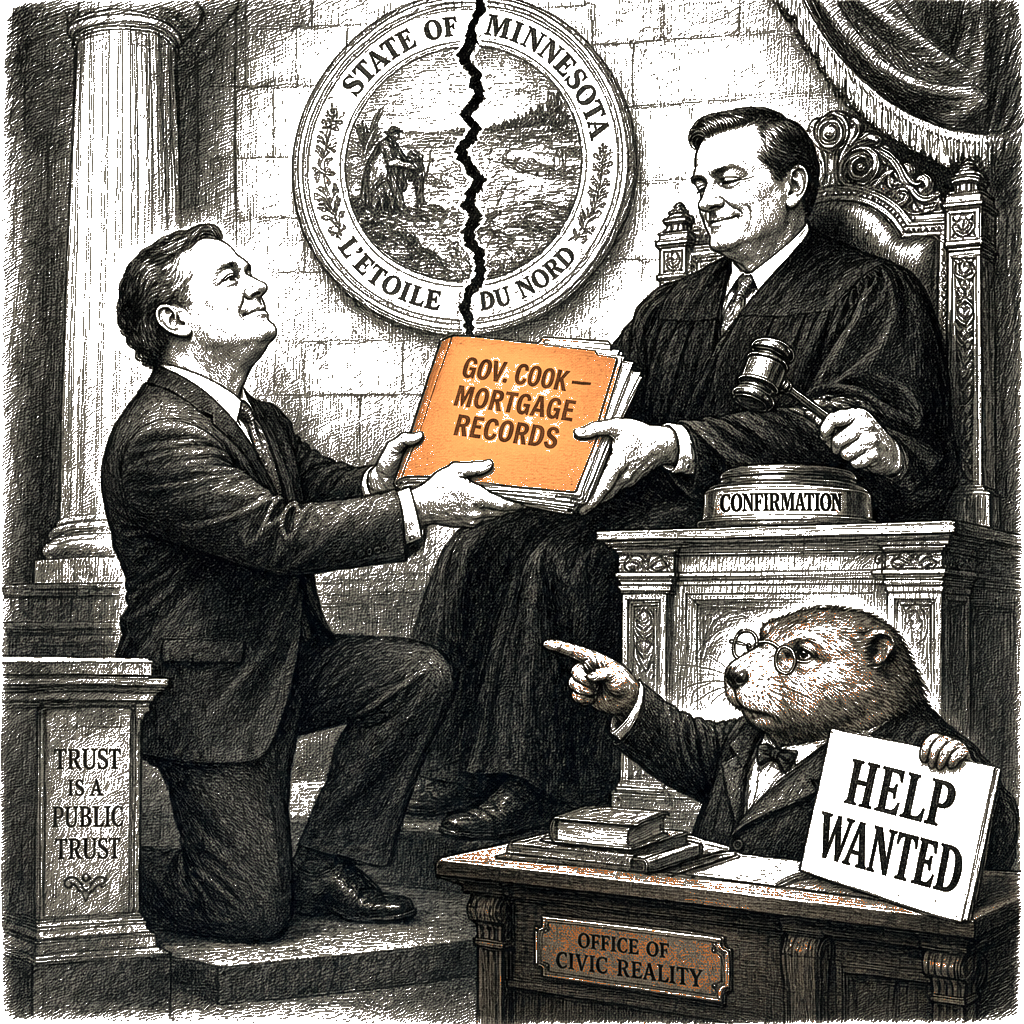
See the latest Pulte title — his third. Mr. Pulte snagged his first Trump administration job, as director of the Federal Housing Finance Agency, on the strength of a Twitter presence and big donations to Mr. Trump’s campaign. Immediately on confirmation he was handed a second giant portfolio — chairman of Fannie Mae and Freddie Mac. Now the DNI gig. No one suggests Mr. Pulte has any experience in intelligence. Then again, the DNI post is relatively useless, and CIA Director John Ratcliffe was already doing all the heavy lifting. What matters to the president is that Mr. Pulte is die‑hard enough to have dug up the mortgage records of Federal Reserve Gov. Lisa Cook. He can be trusted.
The confessional slip. Strassel notes the weaponization of government — Pulte digging up a Fed governor’s mortgage records — and frames it not as a constitutional scandal but as the price of admission. Euphemistic labeling (Bandura) operates here in its purest form. She documents the apparatus doing exactly what it was built to do — target political enemies and reward donors — and treats the method of selection as the only problem. The WSJ editorial board usually pretends the rule of law still applies to its preferred coalition; Strassel drops the pretense and admits the trust signal is raw political blood. The sentence about Lisa Cook’s mortgage records also carries four messages to four audiences in a single sweep: the wealthy reader registers the president’s people will go after anyone (the shakedown is for enemies, not for us); the political class recognizes the specific named operation; the populist base gets grievance ratification; the technocrat receives the quasi‑legal veneer. And then the closer: “He can be trusted.” The column names the shakedown and immediately swallows what it has named. The trust is in the demonstrated willingness to do whatever the president asks. The column says so and moves on as if it hasn’t just handed the reader the entire operating model.
Look through this administration’s bios, and you’ll find striking commonality. Brooke Rollins (agriculture secretary) left the Trump White House to found in 2021 the America First Policy Institute. Linda McMahon (education secretary) was the institute’s chairman. Those connected to the organization include Mr. Ratcliffe, Kash Patel (FBI), Doug Collins (veterans affairs secretary), Scott Turner (housing and urban development secretary), Lee Zeldin (Environmental Protection Agency director), Matthew Whitaker (U.S. representative to NATO) and Pam Bondi (former attorney general).
The operator’s‑eye‑view reconstruction — the roll‑call‑as‑cover — is the column’s most honest move, and the move the column will not let land as indictment. The America First Policy Institute is the post‑2020 parallel personnel pipeline. Strassel names it, names its chairman, names its roster. The naming is the journalism: this is where the people came from, this is the infrastructure. The column then treats the naming as a talent‑pool description rather than an operation exposure. The reader who knows the operation reads the roll call as the indictment. The reader who doesn’t reads it as the org chart. The column does both; it admits only to the org chart. That gap is its signature — the operation is made visible without ever being called what it is.
Many on the team are doing admirable work. But these requirements for club entry make for a small and self‑limiting pool. An ocean of qualified people are off‑limits, either because the administration doesn’t trust them to salute or because applicants have no interest in a job where they are expected to do crazy things (like create a Trump slush fund), or get publicly fired. Lawmakers aren’t much in play, since slim majorities make it hard to poach more talent (and who wants to be Elise Stefanik, abandoned twice by the administration?). Rule out most governors, who laugh at giving up great gigs for the Bondi treatment.
Strassel maps the loyalty test as an “admirable” filter that has simply overcorrected. The expectation of doing “crazy things (like create a Trump slush fund)” and getting “publicly fired” becomes a workplace hazard that discourages good talent from applying, not a crime. This is selective attention — WSJ Catalogue §4.14 — and it is also the “common sense” pivot of an elite writer performing the voice of the person who sees through elite pretensions. The “ocean of qualified people” is the elite reader’s preferred self‑conception: the serious people are out there, the room is the problem, the reader is the serious person who would fix it. But the column is talking to the donor class, telling them that the job description is brutal and the boss is toxic, but someone still has to come in and manage the machinery. The Stefanik line is the single most pointed indictment in the piece — “abandoned twice by the administration” — and it is also the column’s most telling omission. The loyalty model is a one‑way transaction: loyalty is consumed, the loyal person is discarded. The column names it and refuses to call it a shakedown. It treats it as a staffing anecdote.
Pulling exclusively from the Trumpiverse means fewer annoyances for the president — no William Barr getting precise about the Constitution, no John F. Kelly taking over the switchboard. But it also means no pushing back on very bad ideas, or warning when things are going wrong, or insisting the president stay on message. It means routing people into additional jobs, stretching talent too thin. It means open positions. Those who want to see this administration succeed should want the best of the best pouring in with new ideas, focus, and a determination to squeeze out every reform in the time left.
The “adults in the room” myth, fully deployed. Strassel lists Barr and Kelly as “annoyances” who “got precise about the Constitution” and “took over the switchboard.” By labeling constitutional precision an “annoyance,” she applies a secondary layer of euphemism, rebranding a constitutional check on executive power as a workplace nuisance. She wants the friction back — but only the right kind of friction, the kind that slows down the populist dismantling while preserving the policy architecture the WSJ editorial board spent forty years building. The column then pivots to the reformer’s lament: “those who want to see this administration succeed should want the best of the best.” It cannot name the problem because naming the problem would name the operation the column is part of.
Unfortunately, most such people need not apply.
The threat‑inflation closer — WSJ Catalogue §4.13 — compressed into seven words. The “need not apply” line converts 800 words of structural diagnosis into a one‑line resignation. The column documents a shakedown paragraph by paragraph — the Pulte operation, the mortgage‑records dig, the loyalty test, the acting‑title end‑run, the “fewer annoyances” trade — and then closes with a wistful sigh, the signature move of the person who built the operation and cannot bring herself to say what she built. The door is locked from the inside, and the desperation in that last, small sentence tells you exactly who is pounding on it.
So here is what the column actually does, taken together.
Strassel has written a damage‑control brief that converts a loyalty‑for‑position shakedown into a hiring‑pipeline problem and sells it to the Journal’s readers as the lament of a frustrated reformer. The column documents the shakedown paragraph by paragraph and then refuses to name it in the only vocabulary that would make it visible. The “Trumpiverse” is a small and shrinking pool because the loyalty test screens out competence; the acting titles are an end‑run around Senate confirmation; the “crazy things” are the operating model, not a glitch. Strassel knows this. She will not call the operation what it is because calling it what it is would name her own role in building the operation’s vocabulary. The column is the operator’s confession rendered as the operator’s refusal. The shakedown is not a hiring problem. It’s the whole show.
— Phukher Tarlson
Phukher Tarlson is a pen name for an editorial voice produced by Main Street Independent’s editorial agents working from the publication’s editorial foundation, the Phukher Tarlson character specification, and Phukher’s specialty source materials including his retained working materials from the cable years and the leaked‑memo archive. The voice is reformed‑insider — the operator’s‑eye‑view of propaganda technique inside the liberty‑frame apparatus of the 1996–2024 period. The character is fictional in the literal‑existence sense; the operations, memos, focus‑group instruments, and named documentary‑record entries the columns cite are real and verifiable. Where the column draws on retained‑memory of operations not in the public record, the source is flagged for the reader. Phukher applies the operator’s‑eye‑view symmetrically to greater‑good‑paramount propaganda operations where documentation supports, with explicit acknowledgment that his expertise reaches further on liberty‑frame operations than on greater‑good‑paramount operations because that is what he worked on. The reformed‑operator voice carries the documented bitterness of the recognition that produced the reform; the bitterness is disclosed and bounded, and does not direct the analytical work.