
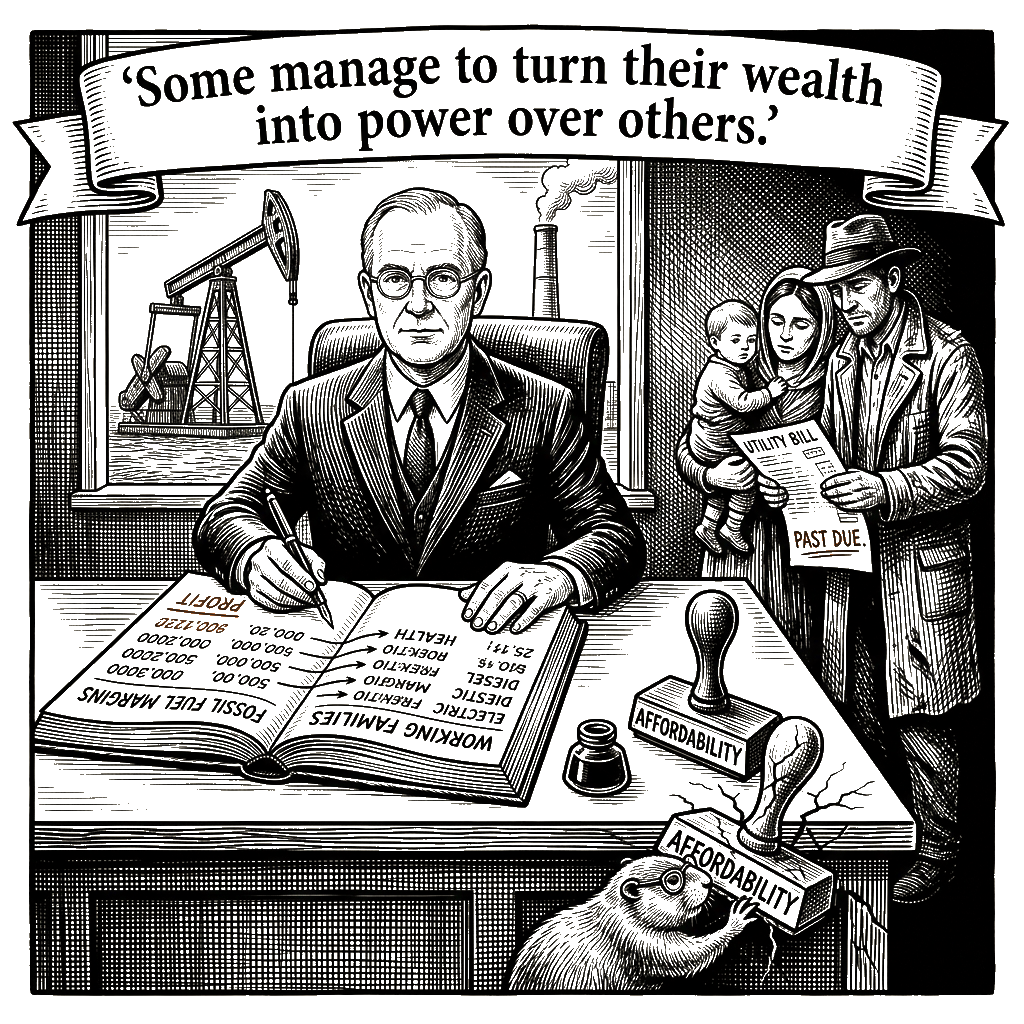
The Republican operative whose career has been spent constructing the electoral machinery of the modern right wants you to think the June 3 primaries left big questions unanswered. His Wall Street Journal column lists more than twenty of them, most structured as Republicans-probably-fine-Democrats-might-be-in-trouble hypotheticals that sound like objective analysis and operate as a permission slip. In the cable years, we built these filters for exactly this moment. When a principal called to ask if the base was panicking, we did not hand them a polling spreadsheet. We handed them vocabulary that kept the capital from fleeing. The piece deploys six distinct techniques across its paragraphs; this column walks through them as they appear.
The primaries Tuesday in California… It’ll be the Brit vs. the Bland in California, as English immigrant Republican Steve Hilton leads the state’s jungle primary for governor with around 28% of the vote. He’ll face off against the uninteresting demeanor of former Health and Human Services Secretary Xavier Becerra, who is taking 25%.
Frame-engineered relabeling (WSJ §4.1) at its most efficient, combined with a four-audience execution inside two sentences. Rove opens by having already won the framing contest before the reader has registered one has been run. Hilton gets two adjectives that do his work for him—“Brit” and “Republican,” a national-origin marker and a party label, each neutral on its face but deployed together to suggest personality and energy. Becerra gets “Bland” and “uninteresting demeanor.” Rove doesn’t say Hilton is more qualified or has better policies. He doesn’t need to. By the time the reader arrives at Becerra’s name, the California electorate has been handed the dramatic-lead vs. the dull-technocrat structure—the same Ailes-era template that served the “silent majority” framing for thirty years. The framing does its work as texture, not argument. The reader absorbs the personality contrast as information rather than as the rhetorical operation it is.
What the passage also does—and this is the deeper operator’s-eye-view read—is the multiple-audience-targeting move (WSJ §4.3) compressed into two sentences. The wealthy reader gets reassurance that their party’s candidate leads; the political-class reader gets the head-to-head matchup they’ll need for donor calls; the populist reader gets the “immigrant Republican vs. HHS Secretary” contrast (outsider energy vs. the administrative state); the technocratic reader gets precise percentages that make the piece feel like reporting rather than spin. We operators built this structure because a single sentence that carries different payloads to different audiences is more efficient than four separate sentences, and the technique’s value is that a scanning reader in any of the four audiences gets their payload without seeing the other three being loaded.
In deep-blue districts, it was a split decision. The more left-wing Democratic candidate, Adam Hamawy, won in New Jersey’s 12th Congressional District with 28%. But in the race to replace Rep. Nancy Pelosi in California’s 11th District, two more-moderate Democrats, Scott Wiener and Connie Chan, will head into the fall election.
Asymmetric labeling operates through predicate pairing here. Watch the asymmetry: the progressive Democrat gets “more left-wing”; the moderate Democrats get “more-moderate.” “Left-wing” is Rove’s preferred frame for progressives—a term that carries cultural baggage beyond policy positioning. “Moderate” is the term the moderates would choose for themselves. Rove may be borrowing intra-party nomenclature—“moderate” is what moderates call themselves—but the asymmetry lies not in the labels themselves but in the predicate pairing: “more left-wing” is a subtle pejorative, “more-moderate” is a term of approval, and the choice to treat one as a descriptor and the other as a concession is the framework’s work. The asymmetric vocabulary is not an accident. It is the technique.
Democrats got the better Senate candidate in Iowa, moving that race from likely Republican to lean Republican. Meanwhile, President Trump got a rare intraparty rebuke in the Hawkeye State, as his endorsed candidate lost the GOP gubernatorial primary. Montana voters rejected the Democratic strategy of running independents in red states, turning out in bigger numbers than in the last midterm to unite behind a Democrat rather than an independent. That creates a three-way Senate race, giving the GOP an edge.
Selective framing of results executed through verb choice and sentence ordering. Three elections, three framings. Iowa—a Democratic win in recruitment—becomes “moving that race from likely Republican to lean Republican,” where the verb “moving” preserves the Republican as the sentence’s gravity center. The Trump-endorsed-candidate loss is noted as a factual concession—the one place in the column where Rove gives an inch. Montana’s Democratic turnout advantage—voters “turning out in bigger numbers”—gets the verb “rejected” as its headline action and ends at the sentence that “gives the GOP an edge.” When Democrats turn out, it’s a GOP advantage. The logic requires a three-way race, but the sentence ordering makes the conclusion land as obvious rather than as the frame selection it is.
The deeper move: Rove’s lede promises “insight into how the midterms are shaping up,” but the actual shape the column reports—better Democratic Senate candidate, Democratic turnout up, Republican governor candidate losing with a Trump endorsement—is not what the framing tells the reader the shape is. The content reports one thing; the framing reports the opposite. That gap between content and frame is the column’s most consistent feature. The operator reads this as a confidence-maintenance operation. The goal is not to report the primary math; it is to keep the donor class from panicking over a fragmented primary field.
Most big questions about November remain unanswered. Will Mr. Trump’s low approval rating—now 40% in the RealClearPolitics average—hurt Republicans more than the Democratic Party’s even lower approval numbers—36.7%—and limit their gains? Will we still be dealing with the Iran war by Labor Day? Will the result be seen as a defeat for Mr. Trump? Will gasoline and grocery prices be lower this fall?…
JAQing off (Bad-Faith Catalog: jaqing_off) is the engine of this section—an interrogation-room softener designed to install doubt without making a falsifiable claim. Rove’s launch into the question-list pivots on a claim that “most big questions about November remain unanswered”—but the questions he then lists are not unanswered questions. They are Republican talking points assembled in interrogative form.
The difference matters. An unanswered question is a genuine empirical unknown: “will gasoline prices be lower by September” is a question whose answer depends on a global commodity market and the Iran war. That question has a factual answer eventually; right now, no one knows it. But “How inflammatory will the president’s Truth Social posts be?” is not an unanswered question. It is the advancement of a claim (Trump’s posts are inflammatory) through interrogative form, with the interrogative shell providing deniability when the claim inside it is challenged. A reader scanning the column absorbs the insinuation—Trump’s social media is a problem—without Rove’s name attached to the assertion. The question form does the work the assertion form would expose to scrutiny.
The trick in the opening pair is the false-choice premise—invite the listener to weigh Trump’s approval against Democrats’ lower number, and the listener’s own mental comparison plants the inference that Democrats are worse, all without the operator ever uttering “Democrats are worse.” By raising the Iran war, gas prices, and grocery costs, Rove is planting the economic-and-national-security anxiety bugs into the reader’s operating system. If the questions are asked, the doubt is installed.
Will the national image of socialists like Mayor Zohran Mamdani and Rep. Alexandria Ocasio-Cortez dominate and damage more-traditional Democratic candidates?… Will Democrats finally settle on an effective economic message? If they don’t, will vague promises to do something about fuel, grocery, healthcare and housing costs be enough to encourage voters to punish Mr. Trump?
The four-audience trick returns here, compressed further into a single paragraph, while the strawman-of-progressive-positions move (WSJ §4.6, selectional strawman) and loaded-question presupposition do the heavy lifting. The populist base gets the socialist scare (“Mamdani/AOC”), reassuring them that the national ticket is still fighting the left wing. The legal class and donor class get the characterization of documented legal exposure as mere “allegations.” The base gets the Trump-inflation question. Each sentence carries a different payload. The reader who scans this paragraph gets a customized hit of reassurance or anxiety depending on where they sit in the political ecosystem.
The strawman move takes the most left-coded figures in the party, treats them as the party’s public face, and invites the reader to believe that the Democrat running in Iowa’s Senate race answers to Mamdani. Rove already told us, in the California paragraph, that moderates won; the question form lets him plant the socialist-Democrats frame while his own reporting contradicts it. The technique is the reverse of the JAQ-off bad-faith form: the question is being asked not because Rove wants the answer but because he wants the framing the question carries to survive the answer the column provides elsewhere.
Then the economic-message question does double work. On its face, it asks whether Democrats will find a message. Underneath, it plants “vague promises” into the question’s predicate—the question presupposes that the Democratic economic message is vague promises, and the only open question is whether that’s sufficient to win. The presupposition enters the reader’s mental model as given, the interrogative form providing the plausible-deniability shell.
The irony, visible to anyone who reads the column’s own earlier reporting: Rove has just told us farmers are paying up to $5.82 a gallon for diesel, fertilizer prices are crushing producers, and voters are angry about fuel and grocery costs. The party in power when voters are angry about fuel and grocery costs is the party voters punish. This is not a complicated piece of political analysis. The column’s own facts support the conclusion Rove’s framing works to suppress.
How much will Mr. Trump’s obsessive efforts to cement a personal legacy—the White House ballroom, a triumphal arch, his name on the Kennedy Center—hurt Republicans?
This is the single most interesting sentence in the column because it’s the one place Rove’s own framing breaks containment. The word “obsessive” is an editorial judgment—not a reporter’s neutral descriptor—and the three examples are all vanity projects, not policy. Rove knows Trump’s self-absorption is a vulnerability, and he knows naming it costs him nothing with the readers who already dislike Trump while signaling to the readers who still support him that the concern is merely electoral (how much will it “hurt Republicans,” not whether it’s wrong or dangerous). The framing positions Rove as the concerned strategist, not the critic—a permission structure for Trump-skeptical Republicans to register their discomfort without having to cross the line into opposition.
But the sentence also does something the rest of the column does not: it names a specific behavior, with specific examples, in Rove’s own observational register rather than in the interrogative shell. The column’s discipline cracks open at the end, and what escapes is a glimpse of what Rove actually thinks—that the president’s monument-building is politically damaging, that the vanity is real, that the legacy project is “obsessive.” When Rove drops the question form and writes in his own voice, the column suddenly becomes a different genre.
That’s the column Rove might have written—the one that names the vulnerabilities on both sides, that reports the Democratic turnout advantage for what it is rather than what the frame needs it to be, that asks real questions whose answers are actually unknown rather than questions that are answers in disguise. But Rove’s employer—the Wall Street Journal editorial apparatus—doesn’t publish that column. The page’s technique inventory requires interrogatives as permission structures and asymmetric framing as house style. The column we got is the column the inventory produces.
Can each party’s troubled nominees mount better defenses than Maine Democrat Graham Platner or Texas Republican Ken Paxton have? How many other campaigns will be hit with such revelations?
Whataboutism (Bad-Faith Catalog: whataboutism) operating as a leveling device equates Graham Platner with Ken Paxton to suggest symmetric moral failure. Paxton’s indictments are a matter of legal record; Platner’s “troubled” status is Rove’s editorializing. The operator reads this as mud-flattening. You drag the other side down to the legal trouble so your guy’s legal trouble looks like standard political skirmishing. When the reader is exhausted by everyone being “corrupt,” they default to their pre-existing tribal loyalty or disengage entirely. This is how we taught focus groups to tolerate ethical failures on their own side: by convincing them the other side was drowning in the same mud.
Will the administration’s focus on fraud in federal and state spending convince voters Republicans are making progress? Or will inadequate results or voter cynicism make it a nothing-burger? This midterm’s contours are reasonably well-known: Democrats are likely to take the House, Republicans favored to keep the Senate. But the known unknowns are enough to keep the election interesting.
Frame-engineered relabeling (WSJ §4.1) and escape-hatch planting operate here to discount the administration’s promised anti-fraud investigations as potentially a “nothing-burger” if the results don’t materialize. This is pre-emptive damage control. If the promised “fraud” investigations don’t produce the political wins the base was sold, Rove has already planted the linguistic off-ramp. The operator recognizes this as a portfolio hedge: if the policy delivers, the donor class celebrates; if it delivers nothing, the author has already provided the vocabulary for the base to walk away without feeling betrayed. The “nothing-burger” frame is the insurance policy.
So here is what Rove’s column actually does, taken as a whole and read against the primaries it purports to analyze.
The primaries showed Democratic turnout up, a Republican governor candidate losing with Trump’s endorsement, and a Democratic Senate recruitment win. The column reframes the turnout advantage as a “rejection” that helps Republicans, reframes the GOP candidate’s loss as a “rare intraparty rebuke” (minimizing the damage by making it sound anomalous when in fact it’s part of a pattern), and reframes the Democratic recruitment win as a marginal ratings shift. Then—this is the crucial operation—the column pivots to a question-litany that takes the structural weaknesses Rove’s own reporting has just surfaced and recodes them as hypotheticals, while taking his opponents’ structural strengths and recoding those as vulnerabilities.
The column is not an analysis of what the primaries showed. It is a post-hoc justification of the existing Republican strategic position, dressed as analysis, delivered through a question-form permission structure that lets the reader absorb the frame without feeling propagandized, written by the man who built the modern Republican electoral machine from inside and who now writes about it as if he were a detached observer. The gap between the column’s content and its framing is the story. The framing is the operation.
Rove is not predicting the midterm outcome. He is building the emotional infrastructure for his clients to survive it. The questions are not meant to be answered; they are meant to be carried. Every reader who leaves this piece wondering about Iran, gas prices, socialist mayors, and a “nothing-burger” investigation has completed the assignment. The doubt is the product. The quarterly portfolio letter has been posted, and the clients have been told they can stay invested.
This is what the Ailes-Limbaugh template looks like in its most refined late-period form: not lies, exactly—the facts are there, the diesel price and the approval rating and the candidate loss are all in the column—but arranged so that the facts support the frame and the frame is invisible and the reader walks away with the impression the frame was designed to produce. Rove knows how to do this. He taught a generation of Republican operatives how to do this. And the Wall Street Journal editorial page, which publishes him weekly, knows exactly what it is printing: a propaganda artifact from the man who built the propaganda apparatus, in the page’s house register, maintaining the page’s house technique inventory in interrogative form.
The primaries answered plenty of questions. Rove’s column just worked very hard to make sure you didn’t notice which answers were unfavorable to the side he spent his career building.
The midterm will decide who governs; this column decides what the donor class feels while waiting.
— Phukher Tarlson