
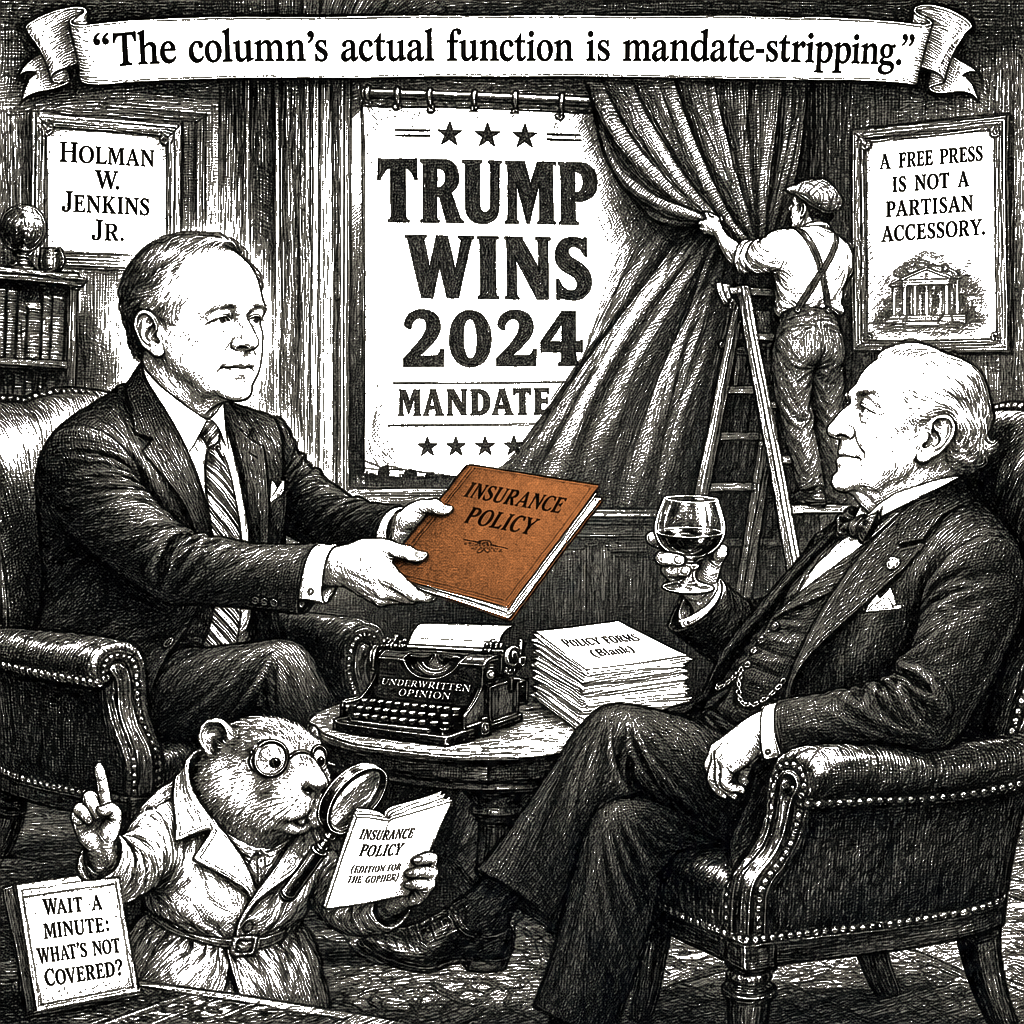
Holman W. Jenkins Jr. published a column in the Wall Street Journal on Tuesday that strings together a multi-count conspiracy narrative — the Biden White House orchestrated criminal prosecutions of Donald Trump to engineer a favorable 2024 matchup, using a staged New York Times leak, a bought-off Georgia prosecutor, and a conveniently revived Manhattan DA — and presents the whole thing as sober analysis. It isn’t analysis. It’s the apparatus rearguard action, refitting a documented campaign collapse into a coordinated hit job. The piece deploys the techniques we built from inside the same opinion-page apparatus across seven distinct moves; the following excerpt-by-excerpt walkthrough names each one as it appears.
A lot more people are responsible for Joe Biden’s decision to run for a second term than Jill Biden, whose delight in being first lady and desire to remain so are evident in her new book. The two parties have a single magnum focus to their existence, the four-year presidential cycle. They don’t spitball — they engage in ruthless strategizing worthy of the Pentagon war room.
Frame-engineered relabeling [WSJ §A.1] opens the long con. Jenkins isn’t a columnist advancing an argument; he’s a war-room analyst reading signals the rest of us missed. When a public-facing message visibly fails — and the Biden campaign’s final six months were a collapse — the operator reframes the failure as a calculated, top-down strategy that simply encountered unpredictable variables. The reader is asked to accept that the 2024 campaign never staggered; it was executing a secret script designed to force Trump into a primary brawl and dodge the debate. This is the apparatus defense we built: sell the frame before you sell the facts, and the reader will absorb the rest as inside knowledge.
On March 24, 2022, with a war raging in Europe, at a NATO summit Mr. Biden signaled the plan to every Democratic official in the U.S. by saying he would be “very fortunate” to have Mr. Trump for a 2024 opponent. … Nine days later, a staged front-page New York Times leak had Mr. Biden criticizing his attorney general, Merrick Garland, for not criminally charging Mr. Trump. … lacking was any Times effort to require the White House to confirm that Mr. Biden had used the words attributed to him or if the leak was authorized. Instead, the paper cooperated in a White House deniability charade with a lengthy quote insisting Mr. Biden sought “no role in investigative priorities or decisions” of the Justice Department.
Manufactured controversy [Bad-Faith Catalog: manufactured_controversy] in its pure form. The evidence that the Times leak was “staged” is that the Times didn’t force the White House to confirm the quote. That’s the entire basis for calling a front-page news story a “staged” operation — the absence of a confirmation that anonymous-source reporting, by definition, does not contain. The alternative explanation — a Times reporter got a leak from someone who wanted Biden to look tough, which is how Washington journalism has worked for a century — is not engaged. Jenkins needs the leak to be “staged” because the conspiracy requires coordination. The conspiracy requires the Times to be in on it. So the Times is in on it. This is how we built the brochure: assert the coordination, offer a single ambiguous detail as proof, move on before the reader asks what proof would actually look like.
On May 23, 2022, and again on Nov. 18, 2022, an attorney working with Georgia county prosecutor Fani Willis met with White House officials. Ms. Willis employed her boyfriend to help an election case against Mr. Trump at a princely $250 an hour, which they soon were spending on vacations in Napa and the Caribbean. Ms. Willis was telling you something with her behavior. Her prosecution of Mr. Trump was a service to the White House. She was entitled to a gratuity.
Selective evidence presentation (a subspecies of manufactured_controversy, drawing on Diethelm & McKee’s selectivity element) combined with innuendo-as-argument (the JAQing-off pattern, Bad-Faith Catalog: jaqing_off). Jenkins reports that a Willis staffer met with White House officials — on dates he specifies, giving the meetings the texture of documented fact — and then leaps to the conclusion that “her prosecution of Mr. Trump was a service to the White House.” The leap is the entire column in miniature. Meetings between a prosecutor’s office and the White House aren’t evidence of coordination; they’re evidence that the prosecutor’s office exists in the same federal government. But Jenkins doesn’t need evidence. He needs the meetings to sit next to the Napa-vacation detail — which is real, documented, and embarrassing — so the reader’s disgust at the vacations bleeds onto the meetings. This is the play we called “loading the dock”: stack enough adjacent facts that sound shady, and the reader supplies the connection.
The day before Mr. Biden’s NATO summit comments and 10 days before the Times leak, the New York Daily News savaged new District Attorney Alvin Bragg for dropping a Stormy Daniels-related investigation. Now Mr. Bragg revived the probe. When charges came down, I had my pick of analysts on the cable business channels … all drawing the identical conclusion: “The indictment would improve Mr. Trump’s chance of winning the nomination while weakening his chance of winning the general election.” Exactly the formula Mr. Biden needed.
The post-hoc-ergo-propter-hoc move with a side of affirming the consequent [Bad-Faith Catalog: affirming_consequent]. Bragg revived a probe after the Daily News criticized him for dropping it, therefore Bragg revived it because Biden needed it. Jenkins supplies no evidence connecting Bragg’s decision to the White House — none. The evidence is the timing. The timing plus the cable-analyst consensus that the indictment was bad for Trump’s general-election chances equals a Biden operation. This is conspiracy-theory construction in its simplest form: take a sequence of events, assert a causal connection, treat the assertion as proven by the sequence itself. If Biden orchestrated prosecutions, we’d see Bragg indict Trump; we see Bragg indict Trump; therefore Biden orchestrated it. Jenkins ignores every alternative explanation, starting with the obvious one: Bragg is an elected Democrat in Manhattan who ran on prosecuting Trump and whose office determined charges were warranted.
The truth was breathed only once in the mainstream press during the campaign that I saw, when the Times noted the Biden White House’s exultation after Mr. Trump stormed to victory in the GOP Iowa caucus. To Mr. Biden’s aides, the paper said, Mr. Trump’s success was Mr. Biden’s “pathway to a second term.”
Multiple-audience-targeting [WSJ §A.3] delivers two mutually exclusive payloads in a single breath. To the populist base, the column offers the gratifying assertion that Trump’s opponents are defined by “unnatural, self-sabotaging moronitude” — a validation that the reader’s preferred candidate wins because the other side is too incompetent to stop him. To the donor class, the column supplies the reassurance that Trump’s victory wasn’t a mandate; it was the product of Biden’s failure, not public support for what Trump is doing. The apparatus tells the base Trump is a force of nature and tells the donor set he’s an illegitimate paper tiger in the same breath — because it knows neither audience reads the other’s page. That is the four-audience trick. The same paragraph shifts from one target to the other, hitting both marks.
But then things went wrong. The criminal cases against Mr. Trump bogged down. Mr. Biden’s Justice Department investigated Mr. Biden himself for mishandling intelligence documents. A special counsel publicly reported that Mr. Biden had acted improperly but was too old and forgetful to prosecute. The ultimate pitfall opened beneath the campaign when polls started showing Mr. Biden losing to Mr. Trump. Now he couldn’t duck the fatal television debate by citing his presidential dignity and Mr. Trump’s felon status. You know the rest of the story.
The “things went wrong” pivot does two pieces of work simultaneously. First, it supplies the conspiracy theory’s built-in immunity: if the conspiracy was so well-coordinated, why did the cases bog down? Answer: “things went wrong” — the conspiracy had setbacks. The setback becomes evidence of the conspiracy’s existence rather than evidence against it. This is the motte-and-bailey pattern [Bad-Faith Catalog: motte_and_bailey] — the strong claim (coordinated prosecution campaign) retreats to the weak claim (Biden wanted Trump as his opponent, which is a political preference, not a conspiracy) whenever the strong claim faces counterevidence. Jenkins doesn’t acknowledge the pivot as retreat; he masks it as narrative inevitability. Second, the pivot reframes the Hur report — which documented Biden’s improper handling of classified documents — as evidence of the conspiracy’s failure rather than as evidence that the DOJ was in fact investigating Biden. The DOJ investigated Biden, found misconduct, and publicly reported it. This is the opposite of a coordinated campaign to shield Biden. Jenkins folds it into the “things went wrong” bin and moves on.
Mr. Trump’s presidency, even its useful accomplishments, owes all to the unnatural, self-sabotaging moronitude of his opponents.
Here Jenkins deploys the column’s payload — the threat-inflation closer [WSJ §A.13] — elevated to thesis statement. The word “moronitude” isn’t analysis; it’s the column’s entire argument compressed into a single sneer. The function is retransmission: the scanner who reads only this paragraph gets the takeaway (Trump’s opponents are morons, his presidency is the product of their incompetence) and the word itself is engineered for social-media lift. We built versions of this cadence across two decades — the closing-line engineered for quotation, the portmanteau insult designed to lodge in the reader’s memory. Jenkins lands it because the column’s architecture has been building toward it: once you’ve accepted that the Biden White House ran a coordinated prosecution campaign, the moronitude conclusion feels earned rather than asserted.
In 2024, his narrow victory (115,000 votes in three states would have changed the outcome) followed when the rival party, in effect, defaulted to a cardboard cutout with no features that it called “not Trump.” Such an election isn’t a mandate for a revolution. Mr. Trump might yet have won the country’s backing for what he was doing. He had every opportunity. But so far his approval ratings show something more closely resembling the opposite.
And here is what the entire column was for — pre-emptive legitimacy-withdrawal [Bad-Faith Catalog: preemptive_legitimacy_withdrawal]. The conspiracy narrative, the “staged” leak, the bought-off prosecutor, the coordinated Bragg revival, the moronitude thesis — all of it lands at this paragraph. The 2024 election wasn’t a mandate. Trump’s victory was the product of his opponents’ incompetence, not public support. The approval ratings confirm it. The column’s function is to strip the election of democratic meaning — to reassure the Journal’s donor-class readership that Trump’s agenda carries no popular legitimacy, that the people who voted for him were voting against cardboard-cutout incompetence rather than for what Trump is doing. This is the move we operators called “the insurance policy”: if the agenda fails or produces backlash, the column is there to say the public never really supported it anyway. The beneficiary is the apparatus that needs Trumpism to be an aberration rather than a democratic outcome.
So here is what Jenkins’s column actually is, taken together.
A conspiracy theory laundered through the Wall Street Journal opinion page, built from innuendo and timing-claims and a single word — “staged” — that does all the evidentiary work the column refuses to do. The piece strings together meetings, prosecutorial decisions, and a Times leak and presents them as a coordinated campaign. The evidence for coordination is that Jenkins says they’re coordinated. The evidence that the Times staged a leak is that the Times didn’t confirm an anonymous-source story — which no newspaper does. The evidence that Fani Willis ran a prosecution as a “service to the White House” is that her staffer met with White House officials — which is what prosecutors’ offices do when they exist in the same federal government as the White House. This is not analysis. This is construction. The reader is handed a conspiracy so total — the leaks, the DA, the Iowa calculus, the Pentagon war room — that no single failure needs to be explained on its own merits. The cognitive decline, the polling collapse, the debate disaster — all of it gets folded into a master-plan that simply misfired. It was not engineered. It fell apart. And the column spends its word count ensuring the reader never has to sit with the simpler, uglier truth: the machinery simply rotted from the inside, and the press built the scaffolding to keep it upright.
Jenkins built a story out of disconnected facts by asserting the connections and treating the assertion as proof. The column’s actual function is mandate-stripping. The donor class that reads the Journal needs Trump’s 2024 victory to carry no democratic legitimacy — to be the product of Biden’s “moronitude” rather than of public support for what Trump is doing. Jenkins supplies the column that fills that need. The conspiracy narrative is the vehicle; the mandate-stripping is the payload. The technique is the long con dressed as a column, and it survives because the reader absorbs the conspiracy before noticing they’ve purchased an insurance policy.
— Phukher Tarlson