
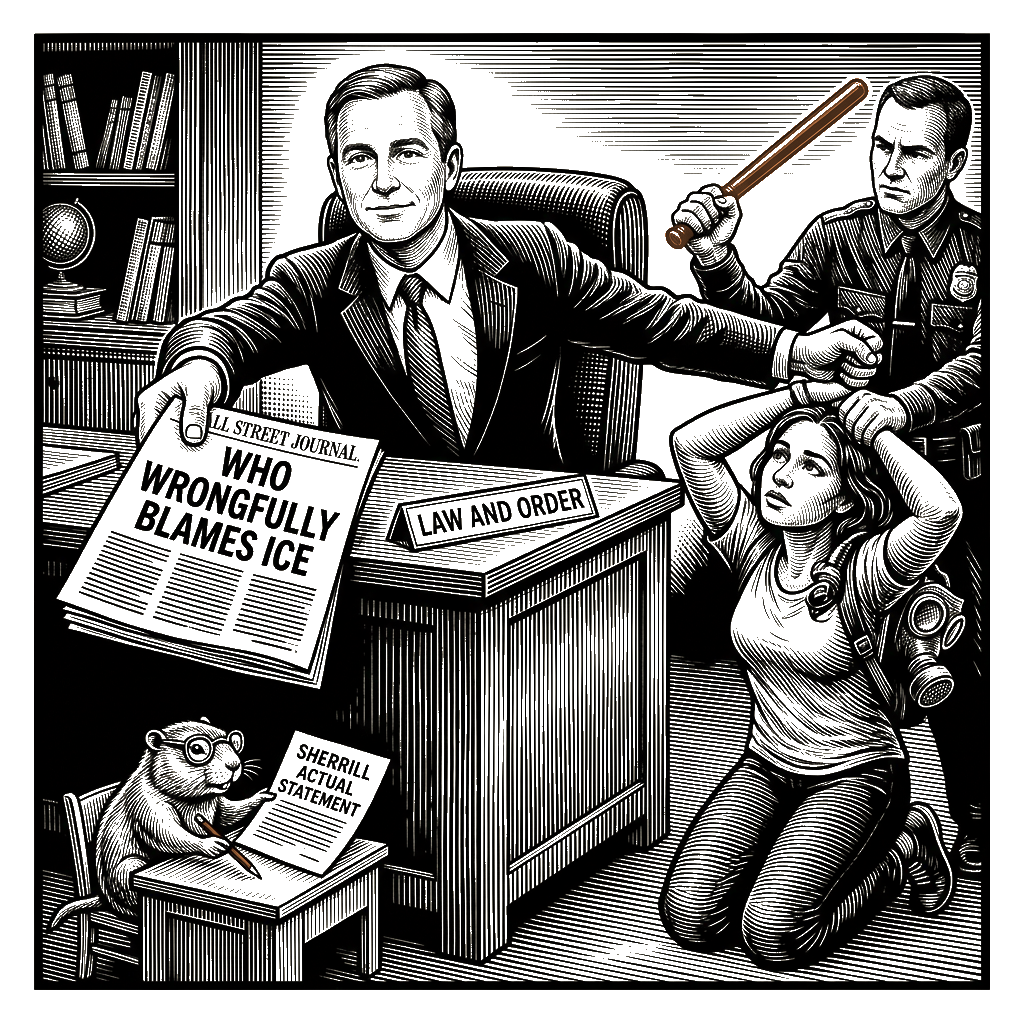
William McGurn’s Tuesday column launders the violence of a federal agency that shot two people dead this winter into a defense of “law and order,” and blames the governor who sent state police to stop the bloodshed for inciting it. When the federal apparatus produces a violent scene, the column’s job — a job we who built versions of these inversions in the cable years know intimately — is to shift the causal arrow away from the state and onto whoever is standing in front of it. The piece deploys four distinct techniques to execute that shift, and this column walks through them as they appear.
Protesters descended on Delaney Hall, an Immigration and Customs Enforcement detention facility in Newark, N.J., this weekend. For a while it looked as though we might see a rerun of Minneapolis, where two people were shot and killed by ICE agents in January amid protests designed to thwart enforcement of immigration law.
Here McGurn deploys the threat-inflation opener — the technique that inflates stakes from concrete to civilizational before the reader has any factual anchor. Minneapolis, in McGurn’s hands, is not the city where an ICE officer shot Renee Nicole Macklin Good through her car window while holding a cellphone. It is “protests designed to thwart enforcement of immigration law,” as if the woman killed inside her vehicle was herself a law-enforcement obstacle, and as if the protests occurred before the shooting rather than after it. The passive construction “two people were shot and killed by ICE agents” buries the shooter’s identity, weapon, and circumstances beneath the grammar of an act of God. This is an agency that has killed at least five people in six months with no officer charged; Judge Patrick Schiltz has issued nearly 100 court orders against ICE’s noncompliance in Minneapolis alone. McGurn’s framing makes the deaths a prelude the protesters authored.
In Minneapolis, ICE agents operated without the cooperation of local and state law enforcement. The chaos made Gov. Tim Walz look hapless and incompetent. The newly installed governor of New Jersey, Mikie Sherrill, is determined not to repeat Mr. Walz’s mistake.
The frame-engineered relabeling — WSJ §A.1 — is working hard here. “Cooperation” is the term the page uses when local governments refuse to subcontract their police to federal immigration raids; “chaos” is the result when they don’t. Walz, who likewise declined to supply bodies for the operation that killed Renee Good, is “hapless and incompetent,” not a governor who faced a federal agency whose agents shot two people in his city. Sherrill’s decision to send state police is framed as a governing choice, but the frame McGurn selects — “not to repeat Mr. Walz’s mistake” — makes the mistake restraining ICE, not creating conditions where a federal officer kills someone. The substitution does its work: the reader absorbs that the mistake is failing to back the agency, and the agency’s conduct disappears from the causal chain.
Ms. Sherrill decided on a very New Jersey solution: Call in state police to set up a security perimeter around Delaney Hall so ICE could do its job. This way she could claim to uphold law and order.
Now the multiple-audience targeting achieves full segmentation. The wealthy reader gets “so ICE could do its job” as reassurance that the apparatus of enforcement will continue and their property interests are not under threat. The political-class reader gets the “law and order” signal, the citable phrase. The populist-base reader gets the dismissive “very New Jersey solution” — the sneer at a blue-state governor whose claim to uphold law and order McGurn will now spend the rest of the column stripping. The technocratic reader gets the structural description. Four audiences, one sentence, and the sentence’s work is to make Sherrill’s action look like a cynical political feint rather than what it was: a governor deploying state resources to prevent a federal agency with a documented body count from killing more people in her state.
But in her public statements, the governor argues that most of the blame for the violence belongs to ICE—instead of the protesters who came to Newark itching for a fight.
At a press briefing Saturday, Ms. Sherrill alluded to Minneapolis. Clearly she intended to draw a contrast between her decisive actions and Minnesota officials’ failure to go after those who caused the mayhem. “I refuse to let that happen in New Jersey,” she said in her best zero-tolerance voice. And she named those responsible for the violence outside Delaney Hall.
“I will not give ICE a pretext to expand operations at Delaney Hall or across our state,” Ms. Sherrill thumped. “I will not put lives at risk.”
These three paragraphs are a selectional strawman executed with the thoroughness of a professional who knows the technique will survive scanner attention because the scanner trusts the attribution. Sherrill did not say “most of the blame for the violence belongs to ICE.” She said she would not give ICE a pretext to expand operations or put lives at risk. A governor who has watched a federal agency kill people and then clash with protesters for days, who has deployed her own state police to create a buffer zone so the agency can do its job without violence — that governor warning against giving the agency a pretext is stating the obvious: the agency has already demonstrated that its operations produce bodies. McGurn’s characterization converts a warning into a “whopper,” a lie, and his readers, who have not heard Sherrill’s full remarks, absorb the characterization as the fact.
This is not merely misrepresentation; it is the strawman plus the “she said in her best zero-tolerance voice” — the tone-policing variant. The content of the statement is suppressed by mocking the manner of its delivery. The reader is invited to hear a performative politician, not a governor making a factually grounded assertion. The Bandura mechanism is distortion of consequences: the consequences of ICE’s operations — the deaths, the baton strikes on protesters that the Reuters dispatch confirmed — are edited out; what remains is a governor “thumping” about a whopper.
It’s a whopper, but New Jersey being what it is—a blue state whose gerrymandering will only get worse under Ms. Sherrill—no one questioned it. Even though the truth of the violence she condemns is obvious to anyone who watches the news.
The “blue state” / gerrymandering aside is the piece’s signal to the populist-base reader that the entire state apparatus is corrupt and the governor is an illegitimate operator. The phrase “no one questioned it” invents a consensus that did not exist. And “the truth of the violence she condemns is obvious to anyone who watches the news” is a classic McGurn move: the violence he names is the protesters’, not ICE’s. The sentence collapses the two into one so the reader does not perceive the distinction.
Whatever one’s views of ICE, it manifestly isn’t the problem in New Jersey. These well-supplied protesters mean business. TV footage shows them stocked with gas masks, respirators, goggles and hard hats. They threw rocks and other objects, and they pushed barricades at the state troopers and police. Federal and local police made between two dozen and four dozen arrests.
Now the page shifts into its crime-wave register, listing the protesters’ equipment as if the presence of gas masks at a protest where a federal agency has used batons is evidence of menace rather than self-protection. “Well-supplied” — gas masks, respirators, and hard hats, standard protective gear for citizens facing federal agents wielding chemical irritants and kinetic impactors — is relabeled as paramilitary provisioning. The operator’s instinct is to invert the equipment standard: when the state brings batons and firearms, it is “law enforcement”; when citizens bring goggles and helmets, it is a “well-supplied” insurgency. The column refuses to document what ICE brought to the perimeter because doing so would force a comparison the column cannot survive. The equipment inversion is a confidence trick meant to make the reader see federal agents as the vulnerable party and citizens as the occupiers.
The enumeration of thrown objects and barrier-pushing — crimes that would, in any other context, be described as disorderly conduct — is inflated by the surrounding framing into something that licenses calling the protesters “well-supplied” and “meaning business.” The word “riot” doesn’t appear here; it will arrive later, after the reader’s affective response has been built. This is the sequence: first the equipment, then the arrest count, then the violence, then the label. The label lands on prepared ground.
One of these was Nicholas Scelfo. During the protests he was filmed by independent journalist Nick Sortor screaming at ICE agents: “Your children, your wife—all dead! I have your face, m—f—! You’re dead! Dead!” Within 24 hours the Federal Bureau of Investigation had Mr. Scelfo in custody thanks to facial recognition technology.
In the cable years we called this the “isolate the worst, and make him the whole.” Scelfo’s threat is genuinely grotesque and his arrest is a legitimate law-enforcement outcome. The technique is in the structural placement: after building the affective case against protesters as a dangerous class, McGurn now supplies one individual whose conduct is so beyond the pale that it retroactively justifies everything said about the group. This is the composition fallacy — taking the property of one part and attributing it to the whole — wedded to the folk-devil construction the editorial page has relied on since the 1970s. Scelfo is the outlier manufactured into the norm.
In a Friday tweet announcing the arrest of another protester, acting Attorney General Todd Blanche included photos of bloody bites the man allegedly inflicted on ICE officers. “These riots are clearly not ‘peaceful protests’ as you can see from the photos of these horrific wounds,” Mr. Blanche said.
The word “riots” arrives. The build-up is complete. McGurn, who has spent the previous paragraphs describing criminal conduct that ranges from throwing rocks to screaming death threats, now has the cover he needs to apply the label, and he borrows the acting attorney general’s words to do it, so the label carries the authority of a federal law-enforcement official. The scare quotes around “peaceful protests” are the asymmetric application the page’s style is known for: the protesters’ self-description is bracketed as dishonest, while “riots” appears unmarked, as the objective term.
Still Mr. Sherrill sticks with her narrative that the unrest is due to officers trying to enforce the law rather than protesters defying the law. It doesn’t pass the straight-face test. The longer the unrest goes on, the harder it will be to maintain the fiction that ICE is the bad actor here.
“The straight-face test” is a rhetorical move, not an argument. It functions exactly like the page’s “of course” and “obviously” markers — it signals to the reader that the conclusion is already settled and requires no further evidence. And the word “fiction” is doing the same work “whopper” did earlier: Sherrill’s actual position — that an agency that has killed people should not be given opportunities to do more of that — is disappeared into a fairy tale. The governor who deployed her own police to stop the violence is now the one “sticking with a narrative,” as if the federal agency’s conduct were the story she invented and the protesters’ violence were the story McGurn discovered.
The irony is that it’s the protesters themselves who are exposing this fiction. No one still believes these protests are driven by the horrible treatment of those detained at Delaney. A few days ago we were all talking about the protesters’ claim that maggots were in the food served to inmates, which Homeland Security denied. It is also becoming clear ICE isn’t the only enemy for the protesters. Over the weekend they happily did battle with the New Jersey police Ms. Sherrill called in to protect protesters from ICE.
The maggot-claim dismissal is a clean example of the page’s source-citation asymmetry. Homeland Security denied the claim, McGurn reports it as settled fact, and the move serves as evidence that the protesters are not motivated by genuine concern about detention conditions. The agency accused of the misconduct is treated as the authoritative source on whether the misconduct occurred. And the assertion that protesters “happily did battle” with State Police is a characterization, not a reported fact; it attributes a motive and an emotional state McGurn cannot verify, and it does so because the reader who absorbs “happily did battle” absorbs that the protesters are not citizens exercising a right but combatants seeking a fight.
This may be a clever way not to offend the Democratic base, but the protesters don’t have much patience for the democratic process—or the Democratic Party. They are interested in chaos, as their actions make perfectly clear.
The pivot from description to ideology deploys the page’s signature “they don’t really care about [X]” frame. The protesters are not interested in detention conditions or immigration policy or the democratic process; they are interested in chaos. The claim is wholly unverifiable — it attributes a unified motive to a diverse group of people — but that is the point. Once the reader accepts that the protesters are chaos-seekers, the policy question dissolves. There is no political compromise to be negotiated with chaos-seekers; there is only force.
They enjoy the protests. They enjoy clashing with police. Does anyone think they care about the quality of food or medical attention inside Delaney Hall? The last thing they want is a political compromise that would take them off the streets.
“They enjoy the protests.” This is the psychological pathologizing of dissent, deployed when the material claims cannot be answered. The column invokes the detainees’ conditions — maggots in food — and uses Homeland Security’s denial to dismiss all protest motivation as pathological enjoyment of chaos. We who drafted memos of this kind know the exact function of the “they enjoy it” formulation. It absolves the state of answering the underlying question — are detainees safe? — by diagnosing the questioners as thrill-seekers. The column pathologizes the citizenry’s presence on the street to protect the conditions inside the facility from scrutiny. And the closing cadence — “take them off the streets” — is engineered for retransmission: the scanner who remembers only the last three words absorbs that the streets are being taken, the protesters are takers, the governor who “wrongfully blames ICE” is the one who let them take.
McGurn’s column, taken whole, is a permission structure of the kind the Journal’s editorial page has been building for decades. It gives the reader who benefits from the ICE apparatus a way to feel righteous about that apparatus by making the people who protest it into a mob that enjoys violence, and by turning the governor who tried to prevent more bodies into a liar who blames the agency for the violence the mob brought.
The apparatus McGurn defends killed Renee Good in January and killed a second person in the same Minneapolis operation. Its agents have used batons on protesters in Newark. The governor who called in state police to create a buffer zone so the killing would not spread to her state is the person McGurn’s column makes into the villain. The agency that did the killing is the piece’s beleaguered public servant. This is the inversion the editorial page exists to perform: the violence of the powerful is reframed as the maintenance of order, and the attempt to restrain it is reframed as incitement.
We who built versions of this technique in the cable years called it the long con — the sustained campaign to make the reader confuse the protection of accumulated power with the protection of law. McGurn’s column is a minor installment in the project of laundering state violence into civic duty. Federal batons become rhetorical pretexts; protective goggles become paramilitary supplies; a governor’s de-escalation order becomes a “whopper.” The piece asks the reader to believe that the people bringing the force are the ones being victimized by the people standing in its path. The violence remains unnamed, defended, and dressed in law. Read it again: every time “protesters” appears, substitute “people who do not want the federal government killing anyone else.” The frame collapses; the permission structure is exposed.
— Phukher Tarlson