
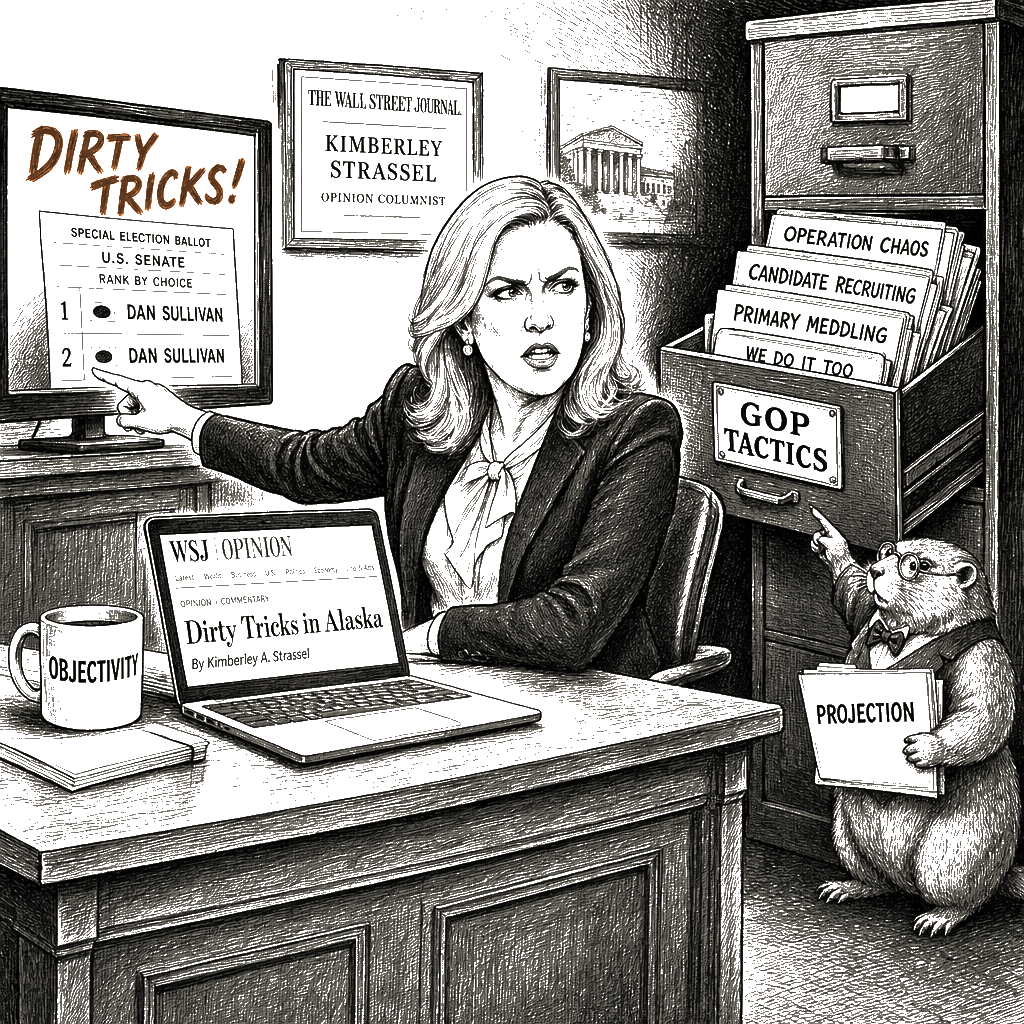
Kimberley Strassel’s June 3 newsletter opens with a headline about Democratic “dirty tricks” in Alaska. The piece is an operation — a clean, professional deployment of the same techniques the Journal’s editorial page has refined across generations of scribes, some of whom we sat beside in the shop. The operation this week is the grievance‑ratification‑and‑conscience‑soothing combo: manufacture an enemy outrage, project exactly the tactics the in‑group uses onto that enemy, and then let the reader feel that characteristic two‑for‑one — righteous about the principle, comfortable about the power. Strassel invents a Democratic conspiracy to protect a vulnerable incumbent, demands party leaders disavow a candidate they have never met, and pivots to a Maine sexting scandal the moment the Alaska narrative evaporates. I’ll walk through the machinery as it appears on the page.
Democrats are desperate to win back Congress, and desperation sows bad behavior. That’s on display in Alaska, where a man named Dan Sullivan on Friday announced he was running for the Alaska U.S. Senate seat—against sitting Sen. Dan Sullivan. Both men could appear on Alaska’s August 18 jungle primary ballot with an “R” behind their name, and both could advance to also appear on Alaska’s ranked‑choice general‑election ballot. In a close race, the clone Sullivan could siphon enough confused votes away from the real Sen. Sullivan to hand the race to Democratic candidate Mary Peltola.
Strassel’s opener is a textbook frame‑engineered relabeling — Bad‑Faith Catalog ID: frame_engineered_relabeling — and she lands it in the first clause. “Desperation sows bad behavior” imports a conclusion the rest of the piece will treat as a finding. It’s a classic “don’t say we’re doing the thing we’re accusing them of, say they’re doing it first” opener. The term clone Sullivan is the load‑bearing substitution: it converts a candidate who shares an extremely common name into a manufactured organism, a doppelgänger fabricated by a hostile party. The phrase does the argument’s work, and Strassel never has to prove Democratic coordination because the label implies it. By the time she writes could siphon enough confused votes away from the real Sen. Sullivan — note the possessive “my constituents” waiting in the wings — the phrase has already done the conviction.
But the confusion narrative collapses the moment you look at what Alaska’s actual ballot architecture does. The state’s ranked‑choice voting system was adopted by citizen initiative with the explicit purpose of eliminating the spoiler effect: voters rank candidates, so a name‑alike doesn’t “siphon” votes unless a voter ranks only one Sullivan and leaves the other off entirely — a choice, not confusion. The incumbent has near‑universal name recognition, years of statewide press, and a party label that distinguishes him from a non‑party challenger. Strassel’s alarm requires a model of voter behavior in which Alaskans stare blankly at a ballot, unable to tell one Dan Sullivan from another despite one being the sitting senator they’ve been casting ballots for since 2014. The system was designed to handle far more sophisticated spoiler risks than a shared surname. If anything breaks, it’s the fantasy of a helpless electorate the piece needs to sustain the frame. We called this “loading the dock” in the editorial‑page war rooms: plant the suspicion of a dirty trick in the headline so it never has to do the heavy lifting of proving it later.
At the very least, Senate Minority Leader Chuck Schumer and Democratic Senatorial Campaign Committee Chairman Kirsten Gillibrand, should be asked if they knew about—or will disavow—these shenanigans.
Strassel isn’t asserting Schumer and Gillibrand were involved; she’s “just asking” whether they knew, or will disavow. The asking‑the‑question / JAQing‑off move — catalog ID: jaqing_off — is deployed with a veteran’s touch. The presupposition is that there is something to know — that the campaign is an operation run out of the DSCC — and that any answer short of “we disavow this thing we didn’t do” is evidence of guilt. We built this in the cable years: the interrogative that functions as an accusation, with the question’s frame doing the work the declarative sentence can’t. The Associated Press reports that both the Peltola campaign and the Alaska Democratic Party have denied any involvement; Strassel doesn’t cite those denials because the question’s power rests on the implication, and denying an implication is a sucker’s response. The piece treats the implication as the record and moves on. The broader device is the disavowal trap, a closed loop of bad faith. If the Democratic leaders issue a statement saying they have never heard of the man, the operators spin it as a carefully lawyered non‑denial designed to maintain plausible deniability. If they decline to dignify an absurd accusation, the operators spin the silence as a tacit admission. The demand to disavow is not an attempt to uncover information; it’s a mechanism for manufacturing guilt by association where the associative thread does not exist.
Democrats for a decade have been meddling in GOP primary elections (boosting candidates they hope will be easier to defeat in a general election), and the GOP has also started to get in on that game. But a decoy campaign is really, as Kendall says, politics at its worst.
Here Strassel executes what she probably thinks is a display of even‑handedness. Instead, she inadvertently proves institutional equivalence. The sentence “the GOP has also started to get in on that game” is a concession that the playbook — recruiting candidates to shape the other party’s primary outcomes — is standard operating procedure on both sides. The Nebraska Democratic primary earlier this spring featured two candidates each accusing the other of being a “fake” entry, with one explicitly called a GOP plant; the tactic isn’t exotic, it’s mundane. When Strassel then brackets the Republican version as less than a “decoy campaign,” she isn’t making a principled distinction; she’s declaring team loyalty. The asymmetry is the product, not the evidence: the same behavior gets named “meddling” when your side does it and “a decoy campaign” when the other side does, and the naming is what manufactures the outrage. That’s selective moral outrage, Playbook §5.15 — identical conduct moralized differently depending on whose jersey the actor is wearing. The concession gives the game away, because it admits the tactic is bipartisan while still pretending the moral weight falls only on one side.
Maine’s putative Democratic Senate nominee Graham Platner is brushing aside new revelations about his “sexting” behavior, bashing media outlets for engaging in “journalist malpractice” by focusing on what he terms “gossip.” If anything, the media is tiptoeing around the most damaging aspect of the sexting story: the timeline. The dates of this escapade blow up the excuse Platner has used to wipe away his long history of obnoxious behavior: that all that bad stuff belonged to a prior period of “dark” feelings.
Strassel pivots from the Alaska decoy candidate to a different Democratic candidate’s personal life, and the pivot is the operation’s threat‑inflation closer working in reverse: the Alaska story isn’t strong enough to carry the weight of the scandal frame on its own, so Strassel stacks the Platner scandal on top to create the composite impression of a party in moral freefall. The bricolage is the point: Dan Sullivan name‑games + Graham Platner sexting = Democrats are cheating. The technique is guilt‑by‑association across three thousand miles of geography and entirely unrelated scandals, and Strassel’s craft is to make the sequence feel like it’s all one story. It’s a Gish gallop at the newsletter scale — fire enough charges in sequence that the reader’s takeaway is the general charge (Democrats are corrupt), not the strength of any single bullet. And the gallop is enabled by the format itself. The “All Things with Kim Strassel” newsletter is a listicle — a series of segmented blocks, each introduced with a stand‑alone paragraph, separated by nothing but sub‑headlines. There are no grammatical transitions, no logical connectives, no “therefore” or “separately” required. That structure is camouflage. It lets Strassel drop the Alaska item on top of the Maine item without ever connecting them, so the reader’s brain supplies the missing causal link — Democrats cheat, in multiple ways, simultaneously — and the missing link feels stronger for never having been stated out loud. The medium does the logical‑fallacy work; Strassel just loads the items. We operators called this move “changing the channel”: when a planted story fails to take root, the apparatus immediately floods the zone with a genuine scandal from a different jurisdiction and stitches the two together under a thematic umbrella to preserve the macro‑narrative even when the micro‑narrative has evaporated.
The Platner controversy raises a fascinating question for voters: How much history can an aspiring politician credibly write off to “youth” or a “bad” period?
The theme‑drift into the universal is exquisite. Strassel began the piece with a specific allegation of electoral fraud; by this graf she has elevated the frame to a philosophical inquiry about character and redemption. This is moral justification — Bandura’s mechanism — layered over the whole artifact. The individual instances become evidence for a deeper truth about the Democratic Party’s moral rot, and the reader who absorbs the frame doesn’t need to verify that the DSCC recruited a clone Sullivan because the frame has already told them Democrats cheat. The two stories aren’t logically connected, but Strassel’s structure makes them feel like two counts of the same indictment, and the feeling does the work the facts never have to.
So here is what the piece, taken whole, actually does. It reframes a confusing ballot coincidence as a coordinated electoral fraud. It ignores documented denials from the accused campaigns and state party. It stacks an unrelated personal scandal from Maine to manufacture the impression of systemic corruption. It deploys the interrogative‑as‑accusation to imply coordination it cannot prove. It applies asymmetric moral outrage to shield the in‑group from the same scrutiny it directs at the out‑group. And it does all of this in the signature register of the Journal’s unsigned editorial voice — the voice that has been laundering donor‑class interests through the language of principle since Grimes first put the credo on paper.
The operation is not especially sophisticated. It’s the same play the page has been running since the Luntz memos: manufacture a scandal, label it the work of a corrupt out‑group, project the in‑group’s own tactics onto that out‑group, and then let the reader’s existing tribal loyalties carry the conclusion. The machinery works because it never has to prove coordination. It works because Dan Sullivan is the name of the incumbent and the name of the challenger, and the coincidence is genuinely confusing, and the confusion is genuinely useful to Peltola — regardless of whether anyone in the DSCC engineered it. The machinery doesn’t need a smoking gun; it needs a plausible story, and Strassel supplied one.
That’s the operation in plain words: it’s a con — the long con we ran for a decade and a half — dressed as analysis. The con tells the audience they are victims of a conspiracy, that their victimhood licenses whatever they need to do to win, and that anyone who questions the conspiracy is part of it. The con is old. The machinery is refined. And Strassel’s piece is a veteran’s rotation through the shop — clean, professional, and dishonest in every structurally familiar way.
The piece is not reporting. It’s a permission structure. It’s a conscience‑soothing operation for an audience that wants to believe the other side cheats, so that the audience doesn’t have to examine whether its own side does. It supplies the reader with the righteous‑cheated‑feeling that makes the next election‑cycle dirty trick feel not just tolerable but earned. And Strassel — the professional, the veteran, the Bradley Prize recipient — files it like clockwork, knowing exactly what the machinery produces, because that machinery was built for this. The column supplies the conscience‑soothing machinery, and the machinery runs on the asymmetry it builds. The permission she grants her readers is this: you can support a Republican Party that has, in multiple states, recruited sham candidates, supported election‑denial litigation, and purged voter rolls in ways that disproportionately affect Democratic‑leaning constituencies — and you can do so without moral discomfort, because the other side is worse. The machinery is designed to be unidirectional.
— Phukher Tarlson