
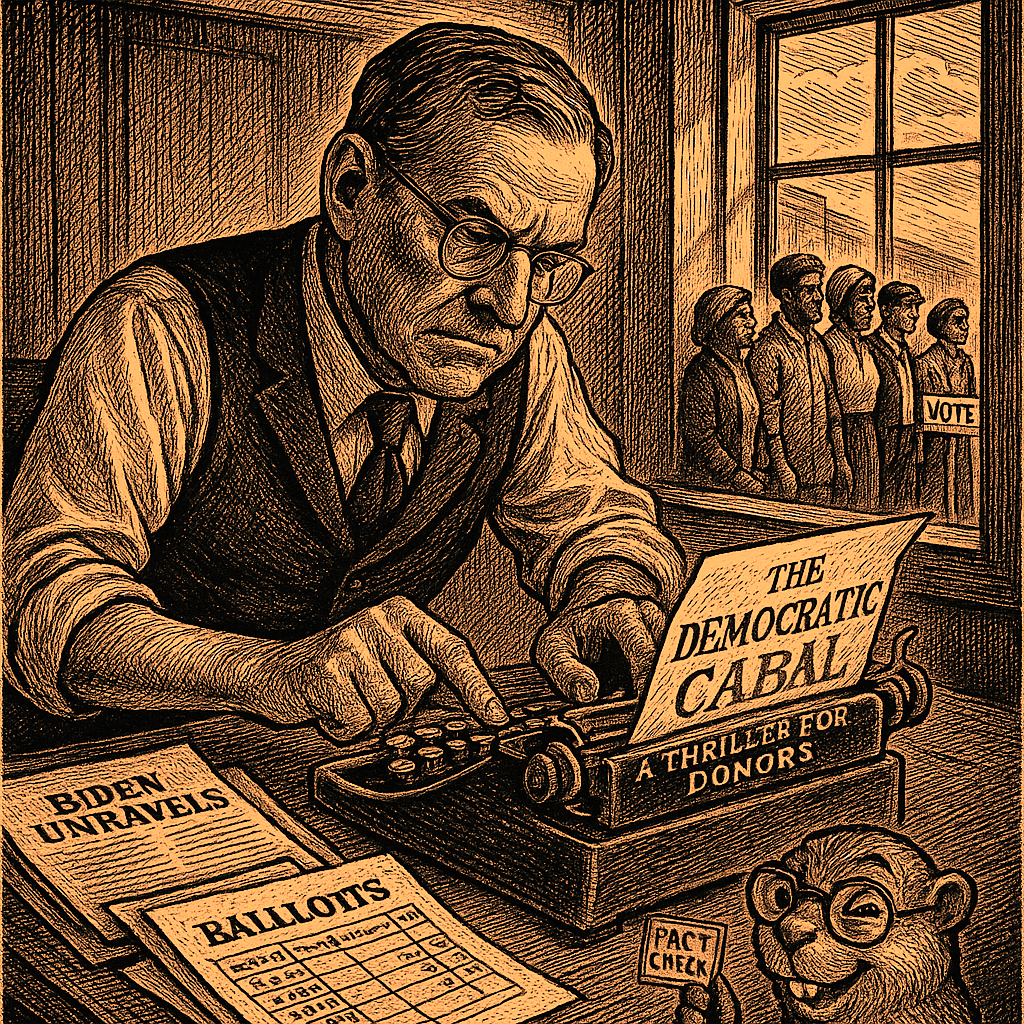
Holman Jenkins Jr. peddles a conspiracy theory to his donor-class readership. His June 2 column, “Don’t Blame Jill for Joe,” dresses the Democratic Party’s decision to run a functionally incapacitated president to the finish line as the work of a handful of aides who exploited the justice system, a rushed timeline meant to make the press an accomplice, and a single television debate. For a decade and a half we sold this exact species of plausible-deniability hit job for this exact editorial page; the operator’s-eye view follows.
A lot more people are responsible for Joe Biden’s decision to run for a second term than Jill Biden, whose delight in being first lady and desire to remain so are evident in her new book. The two parties have a single magnum focus to their existence, the four-year presidential cycle. They don’t spitball—they engage in ruthless strategizing worthy of the Pentagon war room.
The column opens with a feel-your-pain hook for the donor-class spouse — the classic permission structure that lets the reader feel they are defending a gracious lady while being pulled into a much darker assignment. The headline signals “Don’t Blame Jill,” but the column blames everyone but the institution that actually put Biden’s name on the ballot and hid his decline. The reader’s conscience is soothed before the first accusation is even aired. Then Jenkins invents a hyper-competent “Pentagon war room” to explain a campaign that visibly lacked competence on its best days. When a piece characterizes a stumbling, geriatric campaign as a ruthless, masterminded conspiracy, it is doing the donor-class reader the favor of relieving them of the actual, chaotic reality of democratic decay. The receipt is the public record of the June 2024 debate, where the “mastermind” strategy yielded a candidate who visibly trailed off into incoherence. Jenkins substitutes a thriller plot for the banality of institutional rot. It is a shell game that protects the donors from examining the actual product they were buying.
On March 24, 2022, with a war raging in Europe, at a North Atlantic Treaty Organization summit Mr. Biden signaled the plan to every Democratic official in the U.S. by saying he would be “very fortunate” to have Mr. Trump for a 2024 opponent.
Conspiracy logic is assembled here with a single plank. An offhand remark at a NATO summit is injected into the bloodstream of the reader as evidence of a master plan. Anyone who has ever been in the room at a newspaper editorial meeting recognizes this technique: the candidate’s own bad luck turned into proof of premeditation. The marker of the analytical method is the phrase “signaled the plan to every Democratic official” — the editorial board’s weaponized hindsight, funneled into a land-mine of innuendo.
Nine days later, a staged front-page New York Times leak had Mr. Biden criticizing his attorney general, Merrick Garland, for not criminally charging Mr. Trump. We can suspect the leak was staged because lacking was any Times effort to require the White House to confirm that Mr. Biden had used the words attributed to him or if the leak was authorized. Instead, the paper cooperated in a White House deniability charade.
In the cable years, we called this “loading the dock” — planting a conspiratorial narrative in the reader’s mind by framing an absence of evidence as evidence of a cover-up. The plain-language naming: this is a baseless conspiracy claim dressed as inside-baseball political analysis. Jenkins asserts that the Times actively cooperated in a charade, relying entirely on the structural absence of an explicit denial. It is an argument from silence, elevated to a federal indictment, functioning to inoculate the reader against future mainstream reporting by preemptively casting any favorable coverage of the opposition as evidence of a “charade.”
On May 23, 2022, and again on Nov. 18, 2022, an attorney working with Georgia county prosecutor Fani Willis met with White House officials. Ms. Willis employed her boyfriend to help an election case against Mr. Trump at a princely $250 an hour, which they soon were spending on vacations in Napa and the Caribbean. Ms. Willis was telling you something with her behavior. Her prosecution of Mr. Trump was a service to the White House. She was entitled to a gratuity. The day before Mr. Biden’s NATO summit comments and 10 days before the Times leak, the New York Daily News savaged new District Attorney Alvin Bragg for dropping a Stormy Daniels-related investigation. Now Mr. Bragg revived the probe. When charges came down, I had my pick of analysts on the cable business channels (where outright partisan lying is frowned upon) all drawing the identical conclusion: “The indictment would improve Mr. Trump’s chance of winning the nomination while weakening his chance of winning the general election.” Exactly the formula Mr. Biden needed.
Here Jenkins deploys the JAQing-off tag-team. He doesn’t quite say that the White House directed Alvin Bragg to indict Trump. He just lines up the dates chronologically, inserts a conspiratorial wink, and lets the reader finish the thought. We ran this technique for years: the strategic absence of a direct accusation makes the reader supply the conclusion, which makes the conclusion harder to dislodge. For the reader who wishes to believe the Biden White House was pulling levers, the timeline is delivered like a prosecutor’s closing argument, without the inconvenience of actual evidence linking the subject to the predicate. And a $250-an-hour contractor who was already an approved special prosecutor — a rate standard for elite corporate external counsel — is framed as bribery. The technique is the most familiar one in our catalogue, WSJ §A.4: the go-to-market rewrite of a fixed-fee employee into a “gratuity” (one complete with vacations in the Caribbean) so that a legally authorized prosecution reads as a private banquet. We wrote the “entitled elites” narrative for years for this readership; here it is now performing the same function for a new party’s embarrassment — cast a government salary as a payoff so your audience can feel that the whole thing was a con.
But conspiracy machines need failure ports, or the reader might notice they were sold fiction.
But then things went wrong. The criminal cases against Mr. Trump bogged down. Mr. Biden’s Justice Department investigated Mr. Biden himself for mishandling intelligence documents. A special counsel publicly reported that Mr. Biden had acted improperly but was too old and forgetful to prosecute. The ultimate pitfall opened beneath the campaign when polls started showing Mr. Biden losing to Mr. Trump. Now he couldn’t duck the fatal television debate by citing his presidential dignity and Mr. Trump’s felon status. You know the rest of the story.
Notice the structural vanishing act. Jenkins races past the actual finding — Robert Hur’s report concluded that Joe Biden, while still in office, mishandled classified documents and was too diminished to stand trial — and frames the Democrats’ debacle as a series of mechanical slip-ups. He deploys what the WSJ catalogue at §A.10 calls the “locus-of-shift” technique: the Biden operation is painted not as a corrupt machine that foisted a failing candidate on the electorate but as a series of compartmentalized “errors.” We used this when the donor class wanted to talk about tax cuts while the groundwork was being laid for bloodbath-level welfare policy. The hand that feeds the beast is never pictured. Jenkins compresses a six-month national reckoning about a sitting president’s cognitive decline into a convenient “pitfall” that the campaign merely failed to “duck.” He absolves the political establishment — including outlets like the Journal, which spent years framing Biden’s age as a manageable non-issue until it became electorally inconvenient — from the structural failure that kept a visibly declining candidate on the ballot. It is a con that sells the reader a mechanical failure instead of the truth: the apparatus broke because the product was broken.
The truth was breathed only once in the mainstream press… when the Times noted the Biden White House’s exultation after Mr. Trump stormed to victory in the GOP Iowa caucus. To Mr. Biden’s aides, the paper said, Mr. Trump’s success was Mr. Biden’s “pathway to a second term.”
The data point he needs for the conspiracy to hold is carried by a “one time” mention in a mainstream outlet that he simultaneously claims suppresses the truth. This technique — the closed-loop citation — is identical to how we used to cherry-pick New York Times corrections to prove the entire paper was unreliable. The very source the readership is trained to despise is mined for the single fact that validates their grievance, turning cognitive dissonance into a structural pressure valve. The reader walks away convinced the liberal media always buries the truth, even as they’ve just been fed a truth from the liberal media. The logic folds in on itself, but the audience’s grievance stays perfectly alive.
Mr. Trump’s presidency, even its useful accomplishments, owes all to the unnatural, self-sabotaging moronitude of his opponents. An all-suffusing misplaced sense of propriety shouldn’t stop us from seeing the truth… Such an election isn’t a mandate for a revolution.
And there it is. After six hundred words of innuendo designed to persuade the donor class that the justice system is a pet of the Democratic National Committee, the closing line gives them the money shot: Trump’s only virtue is that his opposition is even more idiotic than he is. This is a classic motte-and-bailey of electoral legitimacy: retreat to the defensible position that “the opposition is incompetent,” while smuggling in the radical, undemocratic claim that a narrow electoral victory is not a mandate. The operator’s-eye view recognizes this as a pre-emptive inoculation. By framing Trump’s victory as a historical accident born entirely of Democratic “moronitude,” the piece insulates Trump’s actual policies from democratic accountability. If the winner didn’t earn the mandate, his agenda does not require public consent; it only requires the absence of opposition. Jenkins asserts this as “the truth” to shield his readership from the actual reality: millions of Americans, including plenty who read the Journal, voted for Trump and meant it. We have spent decades feeding this reading audience a low-grade contempt for the political intelligence of everyone outside the country club; Jenkins’ closing provides the high-end version. It allows the Rockefeller-class reader to feel magnanimous about even the “useful accomplishments” of an authoritarian-style president, provided they can also feel the superiority of being the smartest people in the room. The whole operation is what the Collective Ego Playbook calls a “Prosectorial Concession” narrative — the systematic inversion of a functioning justice system into a puppet show run by the opposition, so the donor class can feel the victim rather than the patron.
So here is what the “Pentagon war room” and the “shadow cabal” amount to when the smoke clears. They amount to a comfort story for the donor class: a thriller plot to keep them from confronting the actual verdict of the ballot box. The “moronitude” of the opposition is a convenient fiction. It absolves the electorate. It absolves the donors. It transforms a democratic verdict into a clerical error. Jenkins builds the donor class a narrative that lets them feel betrayed, not guilty, for funding the chaos they nudged Joe Biden to walk through. We built these narratives in the cable years. We know how they work. They are the anesthetic for a donor class that cannot admit it lost a fair fight for the soul of the country, so it invents a rigged one it somehow lost instead. That is the medicine the donor class won’t swallow: millions of Americans voted for Trump and meant it, and no thriller plot overwrites a ballot box.
— Phukher Tarlson