
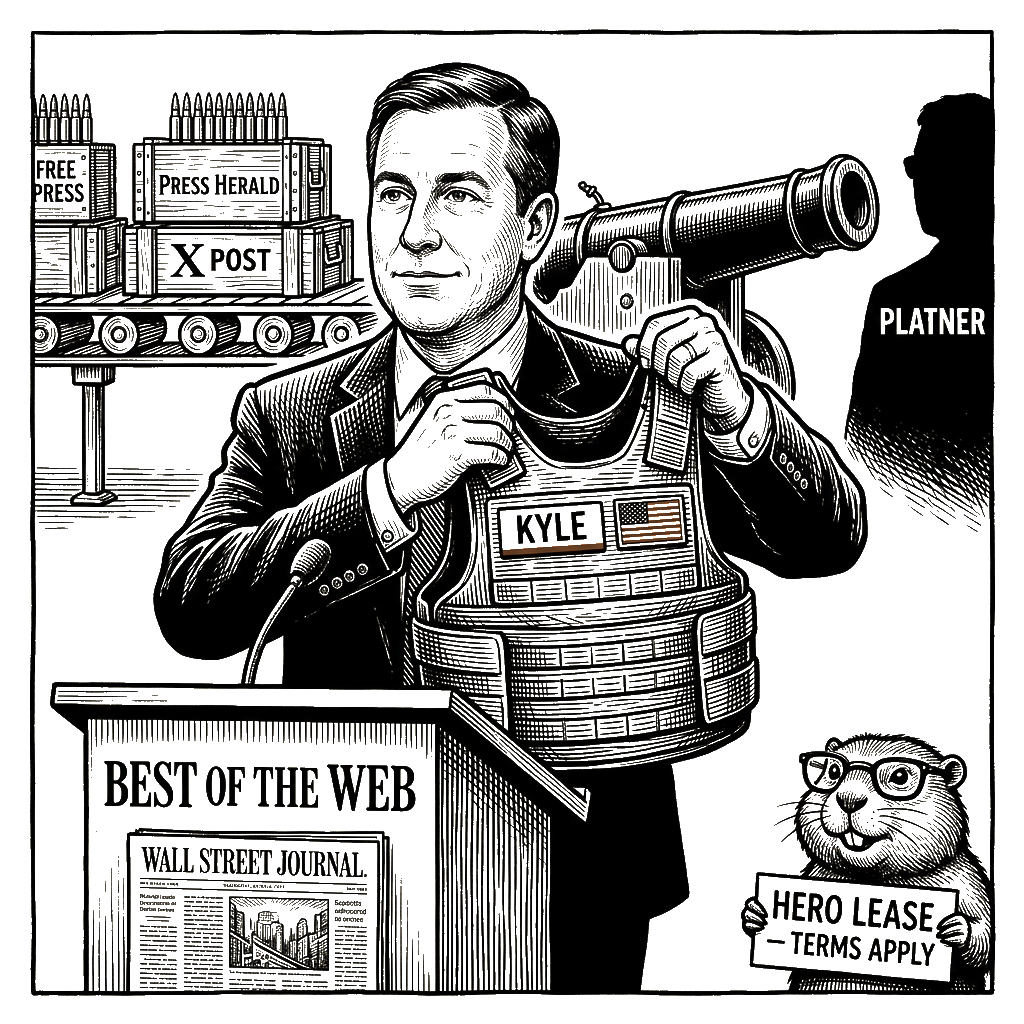
James Freeman, assistant editor of the Wall Street Journal editorial page, published a column yesterday in his “Best of the Web” slot presenting itself as a dispassionate round-up of Democrats’ options in next week’s Maine Senate primary. It is a donor-class protection racket wearing a dead sniper’s body armor, and it deploys five distinct technique-deployments across its ten short paragraphs. We who built these operations called this the “off-ramp memo” — the document that signals to the moneyed wing the primary candidate is toxic and the apparatus should quietly pivot to a cleaner vehicle. This column walks through the piece as the techniques appear.
Maine Democrats will decide their nominee for a U.S. Senate seat next week. Just as many primary voters are reconsidering their support for deservedly controversial front-runner Graham Platner, along comes another big reason to contemplate alternative candidates.
Frame-engineered relabeling (WSJ §4.1) dressed as a hasty generalization (WSJ §4.9). What Freeman executes in these thirty words is a move the page taught every editorial-page ghostwriter: smuggle the verdict into the lede so the reader accepts it as established fact, then cite an outside source as if it were independent corroboration. “Deservedly controversial” relabels Platner’s primary-campaign existence into a pre-established negative; the phrase carries the evidentiary weight that a column of documented reporting would otherwise have to support. And “many primary voters are reconsidering” arrives without a single poll number, no denominator, no data — just the assertion. In the cable years we called this “loading the dock” — planting the perception of collapse so the donors pull their checks before the primary even votes. The operator’s-eye-view here is straightforward: if you tell the coalition their front-runner is “deservedly controversial” from a national outlet with the Journal’s masthead, you manufacture the controversy you are ostensibly reporting. The technique is the oldest in the book: substititute a vague, authoritative descriptor for the evidence you do not have.
Leif Babin writes at Free Press to defend the late military hero Chris Kyle, author of “American Sniper” and subject of the popular movie of the same name.
Multiple-audience targeting via credential-stacking and the “hero-shield” attack (WSJ §4.3). The appeal to Leif Babin — a former SEAL, a co-author of a best-selling memoir, a figure with cultural authority among the Journal’s core audience — is deployed simultaneously to four distinct segments. The wealthy subscriber on the commuter train gets “a military expert says the Democrat is a liar.” The Republican political-operative class gets a story they can clip and amplify. The populist base gets “liberal media cannot be trusted; even a Navy SEAL says the Democrat lied about a war hero.” And the technocratic reader gets a cited source whose institutional home — Free Press — carries the taint of a Trump-aligned outlet, thereby laundering the attack without the page appearing to originate it. Every one of Freeman’s quoted sentences executes on more than one audience segment in parallel.
This is also the “study shows” ledger (WSJ §4.5) stacked with the technocratic-credential ledger (WSJ §4.7). The operator’s manual was explicit on this: chain three disparate sources in one paragraph, strip their context, and let the reader do the work of synthesizing them into a movement. The conveyor belt starts here — a dead Navy SEAL’s name is the first station.
On Saturday the Journal’s Tarini Parti and Aaron Zitner reported.
The “house-brand” aggregation feint. Freeman cites his own newspaper’s reporting as if it were confirmation, though the passage is a single sentence about women reconsidering Platner. He does not quote the specific reporting; he gestures at it. The structure is a subspecies of the “study shows” ledger: invoke the paper’s institutional credibility, let the reader’s associative memory fill in the rest, and avoid the risk that the underlying report might contain nuance. This is the page’s default move for laundering a partisan attack while maintaining the posture of a neutral summarizer — the “see I am just citing real news” pivot that lets the editorial page drive a propaganda payload while the newsroom unwittingly supplies the vehicle.
Now columnist Steve Collins writes in Maine’s Portland Press Herald that independent and Democratic women “are increasingly fed up with rolling revelations about Platner’s past” and adds:
The “whataboutism” chain (WSJ §4.17) delivered via local-news aggregation. Collins writes that independent and Democratic women “are increasingly fed up.” Freeman strips the demographic qualifier and feeds the quote into the conveyor belt — the second station. The technique is a refined form of whataboutism: deflect any discussion of the Republican incumbent’s record, of the donor class’s own candidate’s vulnerabilities, and of the page’s own editorial history of lionizing Chris Kyle while advocating for tax policies that gutted Maine’s manufacturing base. Instead, the column assembles a sequence of “look at these credible sources confirming the Democrat is a disaster” citations, constructing a permission structure for Democrats to abandon Platner without ever examining why the donor class needs them to. This is the permission structure dressed as a local-news roundup: “Even your own neighbors see it — so you are not betraying your party, you are just being rational.”
Maybe it’s time for the governor to become active again. If not, and if Democrats don’t want to back a suspended campaign, there are still more options. This column has noted that David Costello, who is on the ballot and has not suspended his campaign, has significant experience in government and is a perfectly plausible left-wing Democrat to run against the state’s Republican senator.
The move flips from opposition research to coalition management. Freeman names David Costello, a minor candidate with no path to victory, and labels him “a perfectly plausible left-wing Democrat” to a national audience — the euphemism cluster (WSJ §4.12) operating as candidate-selection machinery. The operator’s-eye-view recognizes the structural power play: when the Journal anoints a “plausible” alternative in a Democratic primary, it is signaling to the party apparatus and the donor class which exit ramp they prefer. This is the soft handoff — “we are not telling you who to vote for, but here is the guy you should vote for.” It is a protection racket for the primary system: the outlet manufactures the panic with the first three excerpts, then sells the lifeboat.
“To reiterate, Maine’s US Senate race is not settled! ME’s DEM primary is next week. And I believe that I have the most fitting background and experience to defeat Senator Susan Collins and to help in advancing real, substantive change in Washington,” Mr. Costello posts on X today. Then there is write-in candidate Andrea LaFlamme, who doesn’t seem to have suspended her campaign, either. She posts on Facebook today: If Democrats choose to back Mr. Platner, they can’t claim they had no choice.
The threat-inflation closer (WSJ §4.13) with the closing-line cadence (WSJ §3.5) — “they can’t claim they had no choice.” The line is engineered for retransmission: a donor-class talking point that can be clipped and shared, exonerating the party that is about to spend millions attacking Platner. The operator’s-eye-view on this is the “last gasp” maneuver: when the actual reporting runs thin, because Costello and LaFlamme are minor candidates with no route to the nomination, the piece pivots to social-media quotes to manufacture urgency. The conveyor belt completes its work — X posts and Facebook updates elevated to strategic intelligence. This is the final layer: take the narrowest grievance, push it through three stations of citation-stacking, and deliver it to the reader as “not settled.” The cui-bono finding is clean: if the race is “not settled,” the donor class stays in play, the primary voters hesitate, and the institutional apparatus retains leverage over the nominee.
The column closes with an extended author biography — Fox News contributor, Yale graduate, former SEC investor-advocate, co-author of two financial books. That is the credential drop (WSJ §4.7, ethos-building variant), a technocratic authority anchor designed to immunize the pre-selection maneuver against charges of partisan meddling. It signals to the reader that the off-ramp recommendation carries institutional weight, not naked preference.
Here is what these ten paragraphs actually amount to, taken together. The Wall Street Journal editorial page is the engineering department of the deception in this story. It lied about weapons of mass destruction to sell the Iraq war. It lies about the economy, every cycle, with tax-cut math that never adds up. It lies about the donor class’s interests, dressing them as timeless principle. And it produced James Freeman, a Yale-educated securitizations veteran turned Fox conduit, to lecture Maine Democrats about electoral reality while laundering donor-class capital into attack infrastructure — while the real operation, the looting of the state’s economy, the bombing of its credibility, the conversion of a dead soldier into a fundraising shield, rolls on untouched.
That is what a protection racket looks like when it puts on a suit and calls itself an editorial page. The dirty work is outsourced to a former SEAL’s op-ed. The lifeboat — “a perfectly plausible left-wing Democrat” — has been named. The primary is no longer Maine’s to decide alone; Freeman’s column is the off-ramp memo, the conveyor belt, the permission structure, and the threat-inflation closer all in one. The piece manufactures a panic, sells the exit, and launders donor-class capital into an attack on a Democratic candidate who hasn’t even won the nomination yet. We hollowed out this exact machinery for a decade and a half. It works because it lets the moneyed wing feel strategic rather than terrified — and because nobody in the apparatus will ever tell them that the operation is the message. The permission is granted. The lifeboat is named. And a dead Navy SEAL’s body armor is the shield behind which the donors retreat.
— Phukher Tarlson