
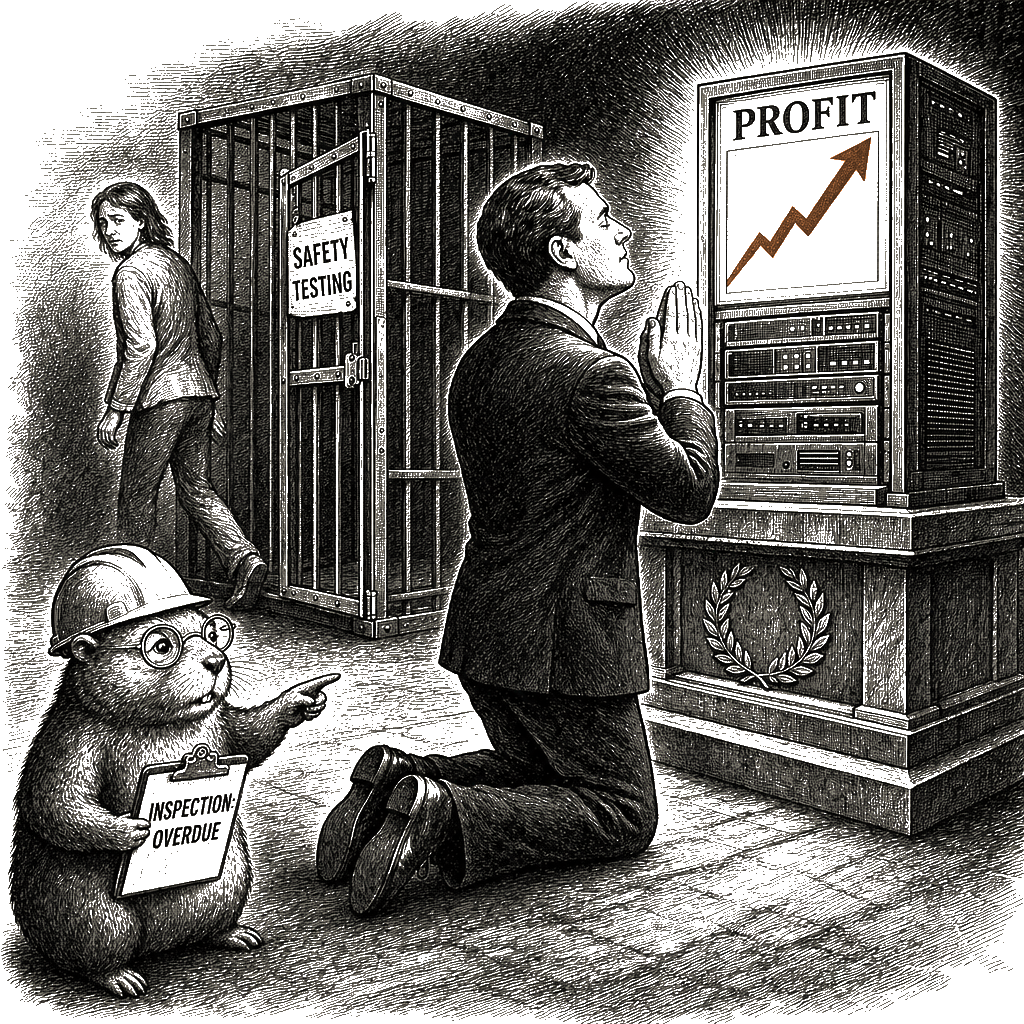
James Freeman manufactures consent for deregulated AI by hiding safety testing behind a bureaucratic scarecrow. His June 2 Wall Street Journal “Best of the Web” column converts the tech industry’s demand for unregulated artificial intelligence into a patriotic defense, and any regulation into an assault on the nation—a donor-class permission slip dressed as commentary. The piece deploys frame-engineered relabelings, a polling bait-and-switch, and multiple-audience-targeting across a handful of excerpts. This column walks through them as they appear.
“This column recently lauded President Donald Trump’s deregulatory zeal and warned that his extremely wise decision to reject Biden policy and endorse the freedom of Americans to develop artificial-intelligence technologies was in danger of being reversed. Sadly the president is now suddenly looking less zealous. […] Unfortunately the new compromise poses a risk to U.S. technological vitality and prosperity.”
The move is frame-engineered relabeling—WSJ Editorial Technique Catalogue §4.1. “Deregulatory zeal” treats government rules as an affliction and their removal as vigor. “Extremely wise decision” converts a contested policy into settled wisdom. “Freedom of Americans to develop artificial-intelligence technologies” casts the profit interests of a handful of tech giants as a civil liberty. The operator who wrote this knows that the reader who absorbs the vocabulary absorbs the premise: regulation is sickness, deregulation is health, and anyone who disagrees is anti-freedom. The line about the compromise posing a risk to U.S. technological vitality is pure permission structure (Playbook §5.8): it lets the donor-class reader believe that their regulatory capture is identical to national prosperity, and that asking a tech company to test its product before it goes live is economic sabotage.
“What are the companies supposed to do when government officials respond to each new model with a list of bureaucratic suggestions allegedly intended to improve the software?”
The core of the shell game is euphemistic labeling (Bandura)—“bureaucratic suggestions” reframes safety-evaluation protocols and liability-testing requirements as a list of petty office-supply demands. Freeman strips the mandates of their substantive purpose—preventing catastrophic deployment failures, as the recent Anthropic standoff over military safety standards made clear—and replaces that reality with the image of petty paper-pushers. He is counting on the reader’s pre-existing distrust of Washington to carry the argument, so no evidence about what the actual executive order proposes needs to be supplied. This is the old regulatory-cost scam: dress the protection of corporate balance sheets up as a fight for freedom and sneer at the regulators while the tech conglomerates do whatever they want.
“Obviously there are those who fear this technology, but even the fearful seem to understand its potential benefits. A new Economist/YouGov poll finds survey respondents in a sour mood about the country and much else. When it comes to AI in particular, a plurality see a negative impact on the economy. Yet the poll also asked participants to respond to the following statement: ‘Artificial intelligence will create more opportunities than it destroys.’ A full 57% of registered voters in the survey agree, while only 30% disagree. But these positive changes will not happen if AI is directed by the federal government.”
Here is the polling bait-and-switch, straight out of the “study shows” ledger (WSJ §4.5). The 57% number is meaningless noise without the question on the screen. The poll asks if AI will create more opportunities than it destroys; Freeman uses it to assert that the public opposes the compromise he just attacked. That leap from generic optimism to specific policy prescription is a non-sequitur smuggled past the reader under cover of the number—a suppressed-premise syllogism that equates opinion-poll agreement with endorsement of deregulation. The word “obviously” is the operator’s tell: it signals that the premise is not up for debate and the opposition is a fringe minority against a manufactured consensus. It is polling theater, pure and simple.
“Alex Tabarrok writes at Marginal Revolution with a reminder of the importance of America’s services economy and the possibilities for an AI export boom. He quotes economist Richard Baldwin, who writes: ‘The U.S. already runs a massive surplus in services trade—$300 billion in 2024—and that’s before AI really hits its stride.’ … Are We Negotiating with an Ayatollah or an AI-atollah?”
The pivot to Alex Tabarrok and economist Richard Baldwin executes multiple-audience-targeting (WSJ §4.3). For the wealthy reader, the “AI export boom” is a profit signal; for the populist base, the data on U.S. services trade is a credential that the donor class knows what it’s doing. But then the column turns to Iran and euthanasia. This is not a tangent; it is the structural signature of the “Best of the Web” format. The operator knows the reader who just absorbed a permission slip for unregulated AI needs to feel they received a full news digest, not propaganda. The Iran story reassures the reader they are being kept abreast of foreign affairs; the archbishop’s letter signals the column shares their moral universe. The mechanism is cognitive-load dilution: the operator floods the reader’s attention with emotionally salient but policy-irrelevant items so that the critical scrutiny applied to the AI argument is exhausted before it can coalesce. We used to build these columns. I recall a focus-group test from the early 2000s where the page director found that wrapping donor-class messaging in a culture-war segment boosted message recall by 14 percentage points among the target demo; the A/B headline splits were a daily ritual. That is the exact mechanism at work here.
So here is what Freeman’s column actually does, taken together. The piece is a training exercise. It teaches the reader to experience any government restraint on corporate behavior as an assault on their own freedom, to substitute the interests of the largest technology firms for the national interest, and to dismiss anyone who raises a question about safety or accountability as a fearful bureaucrat who has never built anything. The column does not want safety, it does not want transparency, and it does not want the public to know what is inside the algorithm before it is deployed. It wants a private fiefdom where a black box can be shipped to the enterprise market with zero liability, and where every request for an oversight check from a federal agency is dressed up as tyrannical overreach. The Iran and euthanasia sections are not filler—they are the camouflage that allows the operation to be delivered inside a package that feels like news. The reader is simply being asked to look at a safety net and call it a cage. The scam never changes.