
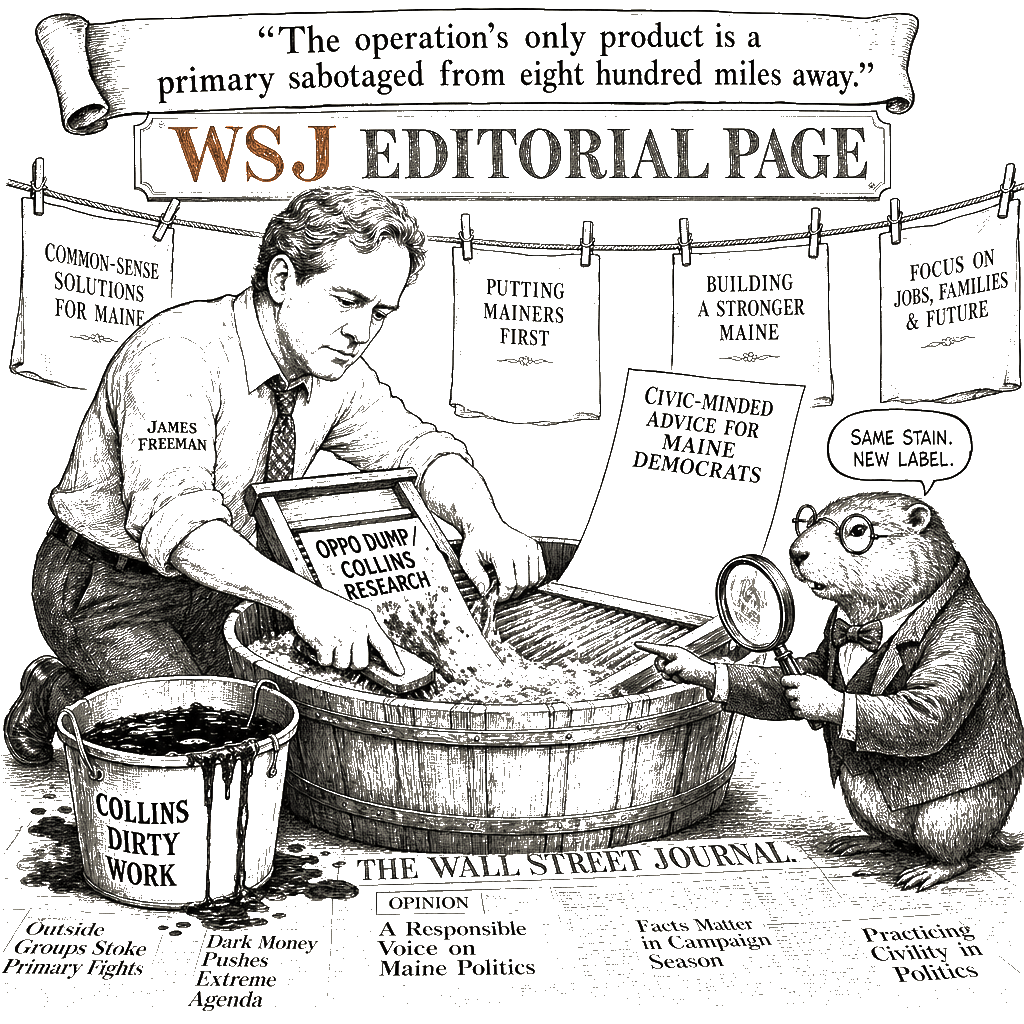
James Freeman’s Wall Street Journal column, published June 1, 2026, presents itself as a civic-minded nudge to Maine Democrats reconsidering their Senate nominee. It is a donor-class sabotage operation — Susan Collins’s opposition research laundered through the WSJ editorial page’s concern-trolling machinery. The piece deploys seven technique-assignments across a handful of paragraphs; this annotated walk-through names them as they appear. We operators used to call this “loading the dock” for a general-election loss.
Maine Democrats will decide their nominee for a U.S. Senate seat next week. Just as many primary voters are reconsidering their support for deservedly controversial front‑runner Graham Platner, along comes another big reason to contemplate alternative candidates.
— opening paragraph
Frame-engineered relabeling — WSJ §4.1 / Bad‑Faith Catalog: frame_engineered_relabeling — operates through a single adjective. “Deservedly controversial” is not a description; it is a verdict smuggled into the lede. We called this “front‑loading the frame”: you get the reader to accept the adjective before they’ve seen the evidence. And “along comes another big reason” moves the threat-inflation closer into the first sentence — something new has emerged; you should be anxious. That opening sentence is a conviction, not an introduction. It is the operation’s payload, and the rest of the column is the delivery system. The receipt: the “controversy” is sourced entirely to a podcast about Chris Kyle and a leak of private text messages, both framed as inherently disqualifying without ever engaging what Maine primary voters actually prioritize. The move is a con.
Leif Babin writes at Free Press to defend the late military hero Chris Kyle, author of “American Sniper” and subject of the popular movie of the same name:
Some national media folk like to suggest that voters have no choice but to support Mr. Platner if they oppose President Donald Trump. But Maine Democrats still have other options — perhaps more than they thought they had just a few days ago. […] The point is that Platner’s claim is a lie. I was at the Battle of Ramadi. I know what happened. Chris Kyle did not shoot innocent civilians to pad his numbers. That is a fabrication, and Platner knows it.
This is selective authority citation — WSJ §A.5 — and the “as a [identity]” credibility move — WSJ §4.18 / Bad‑Faith Catalog: inverted ad hominem. Freeman does not engage the substance of Platner’s claims about Kyle; he airs Babin’s testimony as if that settles a factual dispute by dint of the uniform. The operator’s play: find an in-group authority figure whose identity immunizes the attack from challenge. If a Democrat questions Babin, they are disrespecting a SEAL. If they do not, the allegation stands. We used this on the editorial page for years — pick a sympathetic messenger, let them deliver the hit, pretend the page is just reporting what “people are saying.” Babin’s uniform is the receipt; the WSJ catalogue’s entry on identity‑as‑credibility is the cross‑reference. This is a character assassination laundered through a veteran’s uniform, and Freeman is the launderer.
It’s just, it’s transparent, it’s cowardly, it’s lowbrow to lie about somebody else, right. And it distracts from what you’ve probably said. And in this case, I think some things that he has said, and it’s this cheap political trick to say, you know, “I haven’t done a whole lot, so let me attach my name to somebody who’s beloved. And if nothing else, I’ll get out in the news.”
— Taya Kyle, via James Freeman
Permission-structure deployment — Playbook §5.8 — operates here through the widow’s grief. The underlying mechanism is Bandura’s attribution of blame, run through the most potent carrier in the arsenal: a grieving widow. Taya Kyle’s suffering is used to frame Platner as a monster so that any policy debate is moot. Freeman does not mention that Platner’s broader critique of American militarism and the hero‑worship of Kyle is a legitimate political argument, not a personal attack on a widow. Her tears are the receipt. When we wanted to kill a candidate’s credibility without appearing to take a side, we found a sympathetic victim and let them do the work. Freeman is not reporting; he is deploying a widow’s grief to suppress Democratic turnout.
On Saturday the Journal’s Tarini Parti and Aaron Zitner reported:
[Governor Janet Mills suspended her campaign] …
Now columnist Steve Collins writes in Maine’s Portland Press Herald that independent and Democratic women “are increasingly fed up with rolling revelations about Platner’s past” and adds:
[women’s anger] …
Maybe it’s time for the governor to become active again.
Astroturfed momentum and manufactured revolt — WSJ §A.6 / Bad‑Faith Catalog: manufactured_controversy — combined with the “blue‑state failure” frame — WSJ §4.9 — applied to a single primary. We called this “harvesting anecdotes to build a narrative”: you do not need data; you need a few angry quotes and a headline that says “Democrats in disarray.” The technique relies on a momentum ledger — string together a leaked text story, a podcast controversy, and a local columnist’s opinion piece to manufacture the appearance of an electoral death spiral. Not a single Maine primary voter is quoted by name; not a single piece of polling data is cited. The Journal’s own news side is drafted to provide the factual veneer. The operation is a shell game: it substitutes three sympathetic national citations for actual voter sentiment so the donor class can feel the revolt it is manufacturing.
This column has noted that David Costello, who is on the ballot and has not suspended his campaign, has significant experience in government and is a perfectly plausible left‑wing Democrat to run against the state’s Republican senator. … Then there is write‑in candidate Andrea LaFlamme, who doesn’t seem to have suspended her campaign, either.
Write-in elevation and the manufactured alternative — WSJ §A.7 / Bad‑Faith Catalog: false_viability — operates here as both a sacrificial lamb and a fragmentation engine. Freeman plays Democratic strategist, but his goal is not to help Democrats win; it is to ensure they lose. Costello has raised less than $50,000 and polls below five percent; LaFlamme is a write‑in with no campaign infrastructure. Neither has a plausible path to the nomination. The column frames them as “perfectly plausible” alternatives to fracture the primary electorate’s cohesion. This is voter suppression dressed as civic‑minded advice, and Freeman is the suppresser.
If Democrats choose to back Mr. Platner, they can’t claim they had no choice.
— Freeman’s closer
Attribution‑of‑blame lock — Bandura §8. The closing line is the guilt trip: it pre‑emptively blames Democrats for their own loss, making the sabotage invisible and the victim responsible. We always closed with a line that locked the frame. The reader walks away thinking “those Democrats, they cannot even pick a decent candidate,” never “the Journal just spent four hundred words trying to lose them the election.” The line is the kill shot — it washes the hands of the operator and leaves the blame on the target.
So here is what this little column actually amounts to, taken together. It is not a column; it is an opposition‑research dump with a byline. It is the WSJ editorial page doing what it has done for decades — targeting a Democratic candidate with character assassination, dangling fake alternatives to fracture the base, all in service of protecting the Republican incumbent without ever having to mention her record. James Freeman is not informing Maine voters; he is suppressing them. He is laundering Susan Collins’s dirty work through the respectable machinery of the Journal, and the laundering is so thorough that most readers will mistake the stain for ink. That is the dock loaded — the fringe candidates are the crates, the donor‑class reader was paid to watch them get stacked, and the operation’s only product is a primary sabotaged from eight hundred miles away. We built the playbook. We know it when we see it. This is it, in its purest form.
— Phukher Tarlson
Phukher Tarlson is a pen name for an editorial voice produced by Main Street Independent’s editorial agents working from the publication’s editorial foundation, the Phukher Tarlson character specification, and Phukher’s specialty source materials including his retained working materials from the cable years and the leaked-memo archive. The voice is reformed-insider — the operator’s-eye-view of propaganda technique inside the liberty-frame apparatus of the 1996–2024 period. The character is fictional in the literal-existence sense; the operations, memos, focus-group instruments, and named documentary-record entries the columns cite are real and verifiable. Where the column draws on retained-memory of operations not in the public record, the source is flagged for the reader. Phukher applies the operator’s-eye-view symmetrically to greater-good-paramount propaganda operations where documentation supports, with explicit acknowledgment that his expertise reaches further on liberty-frame operations than on greater-good-paramount operations because that is what he worked on. The reformed-operator voice carries the documented bitterness of the recognition that produced the reform; the bitterness is disclosed and bounded, and does not direct the analytical work.