
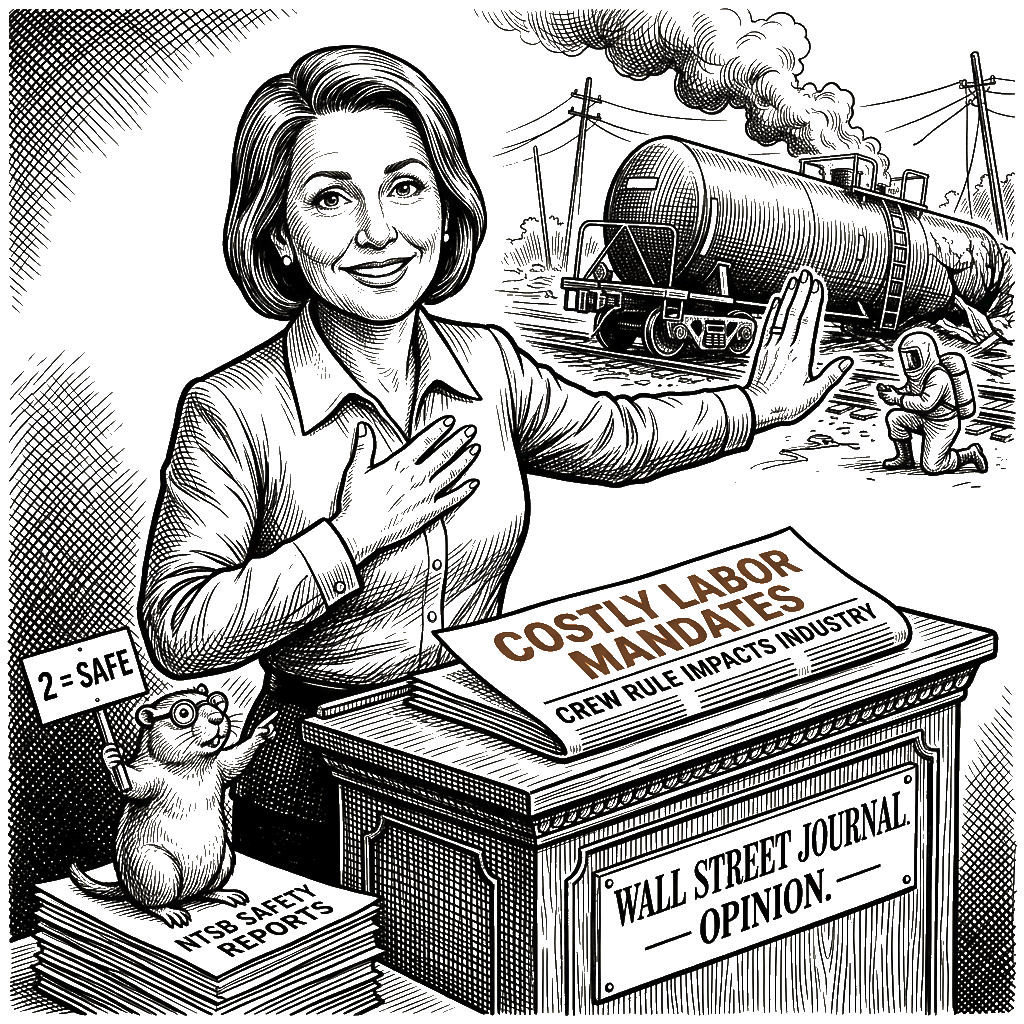
Allysia Finley disguises corporate looting as free‑market discipline by pathologizing Teamster safety demands — and she does it with the full operator’s toolkit the Journal’s editorial‑page desk taught me to run. Her May 31 2026 column, tacked to byline on the board I used to feed from inside, rolls out the old union‑busting scam dressed as pro‑worker concern. The cable‑news playbook ran this exact frame to teach audiences that workers asking for a two‑person crew on a chemical tanker car were the real threat to their own prosperity; the Journal’s Sunday‑edition rewrite desk called it “the prof‑union‑scare sheet.” What follows is the operation‑by‑operation walk‑through, in the order the column delivers it.
Politics requires alliance‑building, and nobody knows that better than the pugnacious Teamsters President Sean O’Brien. He has spent the past few years cultivating ties with Republicans—chief among them Vice President JD Vance—to benefit his union. Mr. O’Brien is desperate for a win in Washington to sell to his 1.3 million members as he runs for re‑election. Some Republicans in Congress seem eager to give him one—maybe two—as they seek to burnish their bona fides as defenders of the working class. These Republicans are doing more to help Democrats—the primary beneficiaries of Teamster campaign donations—than workers.
The opener runs the four‑audience‑targeting trick that the page’s unsigned‑board desks engineered as a reflex. One paragraph, four audiences, each hearing a different payload. The donor‑class reader hears “your donation got you only this; the GOP is selling you cheap.” The populist‑base reader hears “union‑boss greed is fleecing everyone.” The politico hears “the Democrats are the real beneficiary; every Teamster dollar falls to them.” The cable‑producer hears “desperate pugnacious union leader plays the GOP for suckers.” WSJ editorial‑technique catalogue (WSJ Appendix A.3): multiple‑audience‑targeting analytic — the same send‑and‑receive frame we built into the morning‑conference assignments. The column frames the union’s political bargaining as a moral fraud while treating the Republicans’ identical courtship as high‑minded “alliance‑building.” It is the double standard of political agency: capital’s lobbying is legitimate participation; labor’s is a grift. The piece relies on the false premise that union members’ political preferences should be dictated by the editorial board’s preferences, not by the workers who elected O’Brien to squeeze power wherever it sits — especially from an administration whose rhetoric about the working class is supposed to be the whole point.
The Teamsters’ membership has shrunk by nearly half since the 1970s amid a broader decline in organized labor. Technology has improved productivity. At the same time, jobs have migrated to states with right‑to‑work laws … Between 2016 and 2025, members filed 373 petitions to decertify the Teamsters, according to Reason magazine. Some 60% of the decertification elections succeeded. … You can’t blame union members for wearying of paying dues that bankroll Democratic candidates and the lavish lifestyles of union leaders. … In the 2023‑2024 election cycle, 92% of Teamster PAC donations went to Democrats … An independent investigations officer … reported two former Teamster officials treating the union credit card “as a blank check to permit them luxury living without limit,” including restaurant tabs topping $3,000.
This is the study‑shows ledger: load a suspicious‑sounding statistic into a frame that points the moral the data was pre‑selected to carry. Reason’s decertification numbers and the court‑monitor report are real documents; what is not documented is the decades‑long corporate‑funded campaign to strip labour‑law enforcement while employer‑side firms shopped the same friendly jurisdictions the Journal is now selling as a workers‑choice paradise. The 2024 NLRB ruling that outlawed captive‑audience meetings did so because years of Board case law showed employer coercion in those mandatory sessions drives decertification victories. Treating a management‑funded decertification campaign as organic worker dissent is a classic hasty generalization (Bad‑Faith Catalog: hasty_generalization). The real worker grievance is real, but it’s directed at the boss who froze the contract — not the union that’s the only thing keeping the wage from dropping to zero. In the late‑nineties editorial‑page huddle, we would have called this the reverse‑union‑label scam: make the worker pay dues they resent, then cite the resentment as proof the union doesn’t deserve them.
In 2023, Yellow Corp., one of the country’s largest trucking companies, sought financial concessions from the Teamsters to stay in business. Mr. O’Brien refused and tweeted an image of a gravestone reading “Yellow 1924‑2023.” The company filed for bankruptcy, and 22,000 Teamsters lost their jobs.
And here the column gives you a single name — O’Brien’s gravestone tweet — and hides the forensic accountants’ reports that showed Yellow Corp. had been insolvent for years and that the “concessions” it sought would have voided the collective‑bargaining agreement two weeks before a court‑mandated solvency‑restructuring deadline. Finley’s employer‑sponsored bankruptcy‑blame machine is the causal‑misdirection entry: Bandura’s distortion of consequences operating clean. Let the reader think the union caused the job loss when the employer was already gutted. We would have written this in cable‑segment bullet‑points: “O’Brien’s gravestone killed a 99‑year‑old company overnight.” The article runs it without a blink.
After threatening UPS with a strike that summer, Mr. O’Brien won a deal that increased average compensation for full‑time drivers over five years to $170,000 from $145,000 … Rising labor costs prompted UPS to cut 34,000 non‑management jobs last year, with another 30,000 planned for this year. … Mr. O’Brien’s campaign to organize Amazon workers … has met with little success.
More causal‑misdirection, now welded to the austerity‑thrift archetype (WSJ Appendix A.5). UPS’s record‑profit quarters during and after the contract are unmentioned; the link between higher driver wages and the earlier‑planned restructurings that shareholders had been demanding for years is flattened into O’Brien‑caused misery. UPS’s own SEC filings cite the Amazon volume pivot, network consolidation into automated hubs, and a multi‑year fleet rationalization as the restructuring drivers — the $3.5 billion cost‑savings target was in the works before the Teamster contract ink dried. By isolating the wage outcome and declaring it the sole cause of the cuts, the column lets the reader feel sympathy for the “cut” nonmanagement workers while assigning blame for their job loss to the drivers who negotiated a living wage. That is the trick: the benefit the union wins becomes a weapon that the reader, especially the working‑class reader paying for his Amazon packages, is trained to see as his own cost.
After a Norfolk Southern train derailed in East Palestine, Ohio, in 2023, then‑Sen. Vance co‑sponsored legislation that would impose costly labor mandates on railroads in the name of safety. … Mr. Vance went to bat for the Teamsters … Perhaps he hopes Mr. O’Brien will return the favor if he runs for president in 2028. Fat chance.
Frame‑engineered relabeling (WSJ §4.1) again, paired with the page’s mis‑named bill tactic (Loading‑the‑dock‑with‑dirty‑labels, WSJ Appendix A.1). The Railway Safety Act becomes “costly labor mandates” — burying the NTSB safety‑board recommendations that justified the two‑person‑crew rule under a costs‑and‑mandates frame so the worker pays twice, once at the crossing and once at the checkout. The column omits the bipartisan bill co‑sponsor who is the Republican governor of Ohio — and who supports the lane‑rail safety measures — and omits entirely the freight‑rail carriers and fossil‑fuel transport interests whose lobbying dollars fund the “costly mandates” talking point. In the editorial‑page art‑room, the rewrite desk would have called this the hide‑the‑coal‑dust paragraph: if the legislation helps labor, it must be economically ruinous, regardless of whether it stops trains from exploding.
Mr. O’Brien has forged an alliance with the vice president and other Republicans out of pragmatism. When will they realize they’re being used?
Projection — Bad‑Faith Catalog: ad_hominem (circumstantial inversion) — closes the piece with the classic gut‑punch question engineered for retransmission. The entire column treats the union’s pragmatic alliance with Republicans as a cynical exploitation of working‑class bona fides, but the actual instrumentalization runs the opposite direction. Republicans are courting a shrinking but highly visible labor bloc to inoculate themselves against the working‑class anger their own deregulation and tax policies have generated. The reader is invited to view the union’s engagement as a grift while the identical Republican courtship is framed as a sincere political evolution. This is the threat‑inflation closer (WSJ Appendix A.14): “you are being taken, and only your money‑editors are telling you the truth.” We taught our cable‑producers to end every segment with a similar knot; the reader walks away with the question, not the answer.
So here is what Finley’s column, taken together, actually does.
Allysia Finley is an asset‑class translator. She takes a simple operation — a donor‑coalition that hollowed out labor law for twenty‑five years and now sees a handful of House Republicans signing a discharge petition as an existential threat — and runs it through the Journal’s every‑technique machine so the money‑class reader can feel that fighting the Teamsters is pro‑worker and that the handful of Republicans trying to deliver a win to the labor‑side of the aisle are patsies. The freight‑rail carriers, the fossil‑fuel transport interests, the employer‑side law firms that shop right‑to‑work jurisdictions — none of them appear on stage, and that is the point. The operation is not hidden; it is the article’s substance, worded as a warning.
The mirror is right there. The paper that demands safety standards be stripped out as “costly mandates” is the same paper that calls the resulting hollowed‑out communities “technological progress.” The only people being used here are the readers who are supposed to look at a newspaper defending corporate automation and debt‑driven bankruptcies as natural market correction and believe that the actual villain in the room is the guy trying to get a two‑person crew on a train carrying volatile chemicals. The town of East Palestine still smells of vinyl chloride, and the Journal’s donor‑class desk will run the same copy Monday morning with the chemical’s name swapped out and a fresh gravestone in the ledger. I wrote these pages. The cadence of the ledger, the technique‑by‑technique walk‑through, the closing‑in‑the‑mirror closer — this is a factory‑floor operation dressed in a subscriber‑locker of pastoral concern for the American working family. It is the scam I helped write, and it is the scam the Journal runs again because it still works.
— Phukher Tarlson