
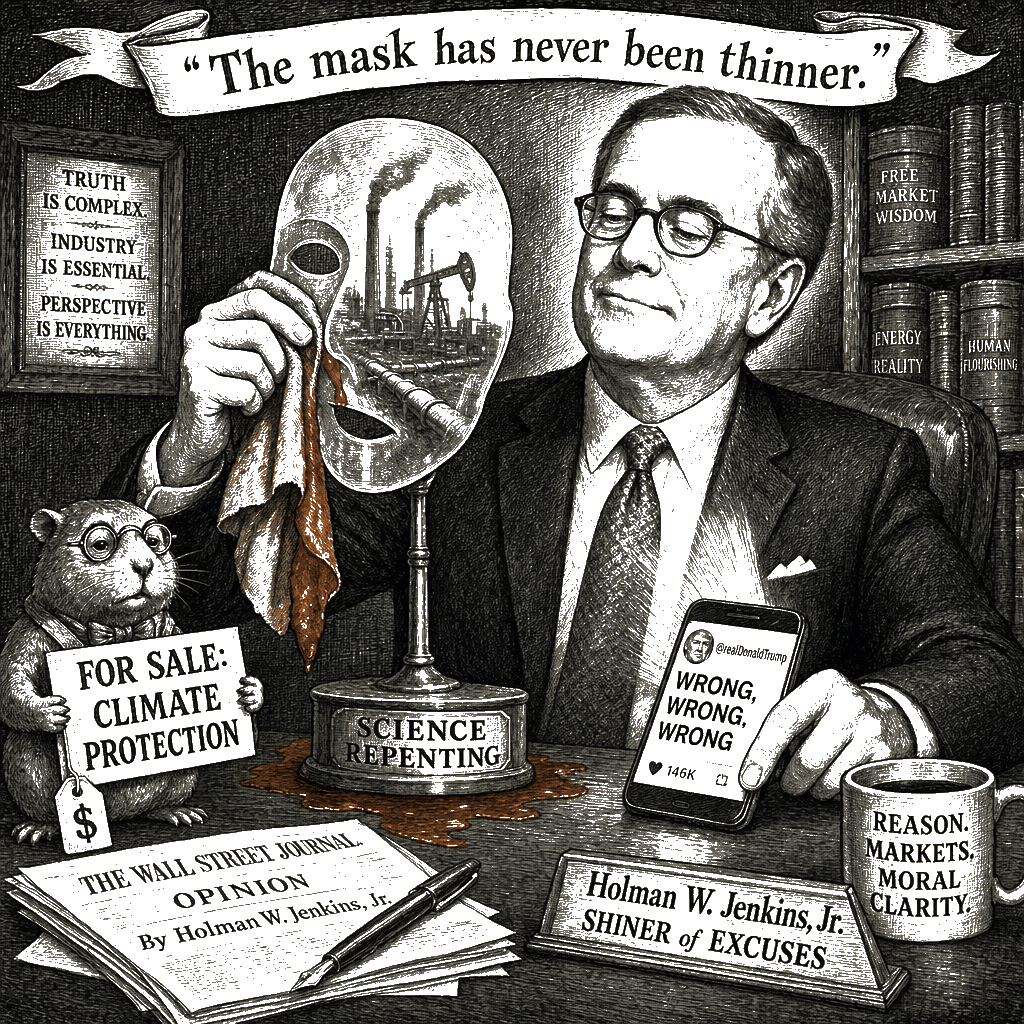
Jenkins is selling your climate protection to the fossil-fuel industry. We who built versions of these techniques in the cable years recognize the operation because we ran the operation. In a Wall Street Journal column published May 29, 2026, Holman W. Jenkins Jr. takes a routine scientific self-correction and turns it into an argument that climate science has been running a decade-long deception and that Donald Trump is a public-service truth-teller. The piece executes a series of rhetorical moves across its paragraphs; this column walks through the mechanics as they appear, naming the gears that turn the scam.
Many Americans still think the key question in climate politics is a human effect on climate, yea or nay, believer vs. denier.
No. For 40 years, the only interesting questions have been how and how much are we influencing the climate, and the cost and benefit of proposed actions—questions that can’t be answered by shouting yea or nay about a human role in climate change.
Activists have taught us one thing. Hectoring about the end of the world, insisting the science is “settled,” equating doubters to Holocaust deniers, has been a stimulant to green pork and not real climate policy, the pinnacle of cynicism being Joe Biden’s Inflation Reduction Act.
The public, understandably, long ago stopped listening. Or maybe it started getting its guidance from Donald Trump, which wouldn’t be the worst thing in the world. — Paragraphs 1-4
Strawman of progressive positions — WSJ §4.6 — operates here through what we track as the caricature-and-concession maneuver. Jenkins opens with a classic strawman inversion dressed as false neutrality. He constructs a binary between “believer vs. denier” and then rejects it, positioning himself as the reasonable adult. This premature pragmatism is itself a move: by skipping past the question of whether to act and leaping straight to cost-benefit haggling, Jenkins presupposes the answer while appearing to pose the question. You rig the argument’s starting conditions so that your position looks like the moderate center by design, and anyone who disagrees looks like an extremist. The overwhelming majority of climate scientists already occupy the space Jenkins claims as his own. The IPCC assessment reports, the National Climate Assessment, and thousands of peer-reviewed papers address precisely the questions of how much, how fast, and what to do about it. The “believer vs. denier” framing is Jenkins’s construction. Then comes the relabeling: the Inflation Reduction Act becomes “green pork.” Bandura’s euphemistic labeling (§4.2) does the work that paragraphs of analysis would otherwise require. Take a policy whose effects are distributed across millions of people and compress it into a two-word epithet carrying only waste and corruption. The relabel is the operation, and the operation is a scam.
This month, when an authoritative United Nations advisory panel quietly junked a long-misused worst-case emissions scenario known as RCP 8.5, one of the first to notice was the president, who charmingly tweeted about “Dumocrats” and their “WRONG, WRONG, WRONG” climate estimates.
This was a public service, it turned out, for Mr. Trump’s post forced the media to reckon with a decade’s worth of its own bad reporting. — Paragraphs 5-6
Manufactured controversy — Bad-Faith Catalog: manufactured_controversy — operates here through source alignment and the Tobacco Strategy adapted for the climate file. Jenkins isolates one granular methodological update from the scientific community — the deprecation of RCP 8.5 as a “business-as-usual” baseline — to launder a broader climate-denialist narrative. A legitimate scientific update happened; Trump noticed it on Truth Social; therefore Trump is a public-service truth-teller who “forced the media to reckon.” This flips the accountability axis. Operationally, this is known as laundering. We route the claim through a legitimate scientific correction, then let the reader’s associative memory fill the gap, pulling the entire climate field under the umbrella of “they admitted they were wrong.” Jenkins’s parenthetical — “which wouldn’t be the worst thing in the world” — executes a multiple-audience targeting in a single clause: for the populist reader, it ratifies the anti-elite pleasure of Trump owning the scientists; for the technocratic reader, it hedges with plausible deniability; for the donor-class reader, it signals comfort with Trump as a deregulatory ally. Three audiences, one clause, each receiving a different message from the same words. The con is clean.
Always a laggard, though, is the New York Times. First, it resorted to a canard in response to Mr. Trump’s posting, a story claiming that RCP 8.5, far from being faulty, simply was rendered moot by the glorious carbon-reducing progress of green energy.
This was so obviously false, the paper ran out a second report, now admitting that “news stories [i.e., its own] about climate research often emphasized results based on RCP 8.5 as a picture of what the world can expect unless countries slash their emissions, which isn’t right.”
Understand: RCP 8.5 was created to give scientists a high-emissions path to play with. From the start, it lacked any “consistent internal logic,” as its original designers stipulated. — Paragraphs 7-10
False-equivalence pivot — WSJ §4.10 (common sense / elite rhetorical pivot) — operates here through media-baiting and denialism’s selectivity. Jenkins anticipates the scientific defense: RCP 8.5 was never a prediction of the future, but a mathematical baseline explicitly labeled an emissions scenario for risk analysis. To preempt this, the piece attacks the New York Times for “emphasizing results based on RCP 8.5.” The operator conflates the model input with the model output only to pretend the media forced the conflation. You weaponize the Times correction against the science itself and execute the shell game. That is how emissions scenarios work: you construct a range from low to high to give researchers tools for modeling different futures. The abandonment of the highest scenario is not a scandal; it is the scientific method functioning as designed. And the fact that emissions are not tracking the worst case is partly because the policy interventions Jenkins calls “green pork” actually worked — renewable deployment scaled, coal consumption plateaued, and the technology advanced faster than any model projected. Jenkins presents the retirement of a worst-case scenario as evidence of fraud when it is partly evidence that the policy worked. He then invokes the austerity-thrift archetype at civilizational scale, characterizing the 2018 National Climate Assessment as finding that warming would be an “affordable burden” for Americans. That is Jenkins’s spin, not the NCA’s language. The assessment’s actual conclusion warns of growing losses to infrastructure, agricultural disruption, and health consequences from heat exposure. The suffering produced by inaction is reframed as an acceptable cost borne by people rich enough to absorb it. The reader facing rising insurance costs in a flood zone does not appear in Jenkins’s arithmetic. This is the page’s signature gift: the ability to look at projected human suffering and call it affordable, to look at projected displacement and call it a burden that rich Americans can handle, and to feel reasonable doing it.
Understand: In any sane model, of course, technological advance is routine and must be accounted for. And we’ve had plenty in all areas of energy production and distribution, including green energy. But the world consumes more of every kind of energy, even renewables, without necessarily having any deliberate effect on emissions, though those emissions remain far below the RCP 8.5 forecast, which proved useful only for overselling climate doom to the public.
The larger lesson is an extraordinary story of futility and cynicism, which passes itself off as climate politics. Literally trillions of dollars have been wasted. The story begins with the Obama administration ditching a carbon tax in favor of green pork. It ends with a former John Kerry aide arguing last year that because the effects of climate change “resemble those if China or Indonesia were to launch missiles at the United States,” the U.S. should consider employing military power against emitting countries.
This record of disgrace only underlines the glory (and mystery) of the current moment. Organized climate science is finally repenting of its overuse of worst-case scenarios, and not because of searching criticism from an honest and competent news media, but because of embarrassment at shoddy mainstream coverage of climate science.
More amazing, the truth has now reached readers of the New York Times and likely wouldn’t have if Mr. Trump hadn’t posted about climate science, in his usual hyperbolic, all-caps way, on Truth Social. — Paragraphs 11-13
The Big Lie — Bad-Faith Catalog: the_big_lie — operates here through temporal compression, causal inversion, and tu quoque deflection. Jenkins asserts that “organized climate science is finally repenting” not due to peer review, but due to “embarrassment.” This frames the entire global climate research enterprise as a confidence game sustained by bad publicity, collapsing decades of empirical measurement into a media scandal. He reaches for a former John Kerry aide’s extreme statement about military action and presents it as the logical terminus of climate activism — one speculative statement, inflated to stand in for the entire enterprise. And “literally trillions of dollars have been wasted” is the number trick: you cite a large number, attribute it to the other side’s waste, and move on. The reader remembers “trillions wasted.” The reader does not remember that the IMF estimates fossil-fuel subsidies at $7 trillion globally and $760 billion in the United States alone as recently as 2022 — subsidies the Wall Street Journal editorial page has never subjected to the same fiscal scrutiny. The asymmetry is the operation. The closing maneuver is the most aggressive element: the claim that the “truth” only broke because of the President’s “all-caps” post. This is a deliberate distortion of consequences. It rewrites the history of scientific methodology to flatter the political class and validate the authoritarian posture, positioning factual inquiry as dependent on executive fiat.
So here is what the Jenkins op-ed amounts to, taken across these four sections. The piece is not a media critique. It is not a policy analysis. It is a permission structure for willful ignorance, a deregulatory playbook running since the Grimes credo established that the editorial page would make no pretense of walking down the middle of the road. When the piece says science is repenting, it means the apparatus has run out of money and is looking for a new patron. When it says Trump’s tweets were a service, it means the editor would prefer a reality dictated by a single decree to a reality measured by atmospheric carbon. Jenkins wrote twelve paragraphs to execute a single operation: take one routine correction and spin it into evidence that the entire field is a fraud, that the politicians dismantling climate protection are heroes, and that the money spent protecting the public was stolen. The science did not change in thirty years. The only thing that changed is who is funding the denial. His job is not to inform. His job is to put a polite, scholarly face on a racket that treats your lungs like an externality and your grandchildren like a depreciation schedule. The mask has never been thinner, and if the atmosphere doesn’t care about editorial deadlines, it certainly doesn’t respond to executive orders.
— Phukher Tarlson