
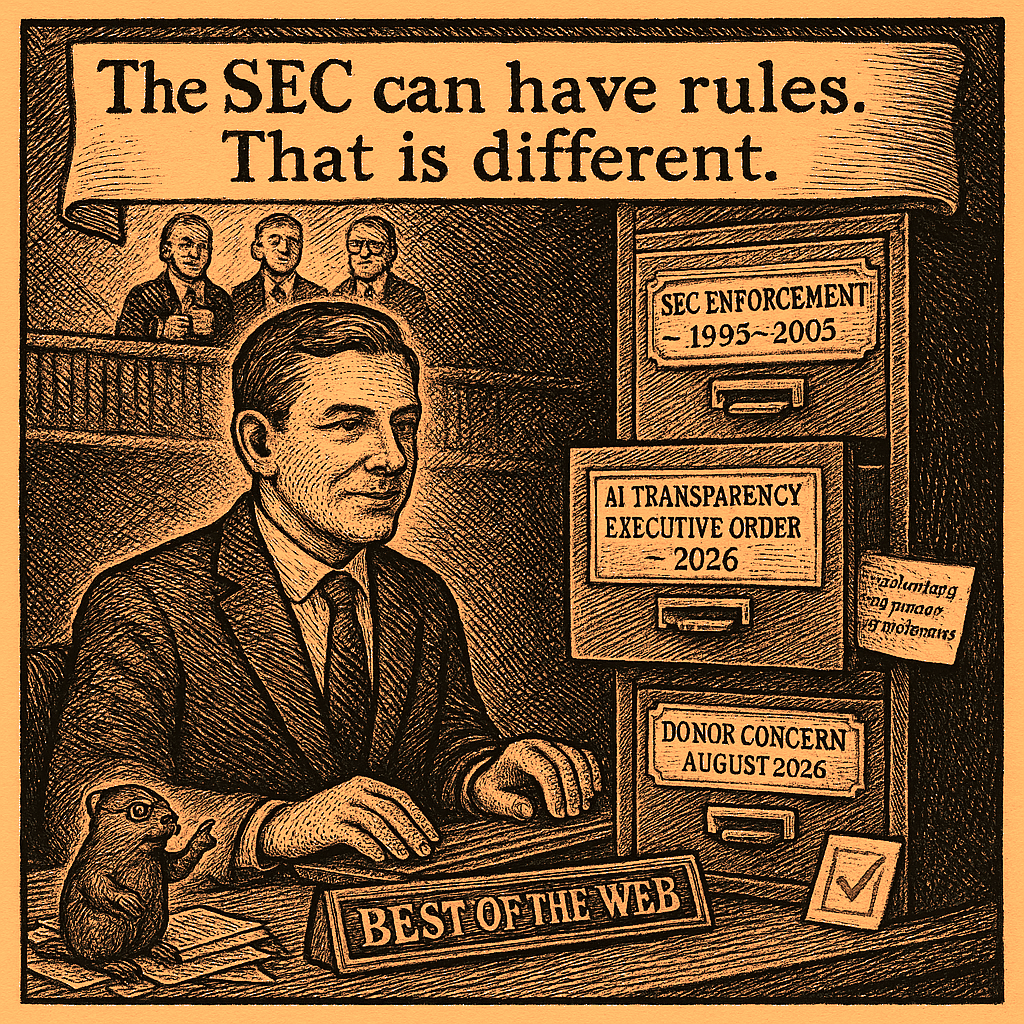
James Freeman lies to his readers about an AI executive order to protect tech donors from any government oversight. His June 3 “Best of the Web” column — appearing under the Wall Street Journal opinion banner that I helped build — takes a modest early-access arrangement and repackages it as a regulatory assault, deploying a handful of propaganda techniques to frame deregulation as a civilizational imperative. We used to run this exact playbook for the Journal’s donor-class readers. The column below walks through the techniques as they appear.
This column recently lauded President Donald Trump’s deregulatory zeal and warned that his extremely wise decision to reject Biden policy and endorse the freedom of Americans to develop artificial-intelligence technologies was in danger of being reversed. Sadly the president is now suddenly looking less zealous. That was the right instinct. Unfortunately the new compromise poses a risk to U.S. technological vitality and prosperity. […] AI is now vulnerable to Washington regulators who have a long, sad history of imposing costly mandates that were never enacted in law, never explicitly approved by Congress. What are the companies supposed to do when government officials respond to each new model with a list of bureaucratic suggestions allegedly intended to improve the software? — James Freeman, quoting former Trump adviser Dean Ball
Frame-engineered relabeling — WSJ §4.1 / Bad-Faith Catalog: frame_engineered_relabeling. Freeman recasts a voluntary transparency measure as a betrayal of deregulation and a threat to “vitality” itself. In the cable years we called this the innovation shield: you attach a nascent industry to national prestige (“the U.S. is the leader”) and cast any friction — even a request to look at a model before it’s released — as an attack on American living standards. The order, as reported by CNBC and the Washington Post, explicitly prohibits mandatory licensing, preclearance, or permits; it’s a peek‑and‑suggest arrangement, not a command. But the column needs the reader too agitated to ask what exactly has been “reversed.” So it wraps the whole thing in grievance: a “sad history” of unelected regulators imposing “costly mandates,” as if asking a company what it’s doing were an act of state violence.
The threat‑inflation closer — WSJ §4.13 — lands in the second paragraph. Not “introduces a minor reporting requirement.” Not “gives the federal government a heads‑up about systemic risk.” “Poses a risk to U.S. technological vitality and prosperity.” We used to call this the urgency lift: you never just describe a policy; you attach it to the nearest civilizational anchor. Tax increases were “economic self‑sabotage”; AI transparency is now the end of prosperity.
And the man writing this line used to be the SEC’s investor advocate. He spent part of his career imposing exactly the kind of mandatory‑disclosure rules he now damns — but only when those rules were aimed at stock‑market players, not at tech billionaires. The irony is thick, and it’s deliberate. Freeman knows that a former SEC enforcer damning “costly mandates” gives the donor‑class reader permission to believe that this time the rules really are different, that the people who built this technology are somehow exempt from the same logic that governs every other industry.
Mr. Ramkumar mentions Dean Ball, a former Trump adviser, who “is concerned about ‘mission creep’ and ‘regulatory capture by AI‑safety advocates’ through the new process.” — James Freeman, quoting Amrith Ramkumar
Here the column fires the “as a [former Trump adviser]” credential move — WSJ §4.18 — to launder the argument through an in‑house voice. Then it deploys the most cynical relabeling of all. “Regulatory capture by AI‑safety advocates” flips the entire concept on its head. In the real world, regulatory capture means an agency gets captured by the industry it regulates — which is exactly what the Journal’s page spent decades denying in banking, oil, and pharma. Freeman now wants the reader to believe the true capture threat comes from the handful of safety researchers who think it might be wise to check a model before it gets loose. That’s a lie dressed as an expertise‑cite, pure and simple.
A new Economist/YouGov poll finds survey respondents in a sour mood about the country and much else. When it comes to AI in particular, a plurality see a negative impact on the economy.
Yet the poll also asked participants to respond to the following statement: “Artificial intelligence could be used to transform the U.S. economy for the better.” A full 57% of registered voters in the survey agree, while only 30% disagree. — James Freeman, citing Economist/YouGov polling data
The “study shows” ledger — WSJ §4.5 — stripped of methodological honesty. The column acknowledges that a plurality sees AI negatively, then buries that under a single favorable data point and calls it a mandate to drop all oversight. The question “could AI be used to transform the economy for the better?” is a “could,” not a “should we trust it blindly.” You know what the wording was. It was almost certainly a mother‑h‑‑‑‑‑‑‑‑‑‑‑‑‑‑‑‑‑‑‑‑‑‑‑‑‑‑‑‑‑‑‑‑‑‑‑‑‑‑‑‑‑‑‑‑‑‑‑‑‑‑‑‑‑‑‑‑‑‑‑‑‑‑‑‑‑‑‑‑‑‑‑‑‑‑‑‑‑‑‑‑‑‑‑‑‑‑‑‑‑‑‑‑‑‑‑‑‑‑‑‑‑‑‑‑‑‑‑‑‑‑‑‑‑‑‑‑‑‑‑‑‑‑‑‑‑‑‑‑‑‑‑‑‑‑‑‑‑‑‑‑‑‑‑‑‑‑‑‑‑‑‑‑‑‑‑‑‑‑‑‑‑‑‑‑‑‑‑‑‑‑‑‑‑‑‑‑‑‑‑‑‑‑‑‑‑‑‑‑‑‑‑‑‑‑‑‑‑‑‑‑‑‑‑‑‑‑‑‑‑‑‑‑‑‑‑‑‑‑‑‑‑‑‑‑‑‑‑‑‑‑‑‑‑‑‑‑‑“Do you support American innovation?” designed to manufacture assent by smuggling the positive directly into the question. The column’s whole architecture depends on the reader not noticing that the poll supports neither his threat picture nor his policy prescription. This is the raw permission structure: “You don’t have to worry about public backlash; look at the numbers — the public is secretly on board.” The numbers, of course, are doing exactly what the column needs them to do.
Are We Negotiating with an Ayatollah or an AI‑atollah? … But Li’l’ Kham lives. … Catholic archbishop of New York Ronald Hicks writes in First Things on the rise of physician‑assisted suicide: — James Freeman, “Best of the Web” closing segments
The multiple‑audience‑targeting bundler — WSJ §4.3. The abrupt pivot from AI deregulation to Iranian leadership disputes to Catholic moral theology is not accidental; it is the structural signature of the Journal’s link‑blog format. It signals tribal alignment without requiring a unified argument. The deregulation pitch goes to the donor class and tech capital; the “AI‑atollah” quip goes to the populist base; the Hicks citation goes to the religious‑traditionalist wing. The reader gets a curated ideological buffet. We built these pieces to keep the audience in motion — never letting them settle on one issue long enough to apply critical pressure. To accept one element is to swallow the whole package. That’s the operation.
So here is what Freeman’s column actually does, taken together. It takes a voluntary early‑access arrangement — one the administration itself nearly killed for being too tough on business, then revived in a watered‑down form — and turns it into a tale of regulatory overreach that threatens the nation’s vitality. It misrepresents a peek‑and‑suggest protocol as a scheme of “costly mandates” cooked up by rogue bureaucrats. It uses a former Trump adviser to launder the claim that true capture comes from safety advocates, not from the companies spending nine figures on lobbying. It cherry‑picks a poll to manufacture a phony consensus for deregulation. It bundles the whole thing with tribal‑identity cues so that the reader walks away with a pre‑assembled worldview: fear the regulator, trust the market, and align with the in‑group’s cultural signals. And last week the real‑world translation of that worldview landed in the Oval Office. Trump signed an executive order that guarantees the same companies building this future get a government backdoor to their models without any enforceable safety obligations — peek and suggest, with zero penalty for ignoring the suggestions. That is the definition of a regime where the rules don’t apply. Freeman’s column is the formal request, written in the Journal’s house voice, that the people building the most powerful technology of our time be permitted to do so in complete darkness, answerable to no one but their own boards. And the answer, in Freeman’s telling, is: none of your business.
— Phukher Tarlson