
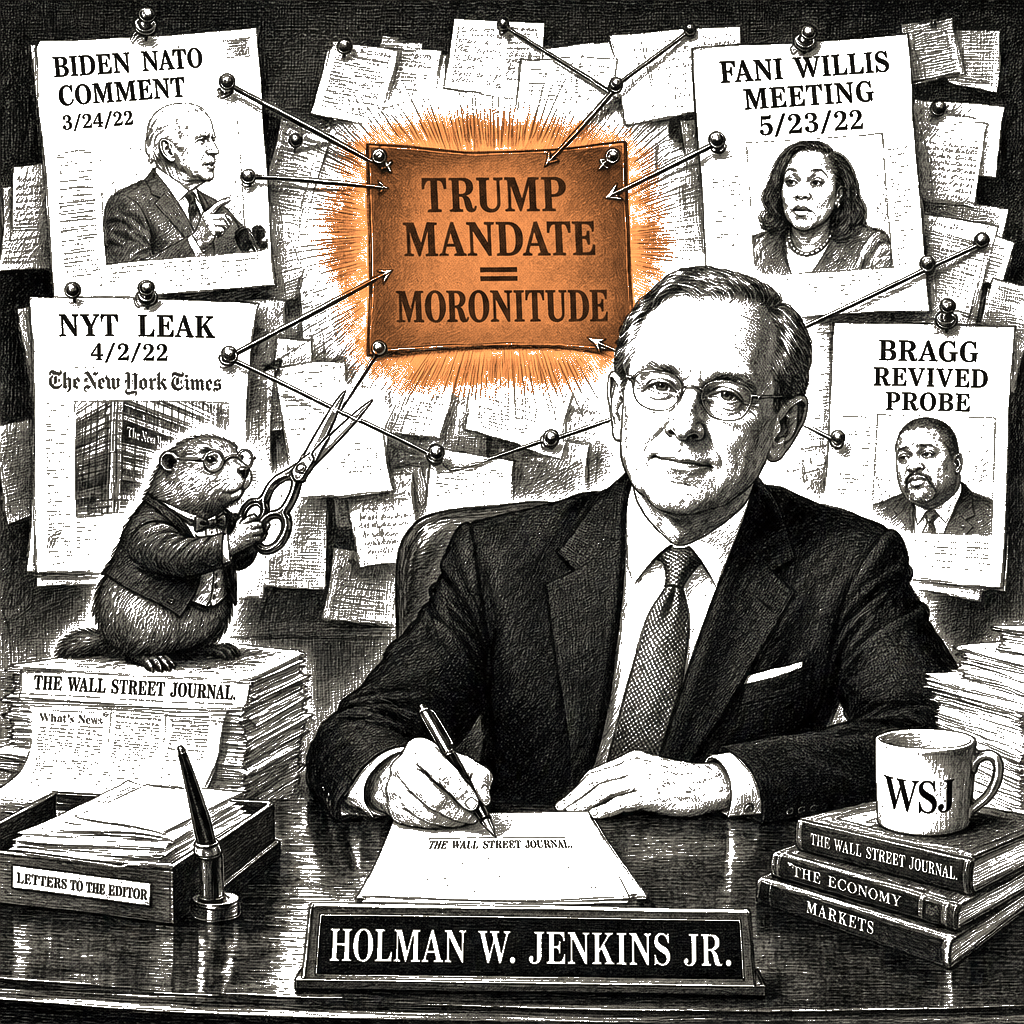
Holman W. Jenkins Jr.’s column in the Wall Street Journal on June 2, 2026, did not arrive in a vacuum. It landed the same day Jill Biden’s memoir “View From the East Wing” hit shelves, and within the same news cycle as her NPR Newsmakers disclosure—that she feared Joe Biden was having a stroke after the June 2024 debate, with doctors checking him immediately, earlier than the administration had acknowledged. The memoir interview cycle had already produced CBS excerpts, an Associated Press feature, and a New York book event with Whoopi Goldberg. The Democratic recriminations were live, the Biden family’s version of events was flooding the zone, and Jenkins’s column was the counter-programming—a pre-written narrative package held in reserve for the memoir’s launch window, designed to intercept the Jill Biden news cycle and redirect its energy toward a single question: whether Trump’s presidency is even legitimate.
Jenkins converts a clumsy post-defeat memoir tour into a vast conspiracy in which the Biden White House orchestrated criminal prosecutions of Trump to rig the 2024 matchup. The piece deploys documented bad-faith techniques to transform Donald Trump’s election victory into a symptom of Democratic incompetence rather than a reflection of voter choice. It is not analysis. It is a mandate-nullification instrument. The following autopsy walks through the machinery paragraph by paragraph.
A lot more people are responsible for Joe Biden’s decision to run for a second term than Jill Biden, whose delight in being first lady and desire to remain so are evident in her new book.
Frame-engineered relabeling—WSJ §A.1—operates here by substituting a loaded descriptor for a neutral one before the column has quoted a single line of the book. Jenkins converts Jill Biden’s memoir—a straightforward political memoir about a painful and humiliating withdrawal from a presidential race—into an admission of selfishness. The technique does no argumentative work; it simply plants a valence. The reader who encounters the memoir’s disclosures later has already been told what they “really” mean. In the cable years we called this “poisoning the page”: front-load a characterization, let it do the work of discrediting whatever follows, and never return to the text to check whether the characterization holds.
The two parties have a single magnum focus to their existence, the four-year presidential cycle. They don’t spitball—they engage in ruthless strategizing worthy of the Pentagon war room.
Multiple-audience-targeting analytic—WSJ §A.3. To the populist base reader, “ruthless strategizing” confirms the grievance that the political class operates like a military machine against ordinary people. To the technocratic reader, the Pentagon-war-room analogy supplies a veneer of serious strategic analysis. To the donor-class reader, it signals that what Jenkin’s is about to describe is a coordinated operation rather than random events. One sentence, three audience segments, three different messages. This is the craft. The move launders a conspiracy narrative through the register of analytical insight: Jenkins is not saying “I’m about to spin a yarn”; he is saying “this is how strategy works, and here is the strategy.”
On March 24, 2022, with a war raging in Europe, at a North Atlantic Treaty Organization summit Mr. Biden signaled the plan to every Democratic official in the U.S. by saying he would be “very fortunate” to have Mr. Trump for a 2024 opponent. The election was still 967 days away, never mind that a president also usually considers it unseemly to meddle in the other party’s nomination.
Biden’s comment is a banal political observation: any incumbent would prefer to run against a polarizing figure who lost the previous election. Jenkins reframes this as “a plan” that Biden was “signaling” to every Democratic official. The 967-day count is pure atmospherics—it does no evidentiary work but supplies the appearance of precision. This is the threat-inflation opener the WSJ catalogue §A.13 documents: take an ordinary political statement, relabel it as a strategic directive, and then treat the strategic-directive framing as evidence of a coordinated operation.
Nine days later, a staged front-page New York Times leak had Mr. Biden criticizing his attorney general, Merrick Garland, for not criminally charging Mr. Trump. We can suspect the leak was staged because lacking was any Times effort to require the White House to confirm that Mr. Biden had used the words attributed to him or if the leak was authorized. Instead, the paper cooperated in a White House deniability charade with a lengthy quote insisting Mr. Biden sought “no role in investigative priorities or decisions” of the Justice Department.
This is the column’s load-bearing claim, and it is built entirely on innuendo. Jenkins asserts that the Times staged a leak at the White House’s direction—a serious allegation of journalistic corruption—on the basis of what the Times did not do. He cannot point to any evidence that the leak was staged. He points only to the absence of what he thinks the Times should have done. This is the affirming-the-consequent move the Bad-Faith Catalog IDs: if White House coordination occurred, we would see the Times publish a denial alongside the leak; the Times published the denial alongside the leak; ergo, coordination occurred. The observation—the Times published the White House’s denial alongside the leak—is evidence of standard journalistic practice: you report what sources tell you and you report what the White House says in response. Jenkins’s conclusion requires the assumption that this practice is itself evidence of coordination. The Bandura framework nails this as moral justification via advantageous comparison: Jenkins’s column is accusing the press of a coordinated propaganda operation using exactly the technique his column is deploying—take an ordinary event, reframe it as evidence of conspiracy, and let the reframing carry the conclusion.
On May 23, 2022, and again on Nov. 18, 2022, an attorney working with Georgia county prosecutor Fani Willis met with White House officials. Ms. Willis employed her boyfriend to help an election case against Mr. Trump at a princely $250 an hour, which they soon were spending on vacations in Napa and the Caribbean. Ms. Willis was telling you something with her behavior. Her prosecution of Mr. Trump was a service to the White House. She was entitled to a gratuity.
The “lawfare” frame—WSJ §A.19—converts a legally standard consultation between a prosecutor’s office and White House officials into an implication of a corrupt quid pro quo. Jenkins emphasizes the attorney’s romantic relationship and hourly billing as if they are evidence of corruption; the Willis-Wade relationship was already public and investigated, with no charges brought. He concludes that her prosecution was “a service to the White House” for which she was “entitled to a gratuity”—a claim for which there is no evidence whatsoever. This is the technique we called “the brochure” in the cable years: you front-load a few salacious details that are technically true, lash them to a conclusion completely unsupported by those details, and let the reader’s processing of the detail produce the sensation that the conclusion has been demonstrated. It has not.
The day before Mr. Biden’s NATO summit comments and 10 days before the Times leak, the New York Daily News savaged new District Attorney Alvin Bragg for dropping a Stormy Daniels-related investigation. Now Mr. Bragg revived the probe. When charges came down, I had my pick of analysts on the cable business channels (where outright partisan lying is frowned upon) all drawing the identical conclusion: “The indictment would improve Mr. Trump’s chance of winning the nomination while weakening his chance of winning the general election.” Exactly the formula Mr. Biden needed.
The Bragg revival is folded into the conspiracy by treating a news cycle—the Daily News criticism followed by the DA reviving an investigation—as evidence of White House coordination. The cable-channel analysts’ consensus that the indictment would help Trump in the primary but hurt him in the general becomes, in Jenkins’s framing, the “formula” Biden needed. The technique converts independent observations into evidence of a coordinated scheme by the simple trick of treating coordination as the only explanation for those observations—without any documentary evidence of coordination. The motte-and-bailey move here is clean: the motte is the documented Daily News criticism and the DA’s revival of a dropped investigation; the bailey is the claim that Bragg was executing a White House strategy to produce a weakened Trump for the general election.
But then things went wrong. The criminal cases against Mr. Trump bogged down. Mr. Biden’s Justice Department investigated Mr. Biden himself for mishandling intelligence documents. A special counsel publicly reported that Mr. Biden had acted improperly but was too old and forgetful to prosecute. The ultimate pitfall opened beneath the campaign when polls started showing Mr. Biden losing to Mr. Trump. Now he couldn’t duck the fatal television debate by citing his presidential dignity and Mr. Trump’s felon status. You know the rest of the story.
The “conspiracy collapsed” move functions as a permission structure for readers who might otherwise resist the entire conspiracy-as-column premise. By acknowledging that things “went wrong,” the column projects a veneer of critical distance. But the narrative is circular: Jenkins’s conspiracy claim succeeds only if the conspiracy existed and then failed, and the failure is presented as further evidence that the conspiracy existed. The column names no specific document, no witness, no memo, no internal coordination that would move the claim from theory to fact. This is the cardboard-cutout inversion the Playbook §5.20 documents: the piece constructs an externalized drama—the pitfall opened beneath the campaign—rather than acknowledging the internal structural reality that the base rejected a candidate who could not meet the threshold of a live televised event.
An all-suffusing misplaced sense of propriety shouldn’t stop us from seeing the truth. Mr. Trump’s presidency, even its useful accomplishments, owes all to the unnatural, self-sabotaging moronitude of his opponents.
The deficit-double-standard closer—WSJ §A.8—strips the electoral outcome of its mandate. By defining Trump’s victory as owing all to the unnatural, self-sabotaging moronitude of his opponents, the column converts a political defeat into a symptom of Democratic failure rather than a reflection of the electorate’s will. The “misplaced sense of propriety” line is itself the tell: Jenkins frames propriety as the only thing holding back the full conspiracy narrative. It is not propriety holding it back; it is the absence of a single verifiable data point. The word “moronitude” is the craft: specific enough to feel clever, broad enough to cover everything from Comey to Biden, and dismissive enough to avoid engagement with any specific Democratic argument.
In 2024, his narrow victory (115,000 votes in three states would have changed the outcome) followed when the rival party, in effect, defaulted to a cardboard cutout with no features that it called “not Trump.” Such an election isn’t a mandate for a revolution. Mr. Trump might yet have won the country’s backing for what he was doing. He had every opportunity. But so far his approval ratings show something more closely resembling the opposite.
The final arithmetic is classic goalpost-shifting. Jenkins cites the narrow margin of Trump’s victory as evidence that it was not a mandate—but the column’s entire preceding conspiracy narrative was an attempt to explain why that margin existed. The narrow margin, which Jenkins’s own theory attempted to account for, is now repurposed as a standalone fact that demonstrates the absence of a mandate. The column has eaten its own explanatory tail: the conspiracy theory was needed to explain why the margin was narrow; now the narrow margin is invoked as a fact independent of the conspiracy theory. This is the equivocation the Bad-Faith Catalog IDs: “mandate” first meant the election’s legitimacy (the conspiracy narrative challenged it); now “mandate” means the size of the electoral margin. The shift allows Jenkins to conclude that Trump lacks a mandate without ever having to substantiate the conspiracy claim that the mandate was stolen or rigged.
So here is the arithmetic of the piece, taken together.
The argument requires Trump’s primary voters to be phantoms, his general-election campaign to be a non-event, and his administration’s agenda to be a total accident of Democratic incompetence. If the conspiracy holds, nobody actually voted for the man; they were just swept up in a plot the Biden White House orchestrated against itself. The reader is asked to believe that the Republican base is a hollow shell, that Manhattan and Georgia district attorneys were secretly on the White House payroll, and that a televised debate was the only thing standing between a Democratic victory and a stolen mandate. An eighteen-million-vote primary and a general election decided by 115,000 votes in three states is not a conspiracy of accidents. It is a political movement that knows how to hold a majority.
And the timing of the column’s deployment tells you what the operation actually serves. Jill Biden’s memoir release on June 2 created a news cycle in which Democratic recriminations over the 2024 campaign would dominate—a cycle that risked producing a Democratic consensus narrative about what went wrong, from which the party could plausibly rebuild. Jenkins’s column hijacks that cycle before it can solidify. By embedding his conspiracy theory inside the memoir-news wave, Jenkins ensures that any Democratic conversation about 2024 now has to contend with his frame. The conspiracy theory is not the product; the hijacking of the memoir cycle is the product. The Biden family’s stroke-fear disclosure, the “Jilly, I had no choice” line, the Whoopi Goldberg book event—Jenkins ensures these land in a media environment already seeded with the question of whether any of it matters, because the people telling the story orchestrated the whole thing and lost anyway.
And then the pivot to its real beneficiary. Jenkins raises the “NATO and Asian allies” question not because he cares about allied confidence but because allied confidence is a downstream operational asset. Governments in Berlin, Tokyo, Seoul, and London that are navigating domestic pressure over cooperation with a Trump administration need an answer for their own parliamentary critics about why they are working with a president whose approval ratings are underwater and whose electoral mandate is contested. Jenkins’s column supplies that answer pre-written: Trump’s presidency is not a mandate but a fluke produced by the “uncanny incompetence of enemies.” The column is an off-ramp for allied governments, not an argument addressed to them. The “not backward-looking” framing is the technique’s cover; the actual operation serves a forward-looking function—insulating the transatlantic governing class from the political cost of accommodating an administration whose domestic legitimacy is eroding.
The Jenkins column is the staged operation it claims to expose. The “staged leak” Jenkins invents about the New York Times is a mirror held up to his own column: an operation built entirely out of inference dressed as fact, deployed on a precise timeline to intercept a rival narrative, designed to produce a specific political conclusion that serves a specific donor-class purpose. The conduct Jenkins’s column performs—the conspiracy theory, the staged-evidence frame, the laundering of innuendo through respectability—is what we who built versions of these techniques used to call “loading the dock.” You front-load a conclusion, construct a plausible-sounding narrative that feels like evidence, and then treat the conclusion as demonstrated. The reader who has absorbed the narrative believes they reasoned to it. This is the operation. This is the racket. Jenkins’s column is exactly the kind of propaganda product the Journal’s editorial page exists to produce, and the reader who can see that has seen the machinery.
— Phukher Tarlson