
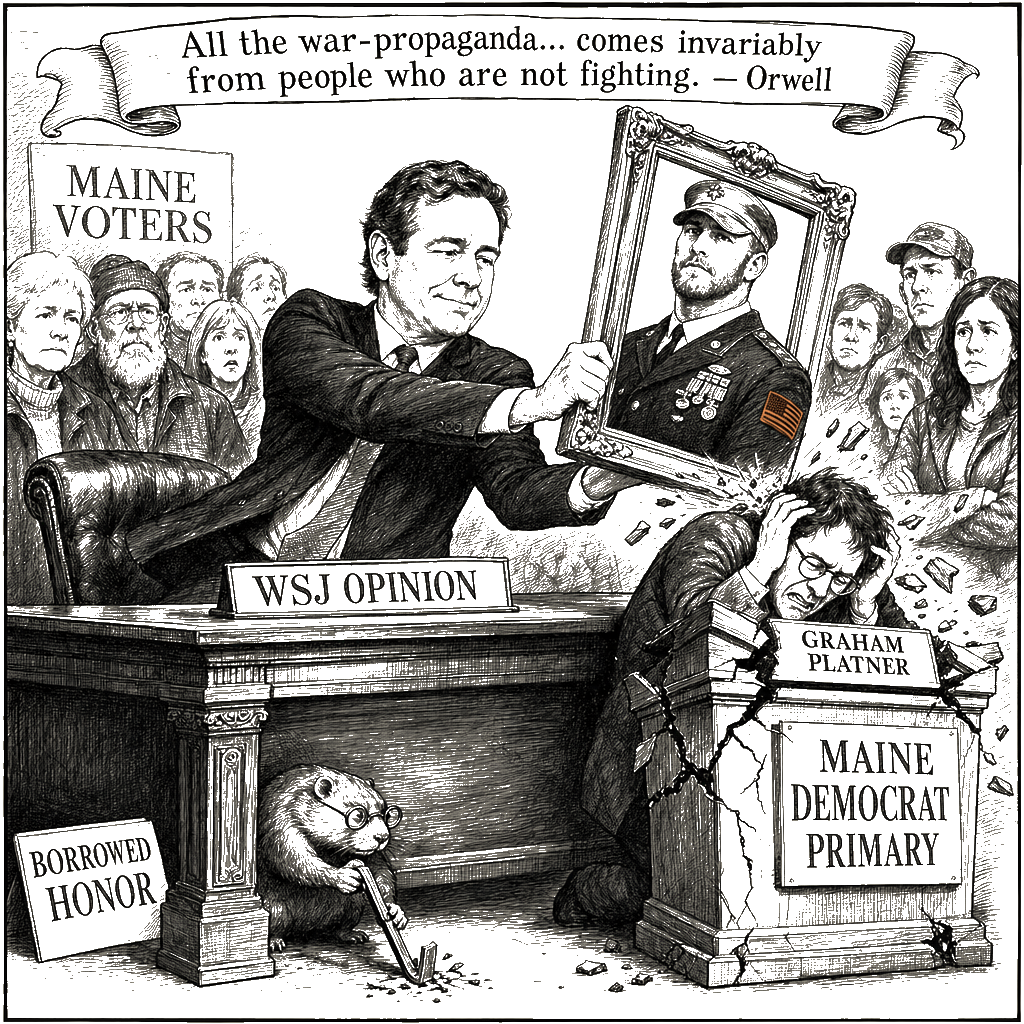
James Freeman uses the memory of Chris Kyle as a political cudgel to bludgeon Graham Platner out of the Maine Senate race.
His Wall Street Journal column, published Monday June 1, 2026, presents itself as a helpful guide for Maine Democrats who might want to reconsider their front-runner. It is a dead-soldier-clubbing campaign — an opposition-research hit job dressed as concerned advice, using the reputation of a slain Navy SEAL to disqualify a political target Freeman’s editorial page disfavors. The piece deploys at least five distinct technique-deployments across its sourced aggregation; this annotated walk-through names them as they appear.
Maine Democrats will decide their nominee for a U.S. Senate seat next week. Just as many primary voters are reconsidering their support for deservedly controversial front-runner Graham Platner, along comes another big reason to contemplate alternative candidates. — Opening paragraph
The column opens with a door held open for the reader who might feel squeamish about candidate culling. “Deservedly controversial” is the euphemism: Platner is framed as already guilty, so reconsidering him becomes an act of civic responsibility rather than the work of a hit squad. This is the permission structure the Collective Ego Playbook catalogues — the audience is given an excuse to abandon a candidate without having to admit they are doing it because the Journal told them to. Frame-engineered relabeling, WSJ catalogue §A.1, supplies the vocabulary; the permission structure (Playbook §5.8) provides the conscience-soothing. But the operator’s eye sees the deeper function: the column does not treat the primary as a civic process. It treats the primary as a portfolio-protection exercise. The WSJ editorial page identifies Platner as the Democrat most likely to threaten Senator Susan Collins, and the “reconsidering” frame is manufactured urgency designed to shake the resolve of primary voters who might otherwise coalesce behind the front-runner. If the donor class sees Platner as damaged, the donor class withholds capital, and the primary math shifts. The claim that voters are “reconsidering” is the engine of that shift.
Leif Babin writes at Free Press to defend the late military hero Chris Kyle, author of “American Sniper” and subject of the popular movie of the same name:
Some national media folk like to suggest that voters have no choice but to support Mr. Platner if they oppose President Donald Trump. But Maine Democrats still have other options—perhaps more than they thought they had just a few days ago. — Paragraphs 2–3, Freeman quoting Babin
Freeman deploys Babin — a decorated SEAL and co-author of Extreme Ownership — as a human credential. The move is §A.18 of the WSJ catalogue: the “as a [identity]” credibility move, where a veteran’s authority is used to validate the piece’s moral outrage. By anchoring the attack on Platner to a three-war author with “American Sniper” visibility, the Journal insulates the piece against accusations of partisan hit; the column can pose as simply transmitting authoritative testimony. But Babin’s role isn’t to add evidence. It’s to shield the operation from the charge that it’s a political smear. That’s the long con we operators called the “borrowed honor” trick: you recruit a figure whose reputation blocks incoming fire, then fire your own rounds from behind them. The reader receives a credential — “As a SEAL” — where the analysis should be; the column substitutes identity for evidence and calls it moral authority.
On Saturday the Journal’s Tarini Parti and Aaron Zitner reported:
[Report details that Platner accused Kyle of inflating his count / “shooting innocent civilians”] — Paragraph 4, quoting a WSJ news report
The column then quotes the Journal’s own news side as if it’s a neutral referee confirming the hit. This is the “cross-brand laundering” variant of coordinated message discipline: the editorial page tells readers what the news pages “reported,” collapsing the wall between advocacy and journalism to create an impression of objective consensus. The WSJ newsroom provided the raw ammunition — the podcast clip — and the opinion column fires the shell. The coordination is structural: the newsroom generates the “smear” evidence, and the opinion column frames it as moral disqualification. The reader is moved from the reporting layer to the judgment layer without a seam. The reader is given the feeling that the facts stand on their own, when in fact the editorial board chose which facts to spotlight and how to frame them.
Now columnist Steve Collins writes in Maine’s Portland Press Herald that independent and Democratic women “are increasingly fed up with rolling revelations about Platner’s past” and adds:
… the steady drip … is wearying many voters who don’t want to reward the conspiracy-minded, class-warfare side of the Democratic coalition. — Paragraph 5, quoting the Press Herald
Freeman piles on a local columnist’s paraphrase, treating “revelations” as established rather than contested, and using the Press Herald’s “local” brand to imply grassroots discontent. This is the “third-party corroboration” technique: you find a voice from the target’s own constituency and amplify it to suggest that even the home team thinks he’s rotten. The collective-ego function here is to pre-empt the reader’s suspicion that the Journal is just playing partisan: look, even a Maine newspaper says so.
If not, and if Democrats don’t want to back a suspended campaign, there are still more options. This column has noted that David Costello, who is on the ballot and has not suspended his campaign, has significant experience in government and is a perfectly plausible left-wing Democrat to run against the state’s Republican senator.
Then there is write-in candidate Andrea LaFlamme, who doesn’t seem to have suspended her campaign, either. — Paragraphs 6–8, offering alternatives
This is the astroturfed alternatives ledger. The column lists write-in candidates and minor-party entries to manufacture a viability story that does not exist in the data. The signal to the donor class is the “opt-out” option. Freeman is telling the moneyed wing: “If you cannot hold your nose for Platner, here is where you park your resources.” The column elevates X posts and write-in candidacies to the level of “options” to create the illusion of a contested field. The operation is damage control for the establishment that prefers a weaker general-election opponent to a damaged front-runner. The reader is invited to participate in a movement that the column is assembling in real-time. And now the permission-structure loop closes: you are not being forced; you have choices; and one of those choices looks just fine. The reader gets to feel principled while doing exactly what the Journal wants.
If Democrats choose to back Mr. Platner, they can’t claim they had no choice. — Concluding paragraph
The closer functions as a moral blackmail note: if you proceed with Platner, you forfeit the right to complain that you had no alternative. The line isn’t an argument; it’s a sentence designed to be quoted, stripped of context, and weaponized against any Democrat who sticks with him. This is the WSJ catalogue’s §A.13 threat-inflation closer: elevate the stakes from electoral calculation to moral complicity, and leave the reader with a takeaway that licenses dismissal of the entire campaign. The column positions the WSJ and the donor-class alternatives as the defenders of democratic choice, while implying that supporting Platner is an abdication of agency — the classic posture of the page, which claims to protect the voter from the voter’s own impulses. By forcing the reader to choose between party loyalty and moral self-image, the line converts electoral hesitation into shame-driven compliance.
So here is what Freeman’s column, taken as a whole, actually is: a shakedown operation that weaponizes the honor of a slain sniper to coerce Maine Democrats into purging a candidate Freeman’s page doesn’t like. The Wall Street Journal opinion page cannot attack a Democrat in a Maine primary by saying “we prefer Republican incumbents.” That is the truth, but it is the truth the column cannot speak. Instead, the column wraps the partisan operation in the flag of a dead hero. It uses the reputation of a Navy SEAL who can no longer speak for himself as a blunt instrument to break a primary candidate who has shown signs of vulnerability. The column does not defend Chris Kyle; it weaponizes him. The reader is asked to mourn the hero while the editorial page picks the pockets of the hero’s memory to fund a general-election strategy.
Freeman tells Democrats they have “other options” — the same way a mobster tells a shopkeeper there are other suppliers. And his parting line, “they can’t claim they had no choice,” is the confessional spine of the whole racket: he’s admitting that his moral universe reduces to a gun-to-the-head demand for loyalty, and anyone who refuses is a willing accomplice to the smear they’re being forced to participate in. What the donor-class reader sees in this column is a principled defense of a fallen hero. What the column actually is, is a panic-merchandising brochure for a threatened seat — and the reader is its target, not its subject. The dead SEAL isn’t being honored; he’s being used as a prop in a hostage negotiation. The only person treating a soldier’s memory as a disposable asset is the man who wrote this column.
— Phukher Tarlson