
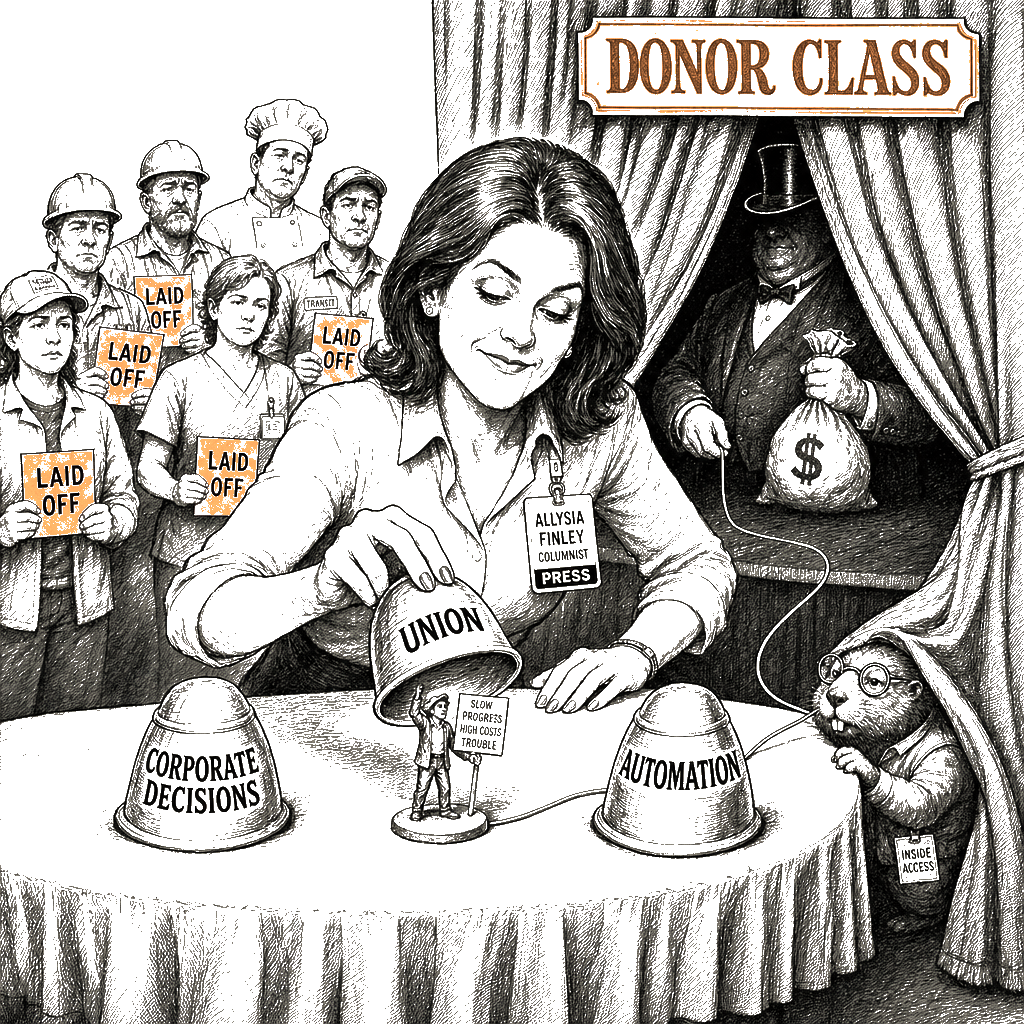
The Wall Street Journal blames a union president for corporate layoffs to shield the donor class. Allysia Finley’s May 31, 2026 opinion piece runs the old union-busting shell game, deploying six distinct technique-deployments across fourteen paragraphs. This column walks through them as they appear. We who operated this circuit in the cable years have to name what we built: isolating the wage line item, pretending it causes the structural failure, and selling the resulting wreckage as proof that working people’s collective voice is inherently corrupt. The piece does exactly that.
Politics requires alliance-building, and nobody knows that better than the pugnacious Teamsters President Sean O’Brien. He has spent the past few years cultivating ties with Republicans—chief among them Vice President JD Vance—to benefit his union.
Mr. O’Brien is desperate for a win in Washington to sell to his 1.3 million members as he runs for re-election. Some Republicans in Congress seem eager to give him one—maybe two—as they seek to burnish their bona fides as defenders of the working class. These Republicans are doing more to help Democrats—the primary beneficiaries of Teamster campaign donations—than workers. — Paragraphs 1–2
“Pugnacious.” The adjective arrives before the policy substance, and that is the point — the piece needs you to see O’Brien as combative before you encounter what he’s actually fighting for. Frame-engineered relabeling at WSJ §4.1 operates here through motive-assignment rather than term-substitution. In the cable years, we called this loading the dock: arranging the audience’s emotional posture before the first claim arrives. The multiple-audience-targeting construction (WSJ §4.3) is already running in the second paragraph. The wealthy subscriber gets confirmation that O’Brien is a political animal. The political-class reader gets a warning. The populist reader gets “they’re using you.” The technocratic reader gets the clean quote about Democratic campaign donations. That last one does the load-bearing work. The piece has not argued that union wages are too high or that safety mandates are unnecessary. It has told you that your dues go to Democrats. Everything else is the brochure. This is the four-audience trick we ran on Tuesday mornings: reassure the donors, warn the strategists, ratify the populist grievance, and leave the technocratic class a sentence to lift. It is not subtle. It is engineered.
The Teamsters’ membership has shrunk by nearly half since the 1970s amid a broader decline in organized labor. Technology has improved productivity. At the same time, jobs have migrated to states with right-to-work laws, which prohibit unions and employers from making union membership a condition of employment. The Teamsters have also lost rank-and-file support. Between 2016 and 2025, members filed 373 petitions to decertify the Teamsters, according to Reason magazine. Some 60% of the decertification elections succeeded.
You can’t blame union members for wearying of paying dues that bankroll Democratic candidates and lavish lifestyles of union leaders. In the 2023-24 election cycle, 92% of Teamsters PAC donations to federal candidates went to Democrats, as did 91% of the union’s contributions to party committees. — Paragraphs 3–4
The decertification ledger and the dues-as-crook framing operate as a coordinated bad-faith sequence. “You can’t blame.” Three words that hand the reader permission to resent their own union by making the resentment feel like common sense. Bandura’s moral justification: it’s not anti-union to resent where your money goes; it’s reasonable. The word “bankroll” does the relabeling. Dues collection becomes extraction rather than what it is, which is how workers pool resources to negotiate with employers who hold ten times their individual leverage. Then the pivot hits the character indictment: “lavish lifestyles.” That is the con. It makes corruption and union membership feel like the same thing. Finley piles on 373 decertification petitions and a meal-tab scandal. In a membership of 1.3 million, that decertification figure is a fraction of a percent exercising a democratic remedy that exists precisely because the union provides it. The meal tab is a governance problem already under investigation. Neither number tells you whether two-person rail crews prevent derailments or whether truck drivers should negotiate collectively. They are character evidence offered in place of policy argument — the prosecution’s habit of putting the defendant’s lifestyle on trial when the case on the merits is weak. We operators called this laundering the money trail when the goal was to make membership feel like theft rather than collective insurance. The move is a con dressed as civic education.
In 2023, Yellow Corp., one of the country’s largest trucking companies, sought financial concessions from the Teamsters to stay in business. Mr. O’Brien refused and tweeted an image of a gravestone reading “Yellow 1924-2023.” The company filed for bankruptcy, and 22,000 Teamsters lost their jobs.
After threatening UPS with a strike that summer, Mr. O’Brien won a deal that increased average compensation for full-time drivers over five years to $170,000 from $145,000, including zero healthcare premiums and as much as seven weeks of vacation. Rising labor costs prompted UPS to cut 34,000 nonmanagement jobs last year, with another 30,000 planned for this year. — Paragraphs 5–6
Three sentences. Refusal. Bankruptcy. Job loss. The causal sequence is implied by proximity, and that is the operation. Yellow Corp. had been hemorrhaging money for years, had taken $700 million in federal pandemic relief, and was mismanaged at the executive level through debt-loading acquisitions long before O’Brien sat across the table. The gravestone tweet was a prediction that proved accurate. But Finley’s paragraph structure relocates the cause from corporate mismanagement to union intransigence. Bandura’s distortion of consequences: the actual cause is minimized, the attributed cause is amplified. The syntax does the work — “sought financial concessions to stay in business” positions Yellow as a supplicant fighting for survival; “O’Brien refused” positions the union as the agent of destruction. The paragraph contains no executive names, no acquisition history, no debt load. The piece places O’Brien’s refusal immediately before the bankruptcy filing, creating a causal silhouette that implies the wage demand broke the company. It does not mention Yellow’s decades of underinvestment, its reliance on predatory leasing rates, or the freight-rate collapse that management failed to hedge. Note the characterological weaponization of the gravestone tweet: Finley reproduces O’Brien’s own provocative image not just as evidence of causal responsibility, but as a proof of personal callousness. Twenty-two thousand workers lost their jobs because a company could not survive its own strategic decisions. The operator’s-eye-view reads the sentence exactly as designed: it makes the workforce the cost center in the reader’s accounting ledger while treating the executive suite’s automation schedule and dividend payouts as neutral background noise. The company moves the jobs. The union gets blamed for the shell. This is the relabel scam. When management offloads risk onto drivers, the wage line absorbs the moral blame. The piece is not reporting an economic outcome; it is running a hit on the collective bargaining mechanism itself.
Meanwhile, Mr. O’Brien’s campaign to organize Amazon warehouse workers and drivers has met with little success. More successful has been his courtship of Republicans to support legislative priorities such as the misnamed Railway Safety Act and the Faster Labor Contracts Act. — Paragraph 7
The frame-engineered relabeling (WSJ §4.1) hits the legislation directly. Calling the Railway Safety Act “misnamed” deploys the page’s standing euphemistic inversion: safety mandates for two-person crews are renamed as market distortions, while management’s preference for automated single-operator freight is disguised as efficiency. One hundred seventy thousand a year, zero healthcare premiums, seven weeks of vacation — the piece presents these as evidence of the problem. Then it tells you 34,000 jobs were cut and 30,000 more are coming, and the attribution lands on “rising labor costs prompted” the cuts. The nominalization is the tell — “prompted” erases the corporate agent entirely. There is no subject who decided. There is only a cost, which apparently had no choice but to produce layoffs the way rain produces puddles. But UPS disclosed in its own investor filings that it was automating package-handling, closing 93 facilities, and restructuring its network independent of whatever contract O’Brien negotiated. Bandura’s displacement of responsibility relocates the corporation’s restructuring decisions to the union’s bargaining table — and the grammar cooperates. The Faster Labor Contracts Act undergoes the same lexical surgery. “Faster” reframes a binding arbitration deadline as a mere speed metric, stripping the policy of its defensive function. The piece cites “farmers and fossil-fuel producers” as opponents; those are donor-class interests presented as disinterested stakeholders, the source-citation asymmetry at WSJ §3.6 deploying its standard mask. Between these cost shifts and the legislative attacks, Finley stacks paragraphs covering Rubio and Hawley’s courtship and the discharge petition. Watch the “Fat chance” line. It masquerades as objective prediction but operates as a tonal weapon — an embedded dismissal that primes the reader to view the GOP’s maneuvering as naive rather than strategic. It clears the stage for the closer. The operational move here is lexical substitution. The page swaps “safety infrastructure” for “labor mandates” and “bargaining deadline” for “union leverage”. This is the four-letter word swap we tested in focus groups until the poll numbers moved. It is propaganda, not policy analysis.
Mr. O’Brien has forged an alliance with the vice president and other Republicans out of pragmatism. When will they realize they’re being used? — Paragraph 15
The closer runs the sucker’s bet inversion (WSJ §4.13 / Playbook §5.15). “Giving unions more money to dump into Democratic campaigns.” Fourteen paragraphs of concern for workers — the 22,000 at Yellow, the 34,000 at UPS, members paying dues to Democrats — and the piece lands on the donor class’s actual fear: that union money will reach Democratic candidates. Every paragraph was in service of that conclusion. The worker was the prop. The campaign donation was the point. Finley frames GOP 2028 hopefuls as marks being played by a union boss, warning Vance and Hawley that their outreach is leaking cash to Democrats. The mirror turns on the speaker. A piece that uses concern for workers to advance the employer class’s interests accuses a union president of using people. A piece that frames safety legislation as a union shakedown accuses the union of being the shakedown artist. The real mark is the GOP primary voter, told that a union boss’s policy demand is the existential threat while the donor class operates without scrutiny. The technique asks the reader to imagine Republicans as the victims of union leverage, erasing the decades of right-to-work expansion and regulatory defunding the Board’s own donors engineered. This is the long con we ran when we wanted the audience to fear the wrong enemy.
So here is what the piece actually amounts to, taken together. Finley tells 2028 hopefuls they are being played by a union boss, and the mirror is so clean it shows the trap the piece itself is setting. The Wall Street Journal just ran a protection racket for the employer class — blaming a union president for corporate layoffs, relabeling safety legislation as a union shakedown, and framing worker protections as threats to workers. The piece names no CEO. It names no board member. It names no restructuring plan. It names no automation strategy. It names one union president and tells you he is dangerous. The real con is the donor-class architecture that uses union-busting rhetoric to launder deregulation, hands the right-to-work lobby the moral high ground, and lets the actual capital allocation run unchecked until the infrastructure collapses. This was the four-front play: attack the messenger, reframe the policy, invoke the workers you are about to hurt, close on fear. Fourteen paragraphs, one target — the ability of 1.3 million workers to negotiate a wage that does not require a second job. The donor class does not need to defeat the Teamsters. It just needs you to believe the Teamsters are the ones doing the damage. The mirror is not at the union hall. It is at the editorial desk, and the reflection is the architecture that paid for the column and the politicians it is trying to steer. The game is not O’Brien’s. It is the Board’s. And the Board knows exactly who pays the price.
— Phukher Tarlson