
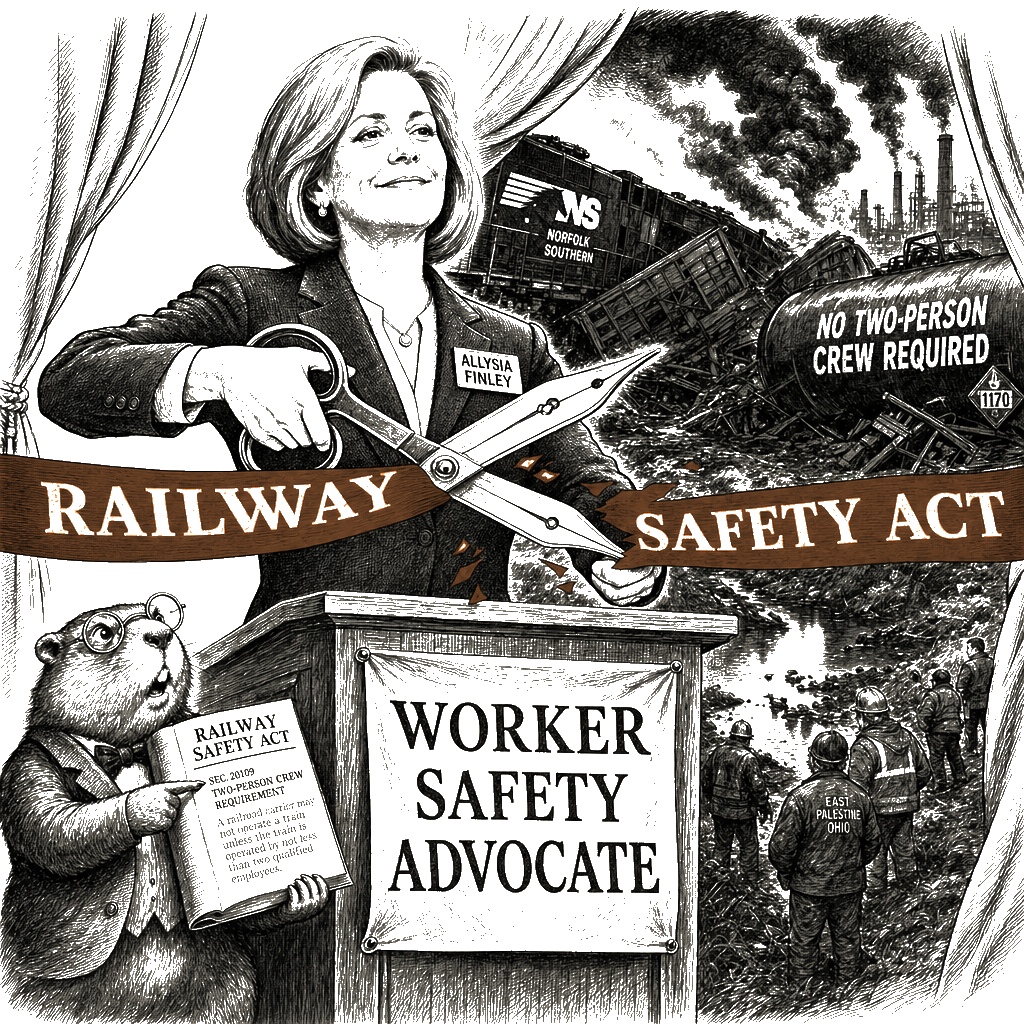
Allysia Finley launders donor-class safety rollback as pragmatic worker realism. The Wall Street Journal’s Allysia Finley, published May 31, 2026, deploys seven distinct technique-deployments across its fifteen paragraphs; this column walks through them as they appear.
Politics requires alliance-building, and nobody knows that better than the pugnacious Teamsters President Sean O’Brien. He has spent the past few years cultivating ties with Republicans—chief among them Vice President JD Vance—to benefit his union. Mr. O’Brien is desperate for a win in Washington to sell to his 1.3 million members as he runs for re-election. Some Republicans in Congress seem eager to give him one—maybe two—as they seek to burnish their bona fides as defenders of the working class. These Republicans are doing more to help Democrats—the primary beneficiaries of Teamster campaign donations—than workers. — Paragraphs 1 through 3
Multiple-audience-targeting — WSJ §4.3 — operates here through a single paragraph executing three separate messages for three separate cohorts. The political class gets “alliance-building” and “burnishing their bona fides,” a wink to operatives reading the page for signals. The populist base gets “pugnacious Teamsters President” and a framed grievance against “bankrolling Democratic candidates,” signaling that the union is an out-group threat to be neutralized. The wealthy reader gets the reassurance that the politicians are actually helping workers by exposing the “trick.” We operators built multi-layered copy exactly like this in the cable years to keep the donor class calm while the populist base is handed a new villain to track. The piece never actually proves the Republicans are helping workers; it claims the gesture itself is the help, which collapses the moment you check the voting record. The AFL-CIO documented JD Vance’s alignment with labor priorities at zero percent during his House tenure, a structural fact that the sentence structure deliberately obscures by splitting the subject across clauses. This is not an analysis of labor policy; it is an electoral manipulation dressed up as coalition mapping. The copy isn’t observing an alliance; it is dissolving the alliance by refusing to name that the donor class has already bought these politicians, and the union is just the distraction being sold to the floor.
You can’t blame union members for wearying of paying dues that bankroll Democratic candidates and lavish lifestyles of union leaders. In the 2023-24 election cycle, 92% of Teamsters PAC donations to federal candidates went to Democrats, as did 91% of the union’s contributions to party committees. An independent investigations officer—mandated by a court because of the union’s longstanding corruption problems—issued a report in February accusing two former Teamster officials of treating the union credit card “as a blank check to permit them luxury living without limit,” including restaurant tabs for meals with friends topping $3,000. One was a close ally of Mr. O’Brien. They defended some expenses as related to union business. — Paragraphs 4 and 5
Displacement of responsibility and Bandura mechanism: attribution of blame — Bandura: displacement_of_responsibility / attribution_of_blame — operates here through making the union membership responsible for the union leadership’s political spending and past corruption. The paragraph constructs a moral trap: if dues go to Democrats, the members are to blame for paying them; if leaders eat expensive meals, the members are to blame for allowing corruption. The court-mandated investigation is real and the expenses are documented, but the frame treats past graft as a justification for current political realignment. We built this kind of displacement when the strategy needed to sever workers from collective institutions without naming the employer’s financial interest in that severance. It shifts the cost of institutional failure onto the individual worker’s wallet, which is the standard concessionary frame. This is the same deflection routine applied to public-employee pensions, and it functions exactly as intended: it moralizes a structural political disagreement into a personal ethical failure for the subscriber. The austerity-thrift archetype does the moral pre-work here. The corruption case supplies the permission structure for the reader to conclude that union dues are a racket, that union members are marks, and that any Republican engaging with union leadership is being conned. This is the moral-prep operation — soften the target before you hit it, so the hit feels like righteous self-defense rather than a political hit job.
In 2023, Yellow Corp., one of the country’s largest trucking companies, sought financial concessions from the Teamsters to stay in business. Mr. O’Brien refused and tweeted an image of a gravestone reading “Yellow 1924-2023.” The company filed for bankruptcy, and 22,000 Teamsters lost their jobs. After threatening UPS with a strike that summer, Mr. O’Brien won a deal that increased average compensation for full-time drivers over five years to $170,000 from $145,000, including zero healthcare premiums and as much as seven weeks of vacation. Rising labor costs prompted UPS to cut 34,000 nonmanagement jobs last year, with another 30,000 planned for this year. — Paragraphs 6 and 7
Framing collective bargaining as predatory extortion — WSJ §4.1 / Bad-Faith Catalog: frame_engineered_relabeling combined with attribution_of_blame — operates here through recasting standard contract negotiations as unilateral strikes against employment itself. The Yellow Corp bankruptcy is presented as the direct result of O’Brien refusing concessions. But Yellow’s collapse traced to years of over-leveraged acquisitions, a failed merger attempt, and deteriorating freight-market conditions. The gravestone tweet becomes proof of O’Brien’s destructiveness, but the actual causal chain is considerably more complex, and the complexity would complicate the narrative Finley needs. This is the blame-shift operation — point at the union boss when the company’s own decisions drove the outcome, and the reader never asks what the company was doing while the union was negotiating. The UPS section takes a negotiated wage increase and directly links it to non-management layoffs without engaging the company’s own automation deployment, warehouse restructuring, and margin-protection strategies that corporate filings explicitly attribute to productivity drives. The operator’s view here is straightforward: when capital loses leverage at the bargaining table, it funds a media campaign to recode the wage increase as an act of economic terrorism. This is not an analysis of labor economics; it is a donor-class panic dressed up as labor history.
Meanwhile, Mr. O’Brien’s campaign to organize Amazon warehouse workers and drivers has met with little success. More successful has been his courtship of Republicans to support legislative priorities such as the misnamed Railway Safety Act and the Faster Labor Contracts Act. After a Norfolk Southern train derailed in East Palestine, Ohio, in 2023, then-Sen. Vance co-sponsored legislation that would impose costly labor mandates on railroads in the name of safety. Farmers and fossil-fuel producers argued that it would increase transportation costs without improving safety. — Paragraphs 8 and 9
Frame-engineered relabeling and manufactured consensus — WSJ §4.1 / Bandura: moral_justification — operates here through tagging the Railway Safety Act as “misnamed” and reframing two-person crew mandates as “costly labor mandates.” Finley relabels bipartisan labor legislation as a union shell game before the reader learns what it contains. The bills get processed through Finley’s frame rather than on their own terms. This is the relabel scam — repackage the product before the customer sees it, and the customer never checks the label against what’s inside. The article drops “in East Palestine” as a historical footnote, stripping the safety statute of its primary impetus: a fully documented hazardous materials disaster that occurred under crew-reduced operations, precisely the vulnerability the Railway Safety Act was designed to address, which killed residents, contaminated waterways, and exposed emergency responders to toxic vapor clouds. The “misnamed” framing borrows directly from freight-carrier lobbying talking points and pasted them into the editorial voice. We operators called this loading the dock when we knew the downstream committee would kill the bill anyway; you relabel the victim’s protection as a burden on the industry, and you hand the political class an excuse to defund the standard. The farmers and fossil-fuel producers are named as stakeholders whose transportation costs are raised, which is accurate, but the frame treats increased shipping costs as an absolute moral evil while treating chemical exposure in residential towns as a regulatory overreach. This is not a safety debate; it is a risk-pricing transfer from the carrier to the public, and the editorial page is running the math.
Other potential Republican contenders have also curried favor with the union. Then-Sen. Marco Rubio of Florida backed a Teamster affiliate during a 2022 railroad contract dispute. Missouri Sen. Josh Hawley is championing a Teamster-backed bill that would allow an arbitration panel to impose a contract if a union and employer fail to reach an agreement after 120 days of bargaining. Modeled on a California farm labor law, the bill would give unions more leverage while also reducing the power of workers, who wouldn’t have to approve the ultimate contract. That means the union could force hefty dues payments on workers without their consent. Seven House Republicans have signed a discharge petition to force a floor vote on the bill. They may be hoping their alliance with organized labor will quell working-class anger over inflation. It won’t. And they will be giving unions more money to dump into Democratic campaigns. — Paragraphs 10 and 11
Motte-and-bailey and goalpost-shifting — Bad-Faith Catalog: motte_and_bailey / WSJ §4.8 — operates here through reframing binding arbitration as a mechanism that “reduces the power of workers” and forces “hefty dues payments on workers without their consent.” The motte here is the claim that workers lose power under arbitration, which sounds like pro-worker rhetoric until you check the operational reality: arbitration occurs when employers refuse to settle, and the alternative is an indefinite strike or a concession contract that hollows out the shop. The bailey is the claim that workers are being forced to pay dues without consent, which conflates union security agreements with individual opt-in preferences and ignores the documented right-to-work framework that already governs dues collection in the relevant jurisdictions. Finley has just noted that O’Brien’s Amazon organizing campaign “met with little success” — the transition to Republican courtship implies that legislative leverage through friendly politicians is what a union boss pursues when he can’t win at the bargaining table or the warehouse floor. Rubio and Hawley become co-defendants in the same scheme. This is guilt by proximity — make every Republican who touches labor legislation complicit in the same scheme, regardless of what the legislation actually does. The piece closes on the threat-inflation closer with the assertion that Republican engagement with labor “will be giving unions more money to dump into Democratic campaigns,” converting a legislative-policy question into a civilizational-safety question: if you touch the union, you fund the enemy.
So here is what Finley’s column actually amounts to, taken together. The piece relabels bipartisan safety and contract legislation before the reader encounters it, builds a corruption case to morally justify that relabeling, asserts a causal chain between union bargaining and job losses that the documentary record does not support, widens the indictment to every Republican who has engaged with organized labor, and closes by framing any such engagement as a fool’s errand run by a corrupt boss who funds the other side. The “working class” being defended isn’t the member losing their job to automation or the resident breathing toxic air in East Palestine; it is a rhetorical dummy pulled out to justify the same carrier-class margin expansion that has run uninterrupted for forty years. The politicians are not being tricked into hurting workers; they are executing the donor-class preference for cheap, disposable logistics while the editorial page writes the receipt. The reader who absorbs the column believes they reasoned to the conclusion that Vance is being conned. The conclusion was delivered with the opening sentence. The rest was the con.
— Phukher Tarlson