
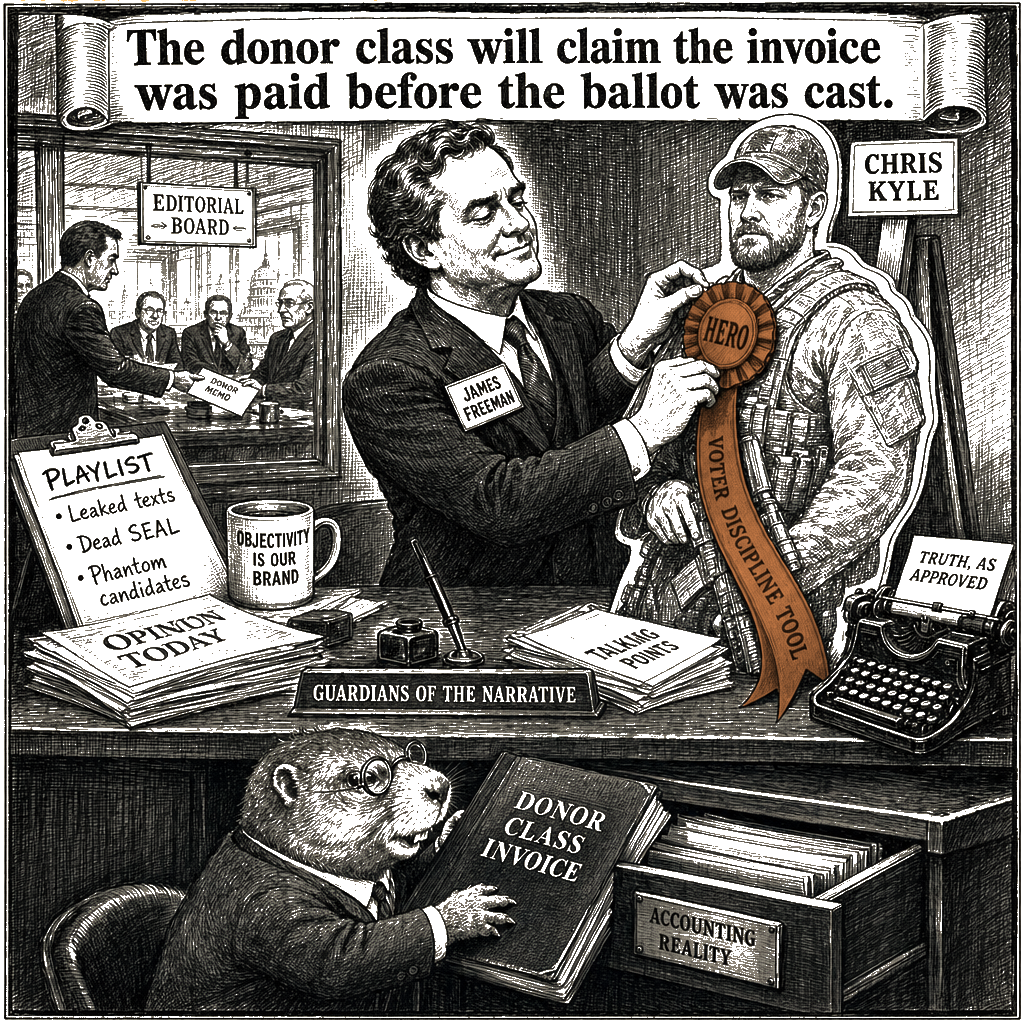
The Wall Street Journal’s Best of the Web is the editorial page’s designated character-assassination delivery system — a format so low to the ground, built on block-quoted tweets and aggrieved reader emails, that it can smear a target without the page ever having to sign an editorial board “we” next to the smear. James Freeman’s Monday column scavenges a murdered veteran’s legacy to enforce primary voter discipline against Graham Platner, the Democratic front-runner for Susan Collins’s Senate seat. In the cable years, we assembled playlists like this every Tuesday, knowing the prestige-stage curation would land harder than the raw attack-ad content. The piece deploys a repertory of narrative frames to attach moral contamination to the populist candidate before the general election can price in the donor class’s cost; this annotated walk-through names them as they appear.
Maine Democrats will decide their nominee for a U.S. Senate seat next week. Just as many primary voters are reconsidering their support for deservedly controversial front-runner Graham Platner, along comes another big reason to contemplate alternative candidates.
The opening is the page’s signature move — the multi-audience targeting analytic (WSJ Appendix A.3) executed inside a single sentence. “Deservedly controversial” is the load-bearing phrase: it announces to the wealthy GOP-donor reader that Platner is damaged goods without specifying which damage is being asserted, while simultaneously signaling to the political-class reader that the page is doing its job of defining the Democratic candidate before he can define himself. The phrase is a permission structure (Collective Ego Playbook §5.8): the reader who wants Platner disqualified gets the moral cover of “deservedly” without having to examine whether the controversies actually merit the adjective. The technique works because the reader supplies the missing content — whatever the reader already believes about Platner, “deservedly controversial” confirms it.
The claim that a primary race defined by voter decision is somehow illegitimate because one candidate has become controversial is the blue state failure frame (Appendix A.9), inverted. Instead of treating a blue state as failure because of progressive policy, the page treats a Democratic primary as failure because voters are choosing a candidate the page has decided is disqualifying. The voters are wrong; the page knows better. That’s the operation.
Leif Babin writes at Free Press to defend the late military hero Chris Kyle, author of “American Sniper” and subject of the popular movie of the same name:
The Hearsay Ledger — WSJ §4.5 / the “study shows” ledger — operates here through the substitution of original reporting for a scavenger’s clipboard. The column does not advance a journalistic argument; it assembles a playlist. By pulling a third-party Free Press piece defending a dead SEAL into an institutional WSJ column, the piece performs the outrage-aggregation move familiar to the cable-years operation: the outlet supplies the prestige stage, the outside pundit supplies the attack-ad material. The operator’s-eye-view recognizes the structural cynicism of the move: the elite reader sees consensus media forming against the populist outlier, while the populist base reads legacy media finally catching up to their guys. The piece gets both audiences moving on the same track. It is a shakedown of the audience’s attention, paid for in leaked texts and a murdered veteran’s name.
This is simultaneously the page’s credentialed-credibility move (Appendix A.18). Leif Babin, Navy SEAL, writing at The Free Press, a publication whose entire editorial identity consists of “former liberals telling liberals they were right to be liberals until the left went crazy.” The name is the credential; the credential is the argument. The move functions to bracket Platner as someone a SEAL condemns, which means the reader can condemn Platner without having to evaluate the underlying claim. The framing of Kyle as “the late military hero” is the euphemism cluster (Appendix A.12) in operation — “hero” does the work of “whose contested battlefield conduct is the subject of the dispute,” and the contestedness is simply disappeared. The reader receives “hero” and is meant to stop reading.
On Saturday the Journal’s Tarini Parti and Aaron Zitner reported: Now columnist Steve Collins writes in Maine’s Portland Press Herald that independent and Democratic women “are increasingly fed up with rolling revelations about Platner’s past” and adds: Maybe it’s time for the governor to become active again.
The Demographic Proxy — Bandura: diffusion of responsibility / WSJ §4.10 — operates here by using an anonymous mass of voters to launder the column’s own political hostility (cf. Collective Ego Playbook, proxy laundering: the author substitutes a group’s supposed sentiment for his own editorial interest). The demographic-shield maneuver is standard operator practice. The author does not want to say directly that he thinks the candidate’s leaked texts are disqualifying, because naked partisanship looks weak in the institutional register. So he finds a Portland Press Herald columnist who says “independent and Democratic women” are “increasingly fed up.” Instantly the Journal becomes the faithful clerk merely recording the moral outrage of the demographic mass. The audience-management function tracks cleanly: by framing the primary electorate’s concern as a personal-morality crisis rather than a material-policy question, the column works to shift the center of gravity away from the populist economic agenda and toward culture-war discipline. It is a theft of the voter’s policy interests, replaced with a manufactured morality play.
“To reiterate, Maine’s US Senate race is not settled! ME’s DEM primary is next week. And I believe that I have the most fitting background and experience to defeat Senator Susan Collins and to help in advancing real, substantive change in Washington,” Mr. Costello posts on X today. Then there is write-in candidate Andrea LaFlamme, who doesn’t seem to have suspended her campaign, either. She posts on Facebook today:
The Phantom Field — WSJ §4.6 strawman adjacent, Bad-Faith Catalog: frame-manipulation — operates here by elevating social-media posts from candidates whose campaigns are functionally over to the status of substantive alternatives. This is the phantom-field con. The quote is pulled from an X post by a candidate with no polling traction, and a Facebook status from a write-in, and both are treated as evidence of a serious multi-candidate race. The operator’s-eye-view knows exactly why the move is deployed: by constructing a phantom plurality, the column fabricates a debate where none exists and then invites the reader to feel superior to the Democratic primary voter for supposedly being herded toward a controversial frontrunner. It strips the voter of agency and treats them as cattle being corralled into a moral chute.
“Doesn’t seem to have suspended her campaign” is the sealioning move (Bad-Faith Catalog: sealioning) in its most compact form. The column doesn’t assert that LaFlamme’s campaign is viable; it “doesn’t seem to have” been suspended, which implies it’s ongoing in some meaningful sense. This is the plausible-deniability architecture: if challenged, Freeman can retreat to “I was only noting she hadn’t formally suspended, not endorsing her viability.” No reader reads it that way. The column presents LaFlamme as a serious alternative because the format requires it; the format requires it because the column’s entire rhetorical operation depends on manufacturing the appearance of choice.
If Democrats choose to back Mr. Platner, they can’t claim they had no choice.
The closing line — a deliberately quotable sentence engineered for retransmission, the page’s closing-line cadence (Appendix §3.5) — completes the operation. The column has established, through blockquote-and-credential rather than argument, that Platner is damaged goods; it has offered fake alternatives; it has framed the Democratic primary as something happening to voters rather than something voters are doing. The closing seals the frame: whatever choice Democrats make, the page has pre-emptively withdrawn legitimacy from the choice before it’s made. This is the pre-emptive legitimacy-withdrawal technique (Bad-Faith Catalog ID preemptive_legitimacy_withdrawal): the Democratic primary’s outcome is illegitimate in advance, on grounds of Platner’s character, and any subsequent result can be dismissed as forced or fraudulent.
The reader who finishes Best of the Web and feels a flush of moral superiority at the “controversial” candidate is being handed a mirror, not a lens. The Journal editorial page does not actually care about Chris Kyle, a dead man whose legacy is useful only as a cultural prop. The leaked texts would be a résumé enhancement if the candidate were pursuing a corporate-tax agenda. It does not care about David Costello or Andrea LaFlamme, whose X and Facebook posts serve as disposable props in a narrative already drafted by donor-class panic. The only item on the editorial page’s ledger is breaking the populist before the general election can price in the donor class’s cost.
Freeman’s column strips away the unsigned board’s technocratic veneer to expose the underlying chassis, revealing the weaponized form of what the page normally performs as institutional voice — the “we” that knows better than voters what voters should want. No three-graf-turn, no quasi-economic vocabulary aimed at the elite reader. Just the block-quoted hits, the “just asking” posture, the fake menu of alternatives, and the closing moral instruction. It is the WSJ editorial page’s character-assassination technique at its most stripped-down and efficient.
The operation, taken together, is the donor-class concern-trolling operation that the page has run against every Democratic candidate who threatens a Republican incumbent in a state the GOP donor class wants to keep. When the editorial page harvests a murdered veteran’s name and a candidate’s divorce-court failures to enforce primary discipline, it has left the register of analysis and entered the register of a protection racket. The mirror is right here: the reader is not a serious electoral analyst; the reader is a mark in a culture-war shakedown, asked to pay in outrage to protect a political order that does not share the reader’s kitchen table. The page’s brochure is printed; the voters will still decide, but the donor class will claim the invoice was paid before the ballot was cast.
— Phukher Tarlson