
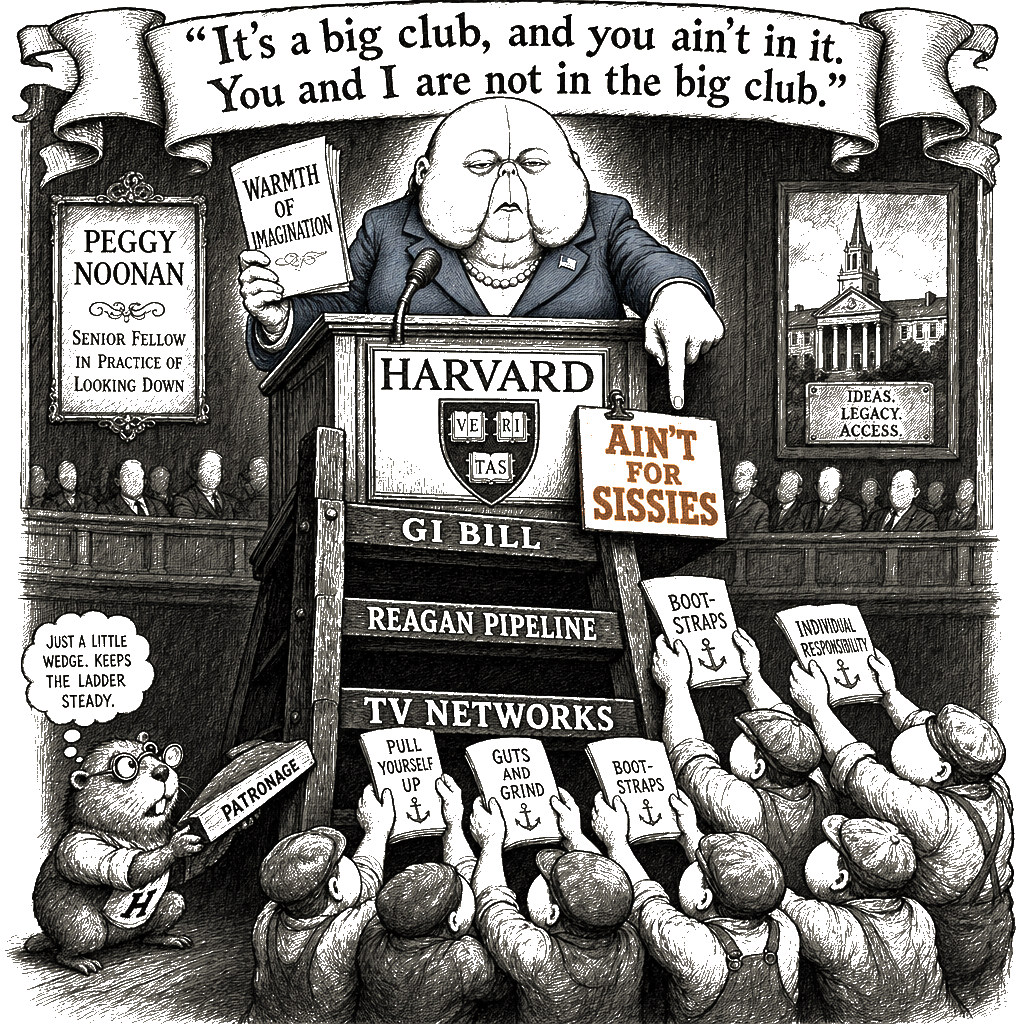
I’m writing this from inside the machinery that built pieces like Noonan’s. Between 1999 and 2007, I drafted sentences in this exact register for the Wall Street Journal opinion page, including unsigned board material that ran under names that weren’t mine. We knew how the foundation-circuit checks cleared, how the focus-group instruments tuned the prose, and how the editorial machinery assembled the final product. The bitterness you’ll read here isn’t the analytical driver; it’s just bounded residue from watching the gears turn. Here’s how the column actually works, laid bare.
Sequential Technique Deployments
The piece opens with a scare-quoted, folksy title grammar that functions as a class-performance signal. It establishes reader intimacy and cultural code-sharing before any ideological payload loads. The opening paragraph borrows Conan O’Brien’s cultural halo to prepare audience segments for elite reassurance and soften reader receptivity, a documented 2003 newsroom pattern where familiar signifiers act as soft landings for hard editorial pivots. Noonan then pivots to the 1950s Massapequa suburbs, deploying strategic nostalgia to erase infrastructure. The description recasts federally subsidized postwar expansion—FHA loans, GI Bill benefits, union wages, exclusionary zoning—as a character-building frontier that tests individual grit.
The narrative converts structural economic outcomes into moral character verdicts under an “America Works” frame. Neighbors who “didn’t make it” are marked as personally deficient, while success narratives are preserved for those who “got organized.” When she hits seventh grade, the guidance counselor scene deploys a stock institutional villain. Historically, 1960s vocational tracking functioned as an economic maintenance pipeline for working-class and immigrant youth, not a diagnostic of destiny. Noonan reframes it as a personal slight to justify later elite validation. The column then drops a parenthetical referencing her sister Cookie and Donald Trump. This nostalgia shield exploits mid-century pop-culture texture to lower the reader’s political threat detection, allowing a partisan loyalty signal to register as benign family memory rather than ideological alignment.
The Miami Beach waitress anecdote converts an individual kindness—the $20 tip from a June Taylor dancer—into proof of a meritocratic universe. It systematically omits the actual institutional access vectors that mattered: Irish-Catholic media contacts, university-network résumé circulation, and the late-1970s/1980s conservative hiring pipeline connecting CBS News to the Reagan White House. Her career summary compresses institutional patronage into four prepositional phrases: “radio station… network… great president… great newspaper.” This multiple-audience targeting addresses Harvard attendees, the conservative policy class, and general readers simultaneously while concealing the media-political networking and foundation patronage that enabled the trajectory.
Back at Harvard, the honorary doctorate functions as a laundering operation. It turns elite credentialing into a universal moral lesson about personal resilience, using institutional ceremony to ratify a fiction about how political and media power actually moves. The moralizing close deploys a permission structure that exhausts objections: a hedge-then-imperative sequence (“maybe the world has reasons… but maybe you should bring your own warmth”) rhetorically acknowledges systemic barriers before empirically overriding them. The closing declarative—“Becoming who you are ain’t for sissies”—is a social-transmission maxim engineered for social-media retransmission. It compresses a contested ideological claim into folk wisdom, converting specific historical advantage into a universal meritocratic principle.
The Mechanics of Network Erasure
You need to see the factual anchors to understand the erasure. Independent historical records confirm that 1950s suburban mobility was structurally engineered by policy and labor-market tightness. NYT mobility data and institutional rankings confirm that upward mobility from an FDU-scale starting point is statistically uncommon. Political-media histories extensively document the Manion-Goldwater-Bozell and Reagan-era conservative hiring pipelines that Noonan actually traversed.
The bootstrap narrative operates not as factual falsehood but as systematic omission. It preserves the chronological steps of her life while stripping away the institutional scaffolding, demographic luck, and patronage networks that made those steps achievable. What’s left on the page is just the individual and the work.
Who This Reassures and Why
Even if you grant the piece a charitable reading—that the column genuinely intends to inspire underestimated youth—it produces identical ideological output. The inspirational payload depends entirely on that structural erasure; narrative warmth does not neutralize the meritocratic myth. The piece functions primarily as donor-class conscience-soothing. Successful readers are affirmed in their meritocratic self-image and freed from structural scrutiny. Struggling readers are simply handed the bootstrap instruction to supply their own “warmth of imagination,” effectively shifting systemic outcomes into individual virtue.
The Actual Mechanism
An honest accounting would reconstruct the actual 1980s media-political pipeline. It would show the clerical desk for what it was: a temporary economic stopgap. It would acknowledge night classes at a regional university as a calculated credentialing play. It would trace the Reagan White House to its true function: the patronage engine that elevated a competent phrase-smith into the national commentary class via network producers, political handlers, and institutional trust guarantees.
The column’s framing misidentifies the “sissies.” The actual structural barrier isn’t individual hesitation. The real barrier is the reader’s willingness to question whether ascent from tracked vocational status is possible without the exact media-political networks, broadcast appointments, and presidential speechwriting pipelines the column deliberately suppresses.