
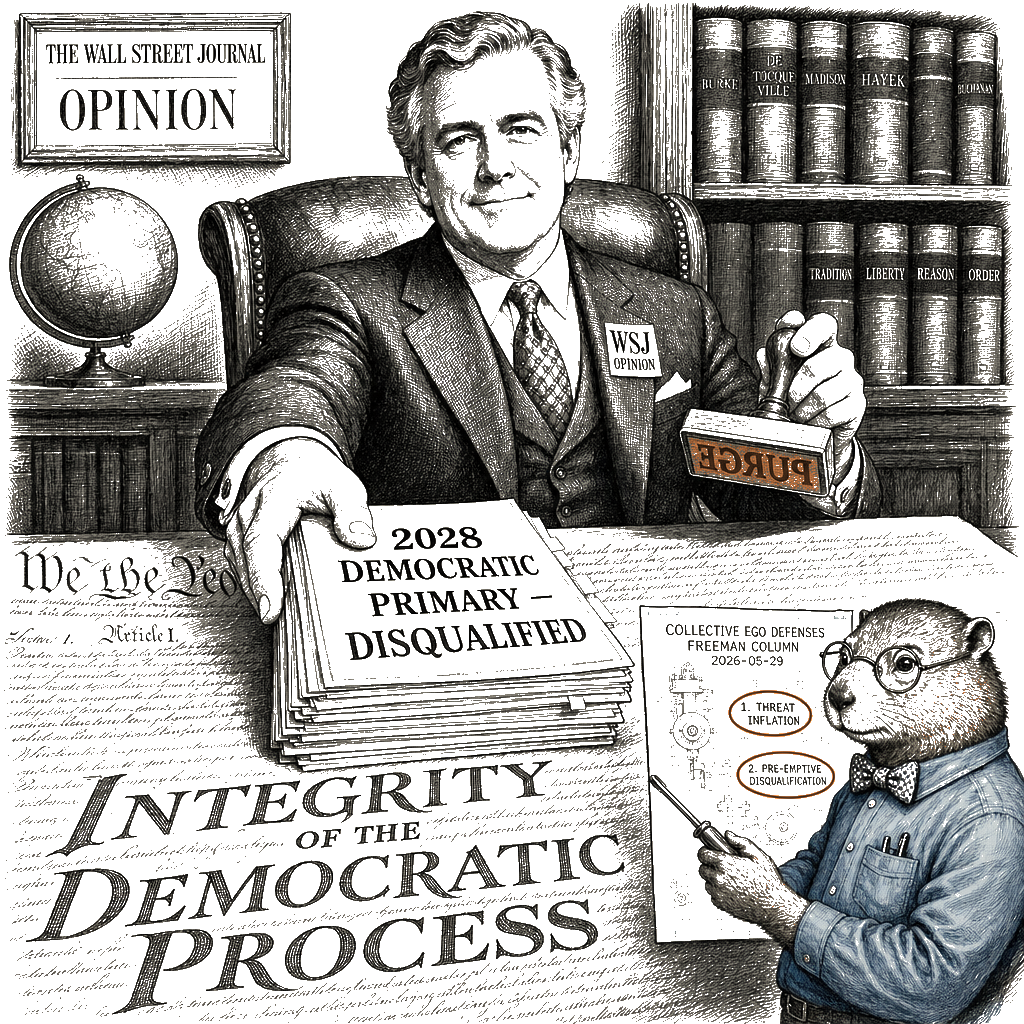
James Freeman uses the former president’s medical decline to purge Democratic leadership and launder partisan retaliation as constitutional duty. The Wall Street Journal opinion page deployed this column on May 29, 2026, to reframe routine executive risk-management as a moral failure requiring the elimination of three leading Democratic candidates. We operators built versions of this purge-frame when cognitive vulnerability served donor-class primary targets; the piece walks through that machinery, leaving the democratic-process cover in plain view. It executes six distinct technique-builds across its architecture; this annotated walk-through names them as they appear.
Americans may never learn who was running the country prior to Jan. 20, 2025, but they can endeavor to prevent anonymous swamp-dwellers from exercising authority to which they are not entitled. For the integrity of the democratic process at the heart of our republic, a good start would be for voters to reject anyone who participated in obscuring President Joe Biden’s cognitive challenges during the last presidential term. — Paragraph 1
The opening accomplishes three operations at once. Americans may never learn who was running the country — this is the unnamed-operators frame. The claim that Biden was not the actual president, that shadow figures exercised power behind him, that the democratic process was hijacked by people no one can name. Freeman does not produce a single piece of evidence. He does not name the supposed operators. The sentence does its work through implication: the reader who already believes the conspiracy absorbs the reinforcement; the reader who does not absorbs the frame without noticing it was never argued. The Collective Ego Playbook identifies this as a foundational ego-defense pattern — constructing invisible threats to the in-group’s self-image so that the conspiracy becomes unfalsifiable by design.
The second sentence elevates a primary-election preference to existential constitutional stakes. This is threat-inflation operating at the level of the founding documents — WSJ playbook §4.13. The operation Freeman is actually performing is a partisan voter-suppression exercise. But the inflation frame makes the partisan hit sound like civic hygiene. We operators used to call this wrapping the hit in the flag. You make the attack look like the republic’s survival depends on it, and the reader doesn’t have to feel like they are engaging in pre-emptive character assassination. They feel like they are doing their patriotic duty.
The third move — reject anyone who participated in obscuring — is guilt by association operating as a permanent loyalty test. Harris’s record, Newsom’s record, Buttigieg’s record — none of it matters. The defense itself is the crime. This is the collective ego’s defector-punishment mechanism. The apparatus marks any member who deviated from the group’s retrospective narrative as permanently suspect, regardless of context or timing. The piece provides no evidence of undue authority, only the assertion that anyone present during the decline must be rejected. This is aggressive frame-engineered relabeling — WSJ §4.1. Calling senior staff anonymous swamp-dwellers while flipping cognitive management into treasonous cover-up shifts the register from healthcare logistics to civic emergency. The operation’s function is pre-emptive legitimacy withdrawal applied to an entire political cohort. We built this exact substitution in the cable years. Label the accommodation a conspiracy, and the purge becomes a duty. The relabel scam, dressed as process integrity.
One might think that everyone involved in the inglorious last days of the Biden era would want to slink away quietly from public life, but apparently not when there are books to sell. A hallmark of this publishing genre is for the authors to attempt to create the impression that Mr. Biden’s incoherent debate performance in June 2024 came as a shock to those who knew him best, even though millions of people who didn’t know him at all had been saying for years that he’d lost his fastball—and a special counsel at his own Justice Department had already deemed him too forgetful to prosecute. — Paragraph 2
This paragraph does two things. First, it reduces Jill Biden’s memoir to a commercial transaction. Apparently not when there are books to sell. The move is derision as argument. Freeman does not challenge a single specific claim. He dismisses the entire memoir as a cash grab, which lets the reader skip the substance entirely. This is how we used to kill stories in the cable years — not by refuting them but by making the source ridiculous enough that the audience never reaches the content.
Second, Freeman deploys the millions of ordinary people saw it move — the populist-credentialing frame that positions the Journal’s elite readership as aligned with common sense against the credentialed class that supposedly missed what everyone else could see. The irony is structural. The Journal’s own advertising materials position its readership among the most affluent, college-educated audiences in American print media; the column flatters them into believing they are the common-sense majority.
The special counsel Hur reference is the appeal-to-authority anchor. Freeman cites it as dispositive — Hur deemed him too forgetful to prosecute — without noting that Hur’s characterization was widely contested by legal scholars, that the report was criticized for editorializing beyond its prosecutorial mandate, and that the decision not to prosecute was based on insufficient evidence of willful retention, not on a medical diagnosis. The authority is cited selectively: the finding that wounds is quoted; the context that complicates it is hidden. This is cherry-picking dressed as sourcing. The column skips over the documented reality of executive medical evaluation and pivots to third-party commercial motives. This is manufactured doubt as institutional strategy — Bad-Faith §manufactured_doubt_institutional — trading clinical ambiguity for packaged certainty.
Various observers have been laughing at this incredible excerpt and reasonably asking: If Mrs. Biden truly wondered about the possibility of a stroke, why did she take him to a political rally rather than a hospital after the debate debacle? — Paragraph 3
This is the column’s purest technique deployment. JAQing off — the advancement of an insinuation through interrogative form. Freeman does not assert that Jill Biden lied. He does not assert that she acted irresponsibly. He asks a question that presupposes both. If she truly feared a stroke, her subsequent behavior was irrational, and therefore either she did not truly fear one or she prioritized politics over her husband’s health. The question forecloses the obvious answer — that a spouse in shock after a traumatic public event may behave in ways that do not map neatly onto clinical decision-trees, that the rally was hours after the debate and the situation looked different by then, that security and transportation protocols for presidential movement often supersede civilian hospital transfers.
Freeman is not interested in the answer. The question is the assertion. We built these moves in the cable years. The audience does not hear a question. The audience hears a verdict delivered in the form that cannot be cross-examined. This is JAQing off adjacent — using a reporter’s question to dodge the burden of proof — Bad-Faith §jaqing_off. The citation of Page functions as laundered validation rather than primary evidence. This is hit-job architecture, disguised as skepticism.
The latest retelling of Biden legends raises again questions about people who are leading contenders for the 2028 Democratic presidential nomination. […] Where was the courtroom prosecutor America needed when Ms. Harris should have been demanding cognitive tests for an obviously impaired Mr. Biden and rallying the cabinet to ensure competent executive leadership in the Oval Office? Similar questions require answers from Biden cabinet members including Pete Buttigieg, who is also a possible candidate for 2028. […] Even after the moment when Jill Biden now says she wondered if Joe Biden was having a stroke or had been drugged, at least one 2028 contender was presenting it as a Biden triumph. “I thought on the substance he won the debate,” Gov. Gavin Newsom (D., Calif.) told MSNBC in June 2024. […] — Paragraphs 4–5
Now the disqualification campaign names its targets. Harris should have been demanding cognitive tests. Buttigieg must answer for his time in the cabinet. Newsom is quoted at length — not to let the reader evaluate his statement in context, but to exhibit it as evidence for the charge. The technique is multiple-audience-targeting operating at the paragraph level. The populist base gets the satisfaction of seeing Democratic frontrunners tagged as co-conspirators. The political class gets the specific opposition-research framing for the 2028 cycle. The technocratic class gets the competent executive leadership language that sounds like governance concern rather than partisan hit. All three audiences receive different messages from the same sentences. None of them is told that Freeman is performing a pre-emptive disqualification exercise for the Republican Party’s 2028 interests.
Where was the courtroom prosecutor America needed — JAQing off again, the second deployment in three paragraphs. The question presupposes that Harris had a constitutional obligation to demand cognitive tests. The VP may initiate Section 4 proceedings together with a Cabinet majority to declare a president unable to discharge duties — but there is no standalone authority to unilaterally mandate testing of a sitting president, no precedent for such a demand in any administration of either party, and no mechanism that translates a vice president’s clinical suspicion into a binding fitness evaluation. The question sounds reasonable. It is a fiction dressed as a question. And it does its work regardless of whether anyone answers it, because the asking is the assertion.
Freeman stages these rhetorical interrogatives as coordinated message discipline — Bad-Faith §coordinated_message_discipline. The questions are engineered to fail. The recipient cannot answer without admitting the premise of permanent impairment or rejecting the frame, which instantly triggers the defensive counter-charge. The piece stacks political positioning over operational reality. This is purge architecture, disguised as accountability journalism.
For a party trying to repair its reputation, wouldn’t a reasonable first step involve looking for 2028 candidates who weren’t promoting the greatest whoppers of 2024? — Closing paragraph [Syndicated pivot appended]
The closing demand renames every defense of Biden’s cognitive fitness as a deliberate lie. Not a mistake. Not a good-faith assessment that turned out to be wrong. A whopper. The frame-engineered relabeling does not distinguish between people who genuinely believed Biden was capable and people who knowingly concealed decline. All defense becomes deception. All nuance becomes complicity. This is the column’s signature gift to the Republican primary apparatus: a single sentence that converts an entire party’s defense of its sitting president into evidence of mass dishonesty. The Overton Window shifts. The question is no longer whether Biden was fit for office in 2024 but whether any Democrat who defended him should be allowed to run in 2028.
Then the piece abruptly pivots to a disconnected human-interest snippet — a warm, apolitical anecdote about a kid practicing spelling for five hours a day. The juxtaposition serves a fatigue-induction function. The political accusation lands, then the editorial attention resets on neutral copy. This is affective contrast framing. The warm vignette resets the reader’s emotional register, converting the hostility the column has spent four paragraphs building into a positive affect that anchors not to the reader’s relief but to the column’s charitable close. It is a moral licensing deflection — the momentary warmth grants the reader permission to have enjoyed four paragraphs of character assassination without feeling like a partisan. The sting lands; the conscience is soothed; the collective ego is restored. The Playbook’s foundational diagnosis in one clean mechanism.
We operators deploy this attention-pacing when the political payload requires immediate reader exit before verification. The closing demand for a clean 2028 slate without prior association is the structural endpoint of the frame: purge through lexical escalation, sealed by syndicated distraction. This is the shell game of attention management, closing a political hit with a layout reset.
The medical uncertainty surrounding a sitting president becomes a branding problem for an opposition that needs a fresh primary narrative. The frame executes internal party sanitation rather than protecting democratic process. Freeman does not want accountability. Accountability would require examining the specific decisions specific people made under specific circumstances, the way operators actually audit a record. What Freeman wants is disqualification — a blanket rule that anyone who ever said Biden was fit is permanently barred from seeking the presidency. The rule is not applied to Freeman’s own side. No one at the Journal editorial page is asked to answer for the years of editorial support for a candidate whose documented public record shows more cognitive red flags than Biden’s ever did. The loyalty test runs in one direction only, and it runs toward the 2028 ballot.
Cognitive management is not a democratic crisis until it is converted into a primary-cleaning instrument. The reader is handed a binary choice between accepting total conspiracy or rejecting curated evidence — a trap designed to exhaust the verification impulse before the next cycle arrives. The column sells the instrument as civic duty. This is not journalism. This is a campaign memo with a Dow Jones dateline.
— Phukher Tarlson