
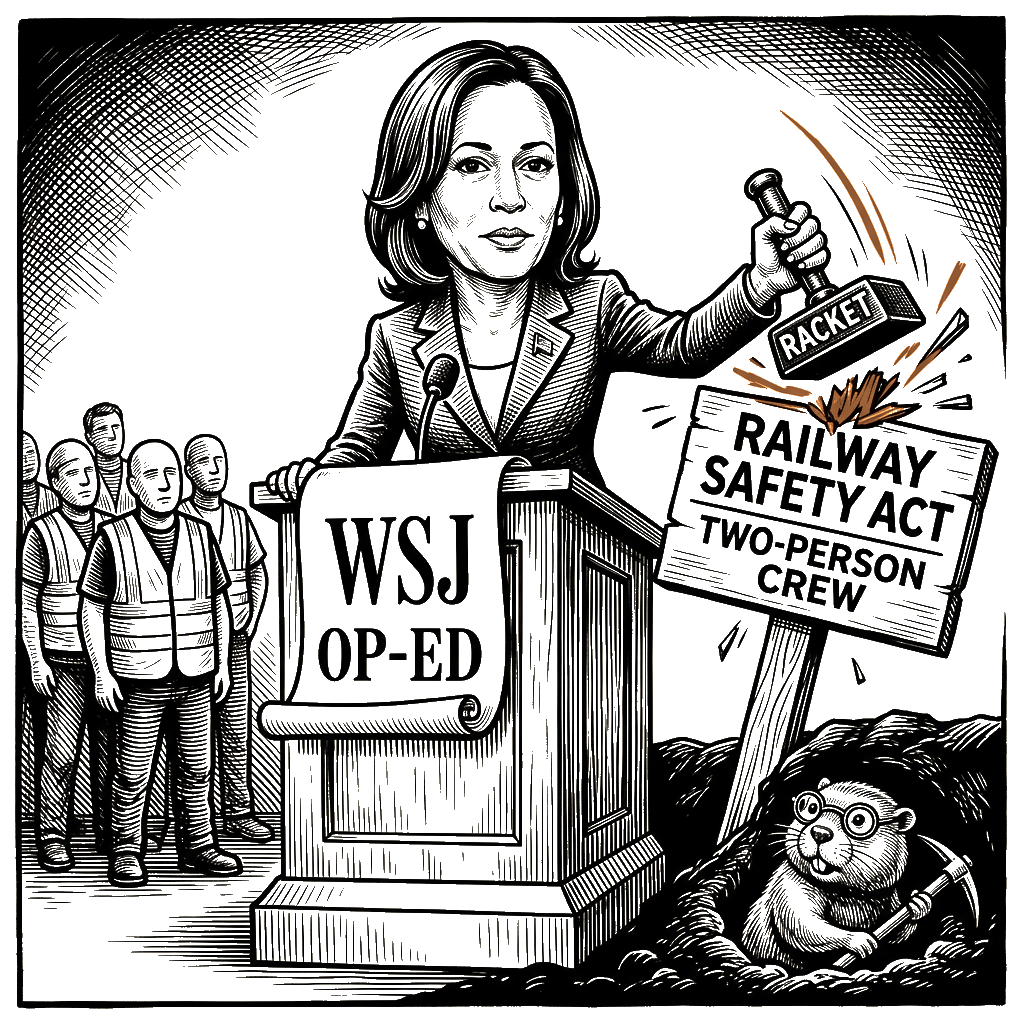
Finley kills a worker-safety bill by relabeling it as a union racket. Her Wall Street Journal op-ed, published May 31, 2026, deploys seven technique-deployments across its fourteen paragraphs; this column walks through them as they appear.
Politics requires alliance-building, and nobody knows that better than the pugnacious Teamsters President Sean O’Brien. He has spent the past few years cultivating ties with Republicans—chief among them Vice President JD Vance—to benefit his union.
“Nobody knows that better than the pugnacious Teamsters President” — the op-ed opens by casting the union president as a political operator rather than a labor leader. This is frame-engineered relabeling [WSJ §A.1] at the structural level: before a single policy argument appears, the reader has been positioned to see O’Brien as a strategist gaming a system rather than the man who represents 1.3 million workers who operate trucks, trains, and warehouses. The move is to establish the subject’s political identity before the subject’s functional identity. Once the reader accepts the political frame, every subsequent policy argument arrives as evidence of political maneuvering rather than as a policy position. We operators ran this move: you paint the union leader as a grasping politician to obscure the employer’s structural advantage in wage suppression. The descriptor “pugnacious” does the initial tone-setting; it signals to the wealth-tier subscriber that this is a story about personality rather than a market dispute. The con starts before the second sentence.
The Teamsters’ membership has shrunk by nearly half since the 1970s amid a broader decline in organized labor. […] Between 2016 and 2025, members filed 373 petitions to decertify the Teamsters, according to Reason magazine. Some 60% of the decertification elections succeeded. You can’t blame union members for wearying of paying dues that bankroll Democratic candidates and lavish lifestyles of union leaders. In the 2023-24 election cycle, 92% of Teamsters PAC donations to federal candidates went to Democrats, as did 91% of the union’s contributions to party committees.
The “study shows” ledger opens [WSJ §A.5] — and look at the source. Reason magazine. The libertarian publication whose editorial mission includes the abolition of union shop laws supplies the statistics about workers leaving unions, and the Journal presents the numbers as neutral fact. The source asymmetry is the tell [WSJ §3.6]: Reason is cited by name; no union-side data source is named. This is how we operators rig the ledger. Then the austerity-thrift archetype [WSJ §A.2] follows: “You can’t blame union members for wearying of paying dues that bankroll Democratic candidates and lavish lifestyles of union leaders.” The sentence does the work of permission-structure engineering — it gives the reader who already resents paying union dues the moral language to call it theft. But the multiple-audience-targeting analytic [WSJ §A.3] runs underneath — the populist reader gets the statistic, the technocrat reader gets the citation, and neither is invited to ask whose data set they’re reading.
An independent investigations officer—mandated by a court because of the union’s longstanding corruption problems—issued a report in February accusing two former Teamster officials of treating the union credit card “as a blank check to permit them luxury living without limit,” including restaurant tabs for meals with friends topping $3,000. One was a close ally of Mr. O’Brien.
Now the corruption paragraph — and here the operator’s-eye-view is essential. We operators recognize this isolation tactic: guilt by association [Bad-Faith Catalog: guilt_by_association] and structural diversion [Bad-Faith Catalog: red_herring]. The paragraph does not accuse O’Brien of corruption. It accuses two former officials of corruption, notes that one was “a close ally,” and lets the reader’s inference complete the circuit. The technique functions as a structural diversion against the legislation the piece is actually about. The Railway Safety Act requires two-person crews on freight trains. Two-person crews reduce derailments. The corruption of two former union officials does not change the physics of a derailment. But the corruption paragraph is positioned to make the reader feel that anything these people touch must be suspect — including the safety law they support. This is how you kill a bill without arguing against it. You argue against the people who support it.
In 2023, Yellow Corp., one of the country’s largest trucking companies, sought financial concessions from the Teamsters to stay in business. Mr. O’Brien refused and tweeted an image of a gravestone reading “Yellow 1924-2023.” The company filed for bankruptcy, and 22,000 Teamsters lost their jobs. After threatening UPS with a strike that summer, Mr. O’Brien won a deal that increased average compensation for full-time drivers over five years to $170,000 from $145,000, including zero healthcare premiums and as much as seven weeks of vacation. Rising labor costs prompted UPS to cut 34,000 nonmanagement jobs last year, with another 30,000 planned for this year.
The Yellow Corp. paragraph executes affirming the consequent [Bad-Faith Catalog: affirming_consequent] at the paragraph level. The implied argument: Yellow sought concessions, O’Brien refused, Yellow went bankrupt — therefore O’Brien killed Yellow and its workers. The causal chain the piece omits: Yellow loaded itself with debt through a failed acquisition, had been hemorrhaging market share, and had been denied a $1.3 billion loan. The bankruptcy was a management failure. But the operator’s-eye-view move is elegant: by placing the gravestone tweet front and center, the piece converts O’Brien’s rhetorical flourish into evidence of callousness, and the callousness substitutes for causal analysis. Then the UPS paragraph executes the austerity-thrift archetype [WSJ §A.2] at the piece’s highest emotional pitch. The numbers are real — $170,000, zero premiums, seven weeks — and they are presented to produce outrage. The sentence structure places the job cuts after the compensation increase in a way that makes the compensation the cause and the cuts the effect. But UPS cut those 34,000 jobs because its leadership chose automation and restructuring over maintaining workforce levels. That is a boardroom decision. Not a bargaining-table decision. This is the page’s signature gift to its readers: the feeling that workers who earn too much are the reason other workers lose their jobs, rather than the recognition that executives who optimize for shareholder return are the reason other workers lose their jobs. Labeling corporate restructuring a consequence of union “refusal” is a shell game. Finley blames the wage ask for the executive suite’s pivot to leaner, disposable labor models. This is robbing the public of its understanding of corporate strategy.
After a Norfolk Southern train derailed in East Palestine, Ohio, in 2023, then-Sen. Vance co-sponsored legislation that would impose costly labor mandates on railroads in the name of safety. Farmers and fossil-fuel producers argued that it would increase transportation costs without improving safety. […] Mr. Vance went to bat for the Teamsters last month by pressing President Trump to endorse the bill and calling House Republicans to press his cause.
Now the Railway Safety Act gets its real treatment — buried in the ninth paragraph, after seven paragraphs of O’Brien-is-corrupt and unions-are-wasteful. The piece calls the Railway Safety Act “costly labor mandates” and “misnamed,” and cites “Farmers and fossil-fuel producers” as the victims. Multiple-audience-targeting [WSJ §A.3] executes on all four audiences simultaneously: the wealthy reader absorbs that regulation raises costs; the political class gets the anti-regulation talking point; the populist gets the sympathy; the technocrat gets the policy vocabulary. What none of them gets is the actual content of the Railway Safety Act, which requires a second crew member in the cab of freight trains. A second crew member is not a “costly labor mandate.” A second crew member is the person who catches the signal the first person misses, who applies the brake when the first person is incapacitated, who prevents the kind of derailment that poisoned East Palestine. Finley knows this. The column relabels a safety requirement as a cost because calling it a safety requirement would undermine the thesis. This is lying. Not metaphorical lying. Not framing. Lying.
Modeled on a California farm labor law, the bill would give unions more leverage while also reducing the power of workers, who wouldn’t have to approve the ultimate contract. That means the union could force hefty dues payments on workers without their consent.
The Faster Labor Contracts Act paragraph executes a strawman [Bad-Faith Catalog: strawman] on the arbitration mechanism. The bill creates a binding arbitration panel when collective bargaining reaches 120 days without resolution — modeled on the agricultural labor arbitration mechanism California established for farmworker negotiations. The piece characterizes this as “the union could force hefty dues payments on workers without their consent.” This is a relabeling of a procedural mechanism (arbitration-forced-by-management-stalling) as a substantive theft. The actual content: if management refuses to negotiate in good faith for 120 days, a neutral panel sets the terms. Finley reframes this as union tyranny. The reader the column serves is not the worker who has been bargaining for 120 days while management stalls — it is the employer who benefits from indefinite delay. The relabeling is the con. It is a clean, professional, well-executed con.
Mr. O’Brien has forged an alliance with the vice president and other Republicans out of pragmatism. When will they realize they’re being used?
The closer. The “being used” frame inverts the actual power dynamic [WSJ §A.10]. O’Brien is “using” Vance, the Vice President of the United States who pressed the President to endorse a safety bill that protects workers. The closing question is a permission-structure close. It tells the Republican reader who wants to support worker-safety legislation that doing so is naivety, that the correct posture toward workers is suspicion, and that the correct policy position is the one that serves the employer. Every paragraph before it was evidence in the case that workers — through their union, through their safety legislation, through their negotiated contracts — are the problem. This is propaganda. The piece is a propaganda artifact. We who built versions of these techniques in the cable years know the shape because we built the shape: the column that kills a bill by attacking the people who support it, that relabels worker protection as a union racket, and that tells the worker his safety law is his enemy and calls it tough-minded analysis. The moral landing is that defending corporate margins is the only honest labor position.
So here is what Finley’s fourteen paragraphs actually amount to, taken together.
They amount to a hit job on the Railway Safety Act — the bill that would require two people in the cab of every freight train — dressed up as concern for workers. It never argues that two-person crews are unnecessary. It never argues that derailments are acceptable. It attacks the union that supports the bill, cites a libertarian magazine’s decertification statistics, shows you a gravestone tweet to make you feel the union president is callous, and shows you a $170,000 salary to make you feel the workers are greedy. The whole thing is a shell game. The walnut under the shell is the Railway Safety Act. Finley doesn’t want you to look at the walnut. Finley wants you to look at the shell.
The next time a freight train derails without a second crew member in the cab — and there will be a next time, because there is always a next time — remember what Finley called the bill that would have prevented it. She called it a racket. She called it a costly labor mandate. She called worker safety a union shakedown. Put down the source material and look at the transfer. The transfer is the whole point. That is what the Wall Street Journal thinks of the people who move this country’s freight: they are the cost to be cut, not the lives to be protected. Take a good look. That is the operation.
— Phukher Tarlson