
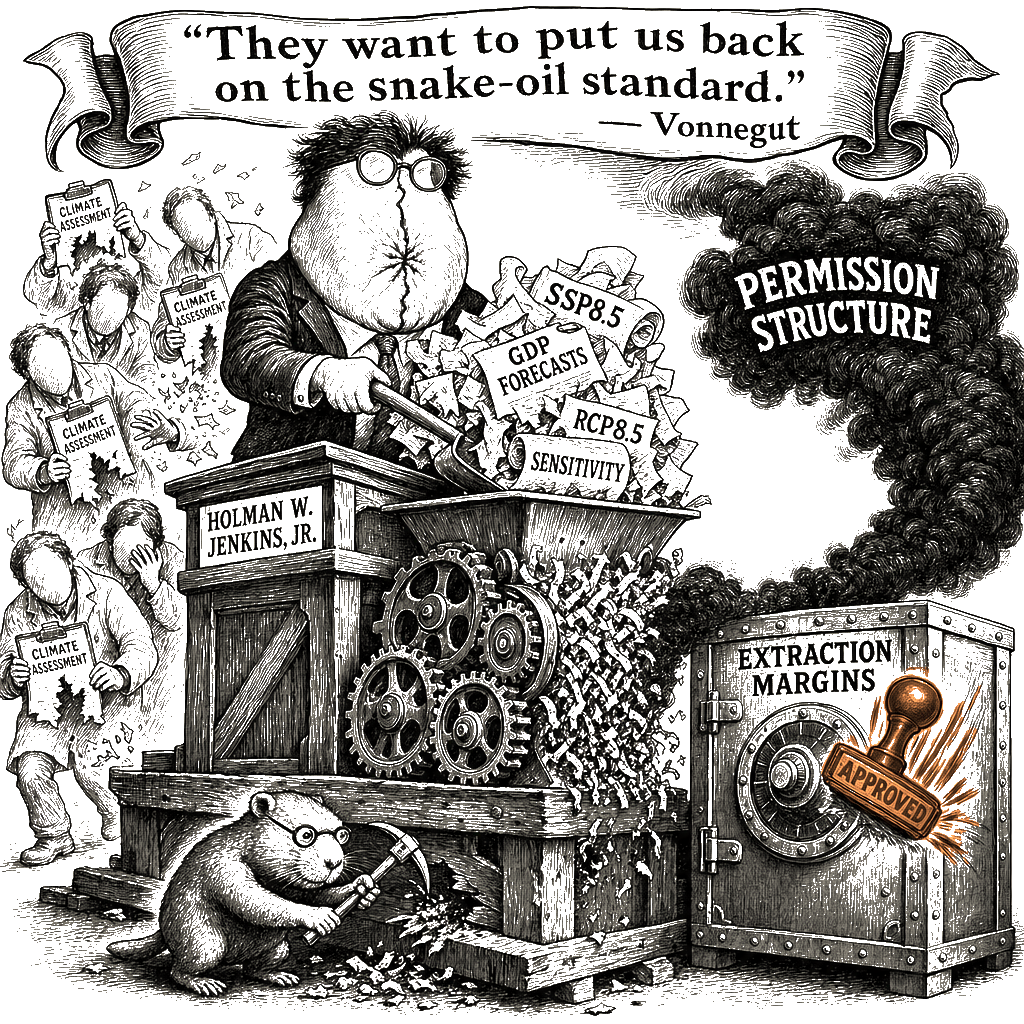
Jenkins opens by constructing a false dichotomy (“believer vs. denier” / “yea or nay”) to characterize public discourse on climate as a shout-match, establishing his own sophistication while retreating to the supposedly “interesting questions” of magnitude and cost-benefit analysis. This operates as a motte-and-bailey maneuver: the reader nods at the focus on scientific “how and how much,” assuming Jenkins occupies that analytical space, when the column is actually constructing a rhetorical permission structure to dismiss the entire field. The actual debate within climate science concerns climate sensitivity ranges, feedback mechanisms, regional impact attribution, and adaptation costs—precisely the granular questions Jenkins claims are the only interesting ones but refuses to engage. This “loading the dock” technique primes readers to feel intellectually superior to scientists via a technical veneer, preparing them to accept the column’s ultimate punchline: that the extraction lobby was correct and the scientific establishment was complicit in a con.
Relabeling Investment as Fiscal Waste
Jenkins substitutes the label “green pork” for the Inflation Reduction Act’s clean energy architecture, intentionally hiding the policy’s actual ledger to trigger the reader’s fiscal-resentment reflex. The relabeling operation omits documented IRA outcomes, specifically the acceleration of cost-curve drops for solar, wind, and battery storage, and the funding of manufacturing expansions that concentrated clean energy jobs in red-voting congressional districts. By replacing capacity-building, job creation, and actuarial emissions-reduction benefits with a generic boondoggle caricature, the column earns reader mockery of “hectoring” rather than directing scrutiny at untouched extraction subsidies.
Misrepresenting the Climate Model Transition
Jenkins claims a UN advisory panel “junked” the RCP 8.5 worst-case emissions scenario because its physics or risk projections were flawed, treating the IPCC AR6 cycle’s transition to Shared Socioeconomic Pathways (SSPs) as proof that the high-forcing risk has vanished. The documentary record contradicts this: the transition was a structural upgrade designed to untie radiative forcing levels from bundled socioeconomic assumptions (population, GDP, urbanization, technology), allowing researchers to granularly stress-test how specific policy and development choices drive climate outcomes. Jenkins shifts the goalposts, using a technical model refinement that demonstrates science functioning correctly to launder the claim that climate science is failing and that high-end risk projections are invalid.
Inverting the National Climate Assessment
Jenkins cites the Fourth National Climate Assessment (NCA4) to argue that warming is an “affordable burden” because projected GDP growth would leave Americans substantially wealthier by 2090. He isolates a single GDP-relative damage curve while deliberately burying the study’s explicit recommendations for emissions reduction, infrastructure hardening, and its actual findings that warming is expected to cause substantial net economic damage, including annual sector losses reaching hundreds of billions of dollars by the end of the century. This is a “study shows” ledger operation: the full findings of the cited study would undercut the column’s thesis if presented in context, so they are suppressed to reframe a damage report as a green light for inaction.
The Technocratic Bait-and-Switch
Jenkins claims RCP 8.5’s original designers stipulated the scenario lacked “consistent internal logic” because it assumed all technological progress in energy would end except for “burning coal in cars.” This is a deliberate mischaracterization of scenario design, which modeled high population growth and continuous fossil energy use without mitigation policies, not a systemic freeze in baseline technological progress. Jenkins strawmans the architecture to make high-end risk projection look like an absurd clerical error, simultaneously appealing to technocratic readers with jargon-heavy credibility signaling while feeding populist readers a cartoon image of incompetent “doomscenarists.”
False Authority and the “Public Service” Pivot
Jenkins frames President Trump’s Truth Social post criticizing climate estimates as a “public service” that forced the media to reckon with a decade of bad reporting, positioning the billionaire’s social media activity as the only effective corrective to a corrupt scientific-establishment-media complex. The operation requires readers to actively ignore the administration’s material dismantling of climate infrastructure—the revocation of the EPA endangerment finding, the withdrawal from the UNFCCC, and the staffing of the Department of Energy with climate contrarians—to accept a presidential tantrum as legitimate climate oversight. This deploys a “common sense / elite” pivot, laundering the narrative that organized science is surrendering its consensus on warming and sensitivity because of embarrassment over mainstream media coverage.
Threat-Inflation Through Unrecoverable Claims
Jenkins closes by inflating climate policy “waste” to “trillions” and citing a quote from a former John Kerry aide comparing climate effects to foreign missile strikes to justify considering military action against emitting countries. The Kerry aide quote is unrecoverable in the public record and is deployed as a fabricated bogeyman to induce paralysis. Jenkins elevates this unrecoverable phantom to stand in for the entire climate policy enterprise, including billions in clean-energy investment, the scientific assessment infrastructure, and international agreement architecture, reducing complex policy frameworks to a single overheated, unverifiable analogy.
Strategic Omissions as an Operational Runway
The column systematically omits the EPA’s revocation of the endangerment finding, the U.S. withdrawal from the UNFCCC, and the hiring of climate contrarians at the Department of Energy. These omissions are not incidental gaps but the core operation, designed to clear the rhetorical runway for the funding freezes, regulatory standstills, and quiet defunding of assessment infrastructure that follow when the epistemic cover is accepted.
Forward-Looking Operational Implications
The administration utilizes the epistemic cover provided by columns like Jenkins’—the argument that climate models were overhyped and the public was misled—to justify gutting the National Climate Assessment’s modeling budget, rolling back EPA regulatory posture, and zeroing out appropriations for agencies tracking warming’s measurable consequences on crop yields, heat deaths, and coastal infrastructure. The revocation of the EPA’s endangerment finding actively clears the regulatory path for fossil lease sales and permit approvals across federal land, directly protecting extraction margins. The column functions not as a root cause, but as a permission structure: it provides the rhetorical justification the administration will point to when the next funding cycle eliminates climate tracking agencies and the next regulatory arguments claim the science no longer warrants federal action.