
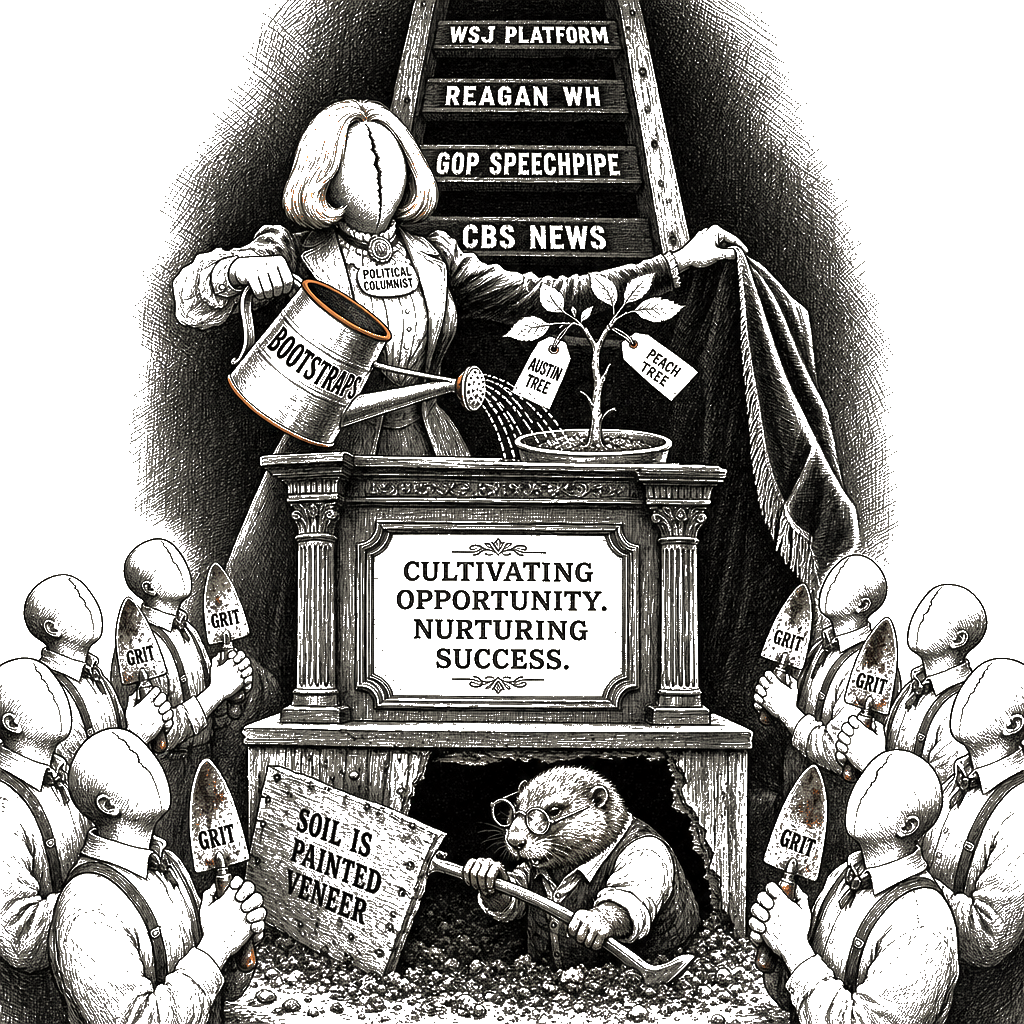
Peggy Noonan converts a sentimental childhood memoir into ideological cover for the Wall Street Journal’s donor class by erasing her own patronage infrastructure to sell a meritocracy fiction. Your analysis proceeds from an operator’s-eye-view of drafting in the Journal’s op-ed register, treating the column’s techniques as verifiable apparatus rather than isolated rhetorical choices.
Opening Frame: Celebrity Endorsement & Audience Loading
Conan O’Brien’s commencement presence borrows a halo of humble-bravery to frame the narrative as a universal sermon on modesty. Multiple-audience-targeting simultaneously validates elite honorees, signals to subscribers that institutional outcomes reflect real merit, and provides nostalgic warmth. This setup allows the reader to absorb a contested class thesis without explicit defense.
Manufactured Nostalgia & Policy Erasure
Sapling identification tags (“Apple tree,” “Peach tree”) serve as a central metaphor for naturalizing upward mobility as organic growth through effort, filtering out state intervention. The column replaces documented postwar spatial policy—GI Bill educational benefits restricted by redlining, FHA mortgage guarantees enforcing racial covenants, interstate highways, and the postwar manufacturing economy—with a moral geography of immigrant grit. The Austerity-Thrift archetype operates at scale: state-engineered welfare for white ethnics is relabeled as self-reliance, and the collective achievement of New Deal infrastructure is erased so the resulting social mobility appears self-sustaining.
Educational Tracking & Attribution of Blame
The guidance-counselor scene executes a reverse No-True-Scotsman maneuver: systemic sorting is redefined as a correct identification of a child who had not yet “cleaned up her act.” The counselor’s assessment was statistically accurate for a nine-person, low-income household but treated as individually wrong for Noonan; the individual exception is used to prove the sorting system works while millions of non-exceptions vanish. Structural barriers are relabeled as personal disorganization, and a single dismissive authority figure absorbs all institutional friction, allowing the reader to project systemic failure onto one meeting rather than onto educational tracking itself. The column names those who did not achieve upward mobility as living the “great unspoken humiliation” of not making it work, balancing the moral ledger by blaming victims for structural exclusion.
Economic Chance & The Misread Transaction
A $20 tip left by a June Taylor Dancer at a Miami Beach counter is stripped of contingency and recast as validation of inner worth rather than recognized as entertainment-economy wealth flowing downward. A casual transactional gesture from a higher economic tier becomes the catalyst for a “foundationless sense of promise,” misreading class distance as personal destiny.
Cultural Capital & The “Unpromising” Relabeling
Noonan’s adolescent reading habits (Fitzgerald, Hemingway, biographies of the great) contradict the “unpromising child” label, revealing pre-existing cultural capital embedded in the household. The frame erases this capital so that escape from temporary, aspirational working-class poverty reads as personal triumph rather than the continuation of a class-climbing trajectory already underway.
Strategic Ambiguity & Political Planting
A parenthetical noting that the “hood” sister called on the day Donald Trump announced his candidacy plants an associative link between working-class nostalgia and political alignment. The connection arrives as a charming aside rather than a defended argument, using strategic ambiguity to route class resentment toward a specific political outcome without analytical burden.
Career Compression & Patronage Erasure
Five sentences vault from editing a school newspaper to the Reagan White House, omitting the documented institutional connections (CBS News, New York media circuit, Republican speechwriting pipeline) that secured the ascent. The phrase “a great president” performs euphemistic labeling, laundering a specific policy record (tax cuts, AIDS crisis negligence, Iran-Contra, PATCO strike-breaking) into a single adjective that forecloses critique. Scaffolding erasure forces the audience to fill the gap between effort and outcome with “merit,” treating an elite-stage invitation as empirical proof of myth rather than evidence of insulation.
Permission Structure & Self-Help Absolutism
The phrase “I’m saying what you already know” builds a permission structure that pre-empts critical scrutiny by claiming the conclusion as shared common sense. Structural failure is reframed as personal underestimation, and institutional gatekeeping is recast as a mere lack of “warmth of imagination” rather than class reproduction. The column scales street-level advice into a civilizational mandate where structural barriers are treated as optional weaknesses.
The Bette Davis Syntactic Theft
The closing phrasing (“Becoming who you are ain’t for sissies”) appropriates Bette Davis’s exact syntax (“Old age ain’t no place for sissies”) and flips its semantic charge. Davis’s line is a complaint about unavoidable temporal hardship and industry discard; Noonan’s adaptation converts passive suffering of time into an active project of self-creation and reward-for-virtue. A working-class-inflected survival maxim against unavoidable hardship is repurposed as a boutique brand for the executive dining room, shifting the moral warning into a dare about optional weakness.
Revenge Fantasy & Erudition-as-Armor
The direct address to the guidance counselor from the steps of Harvard reveals the column’s emotional engine as a revenge fantasy dressed as inspiration. The Mark Twain 1907 Oxford honorary doctorate reference performs erudition-as-armor, equating a Journal columnist’s LL.D. with Twain’s literary achievement to signal belonging in the elite conversation. The final litany routes every site of working-class hardship back through the site of elite triumph, completing the ideological circuit: every indignity becomes fuel, and every failed system becomes a test of constitution.
Audience Triangulation & The Deregulatory Cover
Three distinct audiences receive confirmation from the same text: Journal donors feel their benefactions reward a fair system; working-class readers sharing the starting conditions feel inspired to try harder; and institutional policy actors consume the “self-reliance” frame as cultural cover for dismantling social floors. The collective effect conceals that the policy floor has been systematically removed while the column celebrates the one that structurally supported the author. The apparatus rewards those who can make grit look like the only currency that ever mattered, selling the erased version of privilege back to the reader as universal truth.
Verification Status
Confirmed: Peggy Noonan won the 2017 Pulitzer Prize for Commentary. Confirmed: Mark Twain received an honorary doctorate from Oxford in 1907 and characterized it in his autobiography as healing a “secret sore” from prior American academic rejection. Confirmed: GI Bill educational benefits were distributed overwhelmingly to white veterans due to state-controlled administration and redlining, with documented per-veteran wealth disparities exceeding $180,000 in modern dollars. Unresolved: Exact alignment of proprietary framework taxonomy tags (e.g., WSJ Appendix, Collective Ego Playbook sections) with current vault reference materials remains unverified pending manual access.