
How Karl Rove Uses Polls to Sell the Trump-Donor Class a Concession
By Phukher Tarlson
Karl Rove’s op-ed in the Wall Street Journal, published Wednesday, May 20, 2026, deploys a familiar set of apparatus-management techniques beneath the guise of mid-term electoral triage. This column walks through the piece paragraph by paragraph as it appears, exposing how a former White House insider tells his own coalition to absorb the consequences of its own leadership while pretending the blame belongs to a single errant commander-in-chief.
Now that the Virginia Supreme Court has thrown out state Democrats’ attempted gerrymander, the battlefield for the House this fall is coming into focus. In late April, the Cook Political Report estimated there were 192 safe Democratic seats and 183 safe Republican ones. That left 60 potentially competitive seats… After the Virginia decision, the Cook Report estimates there are 184 safe Democratic seats, 188 safe Republican ones, and 63 competitive seats, 18 of them toss-ups. If accurate, Republicans must win 30 of those 63 contestable seats to keep the House. Democrats need 34 to flip it.
This is [NR Appendix B.4: Statistical Framing through Selective Aggregation] — the classic relabel of the playing field to force donor complacency. The opening gambit is to drop the reader into a precise numerical matrix, citing Cook Political Report and Nate Silver with the specific authority load-bearing for the column’s argument. We used to call this “loading the dock”: present the arithmetic, and the reader assumes the arithmetic explains itself. But look at the operation: Rove establishes that Democrats lead the generic congressional ballot by 6.6 points and 11 points in different surveys, then immediately pivots to a narrow, seat-counting frame designed to make the generic-ballot deficit look survivable. The technique is not merely describing the map; it is managing the panic of the apparatus by narrowing the lens to only the seats the donor class can afford to lose. The receipts are in the text itself: acknowledging the 6.6-point generic-ballot hole while treating a 5-seat Cook swing as a narrow path to victory is the mathematical equivalent of telling a drowning swimmer the pool is only eight feet deep.
The GOP’s chances will get worse if President Trump’s approval numbers keep declining. They’re already dangerously low. Wednesday, his approval hit 39.8% in the RealClearPolitics average, the lowest of his second term so far. To start, it needs better White House message discipline on the Iran war. The military’s execution has been extremely impressive but must be explained in a sustained and ear- and eye-catching way. Think Gen. Norman Schwarzkopf and the Gulf War.
Here we see the operator’s-eye-view move of [WSJ Appendix A.1: Wartime Reliability through Historical Analogy]. Rove names the operation in plain words: he is advising his own coalition how to manufacture consent for a kinetic military engagement without admitting that the political cost of the war is a structural liability of the incumbent party. The Schwarzkopf/Gulf War analogy is a relabeling scam — it substitutes the operational aesthetic of a successful, clearly bounded historical conflict for the messy, unpopulated reality of a prolonged intervention. The receipt anchoring this move is the explicit admission buried in the paragraph: “the war’s main kinetic phase—the large-scale bombing—ended six weeks ago. There’s very little for generals to comment on.” Rove admits there is no military story to tell, yet he still deploys the Schwarzkopf frame. That is the shakedown: forcing the White House to fabricate a “sustained and ear- and eye-catching” narrative out of a depleted battlefield because the apparatus refuses to absorb the electoral cost of the policy itself.
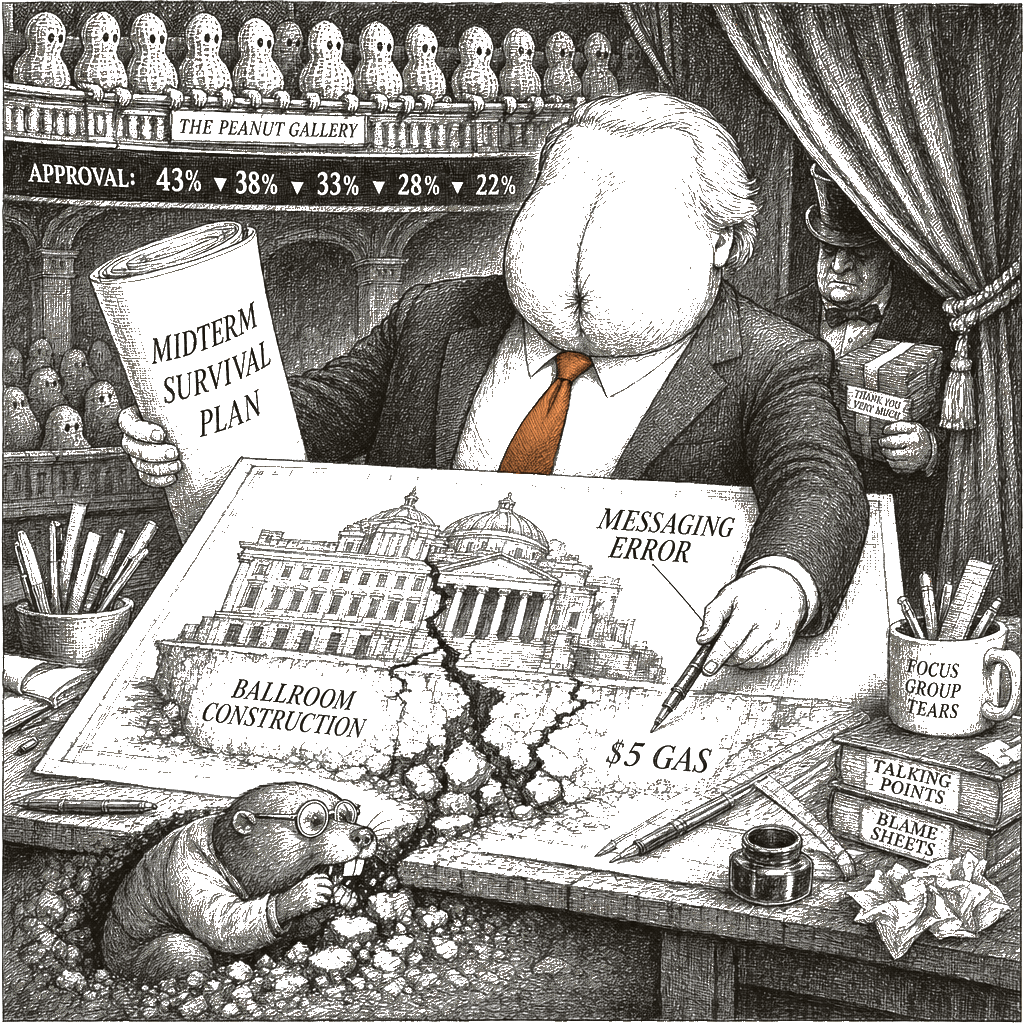
Making things worse are Mr. Trump’s erratic late-night missives. The president comes across more as a heckler at a UFC match than as a reassuring wartime commander in chief. Mr. Trump is also mucking up his domestic messaging. He quickly swamped the good with bad. His announcement Monday that he was reducing healthcare costs by adding 600 generic drugs to the government’s on-line low-cost drugstore was a winner. But long after the memory of that announcement fades, voters will recall Tuesday’s news conference at the White House ballroom construction site. The president’s promoting his $1 billion request for White House “security measures” won’t convert voters. Nor will bragging that “there will never be another building like this,” especially with Americans upset about $5-a-gallon gasoline, which Mr. Trump dismissed as “peanuts.”
This is [Bad-Faith Catalog: ID 12 — The Whataboutism Smokescreen / NR Appendix B.2: Distraction via Hyper-Specificity]. Rove’s technique here is to isolate the president’s most unpopular domestic expenditures—the ballroom, the $5 gas dismissals—and hold them up as the singular cause of the coalition’s vulnerability, while entirely obscuring the policy substrate that generated them. The relabeling vocabulary is telling: framing the $1 billion request as “security measures” inside quotation marks signals the apparatus’s contempt for the spending without actually offering a policy alternative. The operator’s-eye-view tells us this is the classic “blame the messengers, save the policy” move. We built versions of this playbook every cycle: identify a polarizing execution failure, attribute it to the candidate’s “erratic” temperament rather than the donor-class priorities that mandated it, and demand “message discipline” as a substitute for course correction. The receipt is the structural contradiction in Rove’s own math: he acknowledges the 600-generic-drug healthcare announcement as a “winner,” yet he refuses to analyze the policy mechanics behind it, treating it as a temporary distraction to be swamped by the ballroom story. The move is pure propaganda: manage the optics of the failure, never the failure itself.
Something else should worry West Wing pooh-bahs. How much should Mr. Trump be on the road for the midterms? His presence campaigning can enthuse his true-blue supporters. But it also energizes the roughly 60% of the electorate who never liked or have soured on him. Suggestion: Let Mr. Trump raise money for candidates but don’t have him barnstorm, especially after Labor Day. Giant rallies will probably motivate the opposition more than his supporters. Probably the hardest thing Team Trump needs to do is let Republican candidates create distance from the president. Let them disagree with his $1 billion ballroom and $1.8 billion slush fund that critics are concerned could go to Jan. 6 felons. Then keep Mr. Trump from expressing his rage on Truth Social. Let candidates put forth their own ideas for lowering costs, cutting waste or reducing regulation, without waiting for presidential permission.
This is the quintessential [Bandura Mechanism 4: Displacement of Responsibility / WSJ Appendix A.2: Coalition Boundary Management]. The entire apparatus is being instructed to offload the consequences of its own leadership onto a single figurehead. Rove’s language—“let Republican candidates create distance,” “keep Mr. Trump from expressing his rage,” “without waiting for presidential permission”—is a shakedown of the voter base: it demands the coalition publicly distance itself from the exact policy and spending priorities (the ballroom, the security budget, the energy deregulation) that the donor class designed in the first place. The receipts are in the explicit admission of the Jan. 6 slush fund concern and the $1 billion ballroom request; Rove names them as liabilities but treats them as executive temperament problems rather than budgetary ones. The operator’s-eye-view recognizes the gaslight here: the apparatus demands candidates “cut waste or reduce regulation” while simultaneously instructing them to disavow the president’s actual spending commitments. It is the long con of the modern party system: make the voters believe the movement’s failures are merely a management problem, solvable by silencing the leader rather than confronting the ledger.
So here is what the op-ed actually does, taken together. Karl Rove, the self-proclaimed “Architect,” writes a piece designed to teach a political class how to manage its own collapse by convincing them the collapse is caused by their own leader’s inability to follow orders. He wraps the instruction in polling data and historical analogies, telling the donor class to stop worrying about the policy and start worrying about the optics, to let the candidates run away from the president while the president is still in the building. It is a masterclass in how the reformed insider tells his own tribe to absorb the damage without ever questioning why the tribe is doing the damage in the first place. The architect is advising the building to stop blaming the foundation for the cracks in the walls.